LAWMAKING
Countering Extremism and Terrorism
Increasing the Severity of Related Legislation
Regulating the Internet
“Foreign Agents” and “Undesirable Organizations”
LAW ENFORCEMENT
Regulation of Public Speech
Article 2052 CC on Propaganda of Terrorism
Article 280 CC on Calls for Extremist Activity
Article 2804 CC on Calls for Actions That
Threaten State Security
Article 2824 CC on Displaying Prohibited
Symbols
Article 2073 CC on the Dissemination of
Fakes about the Activities of Armed Forces and Government Agencies
Article 2803 CC on Discrediting Armed
Forces and Government Agencies
Article 282 CC on Incitement to Hatred
Article 3541 CC on “Rehabilitation of
Nazism”
Article 148 CC on Insulting the Religious Feelings of
Believers
Vandalism
Summary Data for Articles on Public Speech
Regulation of Organized Activities
Nationalist Associations
“Citizens of the USSR”
Banned Ukrainian Organizations
Banned Opposition Organizations
Banned Religious Organizations
Jehovah’s Witnesses
Followers of Said Nursi
«Tablighi Jamaat»
«Hizb ut-Tahrir»
«Allya-Ayat»
Summary Data on Cases of Involvement in Banned
Religious Organizations
Associations Deemed Contrary to “Traditional Values”:
LGBT
Other Banned Associations: AUE
Overview of Convictions under
Articles on Participation in Prohibited Organizations
Federal List of Extremist Materials
Recognizing Organizations as Extremist or Terrorist
SUMMARY
STATISTICAL SUMMARY ON CRIMES AND PUNISHMENTS
This report is an analytical review of anti-extremist legislation and its use in 2024 to regulate public speech and organized activities. SOVA Center has been publishing such reports annually, summarizing the results of monitoring carried out continuously since the mid-2000s. We define anti-extremist policy as the criminalization of actions driven by political or ideological beliefs in a broad sense. Our analysis extends beyond the formal framework, since we also monitor restrictions related to acts not classified as “extremist crimes” in the law “On Countering Extremist Activity.”
Unlike in previous years, we have decided to merge the review into one, addressing law enforcement in general and related abuses together.[*]
Drawing on our monitoring data and official statistics, we present an analysis of law enforcement across several parameters, including its ideological and political focus, types of penalty, and the appropriateness of prosecutions.
Lawmaking
In 2024, Russian legislation on countering extremism saw no significant changes – only a few procedural amendments were introduced. However, a new Strategy for Countering Extremism approved late in the year, laid the groundwork for further developments. Notable innovations occurred in a related area: Internet regulation, particularly concerning provisions on “foreign agents” and “undesirable organizations.”
Countering Extremism and Terrorism
A law signed in March identified the articles of the Criminal Code (CC) for which a sentence could not be replaced by participation in the special military operation. In October, a similar eligibility exception was introduced for individuals under investigation under the same articles. As expected, the list included members of extremist and terrorist organizations and groups. On the other hand, individuals convicted of (or charged with) vandalism, hooliganism and hate-motivated violent crimes or under Article 2056 (failure to report a terrorist crime), Article 282 (incitement to hatred), Article 2803 (repeated discrediting of the activities of the army and officials abroad), Article 2073 (dissemination of false information about the activities of the Russian military and officials abroad) and Article 3541 (“rehabilitation of Nazism”) CC are allowed to join the special military operation.
In late December, the list of criminal offenses that result in individuals being added to the Rosfinmonitoring register – whether convicted, charged, or merely suspected – was expanded. The newly included articles relate to terrorism and extremism but had not been part of the list previously for various reasons: Article 357 (genocide) CC, Article 2802 (violating the territorial integrity of the Russian Federation), and Articles 2803 and 2824 (repeated display of prohibited symbols) CC. Also included are individual paragraphs of the articles on calls for activities against state security (paragraph “e” of Article 2804 Parts 2 and 3), “military fakes” (paragraph “e” of Article 2073 Parts 2 and 3), hooliganism (paragraph “b” of Article 213 Parts 1, 2 and 3), vandalizing burial grounds (paragraph “b” of Article 244 Part 2) and certain articles on violent crimes[1] specifying the hate motive. Other articles of the CC also qualify if the crimes falling under them involve a hate motive (paragraph “f” of Article 63 Part 1 CC). Crimes falling under two of the articles mentioned above, specifically Articles 2803 and 357 CC, are not currently categorized as extremist or terrorist[2] However, this discrepancy is likely to be resolved in the future, and these articles will be included in the relevant lists of norms.
We would like to point out two additional changes that could be characterized as procedural and generally positive.
The law signed in February required that cases related to recognizing materials as extremist be reviewed in courts of federal subjects, rather than in district courts as before. Such a measure, intended to improve the quality of legal proceedings, was proposed to the State Duma back in 2015. At the same time, authors, translators, or publishers of materials, if known, should be involved in the trials – not as defendants, but as interested parties, so that the process of banning the material does not automatically lead to charges against them; they pay no legal costs. If the material in question is religious, the process must involve an expert “with specific knowledge of the relevant religion.” While this expansion of trial participants is not a cure-all for unreasonable or inappropriate bans, it can help reduce formalism in the consideration of such cases.
In late December, the president approved a law that stipulated the process of removing an entity from the list of terrorist organizations, at least temporarily. This is to be done by a court at the request of the Prosecutor General's Office, if the latter believes that the organization has ceased terrorist activity. The bill was adopted to normalize relations with the Taliban government of Afghanistan (and on April 17, 2025, the Supreme Court suspended the ban against the Taliban). Regardless of our views on the Taliban, such a legal procedure is indeed necessary – not only for terrorist organizations, but also for extremist ones.
In 2024, legislators failed to address a clear shortcoming in the Code of Administrative Offenses (CAO) regarding the calculation of the administrative liability period. Under Article 4.5, for most offenses, this period is calculated not from the moment the offense was committed, but from when it was detected, resulting in numerous punishments under the CAO for online statements made many years earlier.
In March, the Constitutional Court refused to consider Yelena Selkova's complaint against her punishment under Article 20.3 CAO for symbols viewed as attributes of a banned organization (the Navalny Headquarters), even though she had published them before the organization was recognized as extremist. The Constitutional Court directly stated that Selkova’s actions became an offense at the moment the organization was banned.
In April, the State Duma rejected a bill by Vladislav Davankov from the New People (Novye Lyudi) faction, which proposed calculating the liability period under the CAO for Internet offenses (with some exceptions) from the moment the offense was committed.
In October, a bill was introduced in the State Duma proposing to extend the territorial scope of the Code of Administrative Offenses of the Russian Federation to cover the entire world – similar to the Criminal Code of the Russian Federation, which already applies to offenses committed abroad that are deemed to be “against the interests of the Russian Federation.” This is the second such bill submitted by the State Council of Tatarstan. However, there is still no consensus on which specific CAO articles would be involved. In May 2025, the Duma passed the bill in its first reading, but without clarifying the relevant articles, leaving the issue unresolved. Of course, emigrants already face liability under several CAO provisions, as reports of acts committed outside Russia are often filed at the location where the offense was detected. Nevertheless, the new bill appears aimed at increasing pressure on them.
In late December, the President signed a decree on the new Strategy for Countering Extremism,[3] the provisions of which suggested potential future expansions of the legislation.
The definition of “manifestations of extremism” was expanded to include “the motive of hatred or hostility towards representatives of public authorities”; previously, it was treated as hatred or hostility based on membership in a social group. The list of key concepts was expanded to include “xenophobia” and “Russophobia.” The first term was given a generally accepted definition, the second was described as hostility towards Russian citizens, the Russian language, culture, traditions, and history of Russia, expressed “also through aggressive sentiments and actions of political forces and their individual representatives, as well as discriminatory actions of the authorities of unfriendly states against Russia.”
In general, the Strategy, as expected, devotes a lot of attention to describing hostile activities of “unfriendly” states. In particular, it states that “unfriendly states use the Ukrainian crisis to unleash hybrid wars” against Russia and “incite aggressive Russophobic sentiments in the world.” To counter these phenomena, the Strategy provides for “improving the mechanisms for countering the illegal and anti-Russian activities of foreign or international non-governmental organizations, including those recognized as undesirable on the territory of the Russian Federation,” measures aimed at “preventing and countering the spread of extremism, neo-Nazism and Ukrainian nationalism,” “creating a database of individuals who have left the Russian Federation to participate in extremist organizations or to undergo training in foreign centers of unfriendly states,” identifying and suppressing the instigation of “color revolutions,” and monitoring interethnic and territorial conflicts that can “lead to manifestations of separatism in the relevant territories.”
The document elaborates more extensively than the previous strategies on the adverse effects of the “unfavorable situation in certain subjects of the Federation and settlements,” attributed to the “illegal activities of migrants,” on interethnic and interreligious relations. Accordingly, it expands the list of state migration policy measures to introduce stricter rules for foreigners' stay in Russia as well as social and cultural adaptation programs for them.
The Strategy also outlines specific cultural initiatives, including efforts to “counter the propaganda of fascist and neo-Nazi ideas,” support creative projects that promote “the strengthening of an all-Russian civic identity,” and assist in the creation of works of art aimed at preventing citizens from being drawn into the activities of “destructive organizations.” The directives related to working with young people follow a similar focus.
Increasing the Severity of Related Legislation
In February, two new qualifying features – committing a crime motivated by hatred (clause “e”) and for mercenary motives (clause “d”) – were added to Article 2804 Part 2 CC, which is not yet frequently used.
These amendments also expanded the list of offenses that allow for the confiscation of property. In particular, they introduced the possibility of confiscating property obtained as a result of committing crimes under Articles 2073 and 2804 CC when committed for mercenary reasons. In April 2025, Articles 2803, 2842 (calls for sanctions), and 2843 (assistance to foreign criminal prosecution of Russian officials and military personnel) were also added to this list.
Meanwhile, the possibility of confiscating property used to commit a crime was stipulated for cases related to financing extremist and terrorist activities, or activities against the security of the Russian Federation. The latter was clarified in the amendments with a long list of specific crimes, including treason, sabotage, Article 2841 (participation in the activities of an “undesirable organization”), and 2843 CC, as well as ordinary criminal offenses, such as participation in organized crime.
The confiscation rules introduced by the amendments are either primarily declarative (intended to intimidate citizens) or aimed at seizing certain business assets. After all, computers could already be confiscated as instruments of crime under existing laws, and a person’s only residence is not subject to confiscation.
At the same time, the law introduced the possibility of stripping individuals of ranks, titles, and awards as a penalty under eleven articles of the CC, but this change can hardly be considered significant.
In late December, a law was signed to amend several articles of the CC pertaining to rebellion and various forms of treason.
Article 279 CC on armed rebellion was divided into three parts. The previous penalty – from 12 to 20 years of imprisonment – was included in Part 2 and remained in force for ordinary participants. Part 1 was introduced for the organizers of the rebellion, with the associated prison terms ranging from 15 to 20 years. If the rebellion results in someone’s death or other serious consequences, Part 3 provides for prison terms ranging from 15 years to life for its organizers and participants.
The scope of Article 2751 CC (cooperation on a confidential basis with a foreign state, international or foreign organization) has been expanded to include foreigners and stateless persons; previously, only Russian citizens could be held liable under this article.
In addition, a new article 2761 (aiding an armed enemy in activities directed against the security of the Russian Federation) was added to the CC. Penalties under this article include imprisonment for a term of 10 to 15 years and a possible fine of up to 500 thousand rubles or wages or other income for a period of up to three years.
A footnote to Article 275 of the Criminal Code defines the term “enemy” to clarify the meaning of “adhering to the enemy,” as penalized under the article.
In 2024, we witnessed yet another attempt to expand the scope of the part of Article 3541 CC that deals with the denial or glorification of Nazi crimes by adding denial or glorification of the “genocide of the Soviet people.” Defendants had previously faced sanctions under Article 3541 CC for such statements, specifically about crimes against Soviet citizen, although the term “genocide” has not been used with respect to the Soviet people as a whole – either by the Nuremberg or subsequent tribunals, or in any other legally authoritative documents. Nevertheless, activists from the Russian Military Historical Society have promoted the concept of the “genocide of the Soviet people” for several years, and it has appeared in several decisions of regional courts.
In February 2024, a group of deputies from “A Just Russia – Patriots – For Truth” (Spravedlivaya Rossiya – Patrioty – Za pravdu, SRZP) submitted a package of bills to the State Duma on the “genocide of the multiethnic Russian people,” which included a special commemorative law and the corresponding amendment to Article 3541 Part 1 CC. The package was quickly returned to its authors to address its shortcomings, but already in June, a new bill was submitted to parliament – this time from representatives of all factions. Its preamble stated that the genocide of the Soviet people had already been established at Nuremberg, thereby justifying “the recognition of the public justification of Nazi ideology and the genocide of the Soviet people as illegal, and the implementation of measures to counter such propaganda.” The law was not adopted immediately, but it quickly passed all readings in the State Duma in April 2025 and was signed by the president later that month. The adoption of such a law implies further amendments to Article 3541 of the Criminal Code, and possibly to other provisions as well, but this has not yet occurred. However, the new law is expected to come into force only at the beginning of 2026.
Regulating the Internet
In August, the president signed a package of laws banning trash streams and imposing liability for them.
The first law introduced a new aggravating circumstance into the CC (paragraph “s” of Article 63 Part 1 CC) – “commission of an intentional crime with its public demonstration, including in the media or information and telecommunications networks (including the Internet).” A similar provision was introduced as a qualifying element for ten types of intentional violent crimes, ranging from murder to the use of slave labor. At the same time, those among the ten articles that previously did not provide for additional sanctions in the form of deprivation of the right to hold certain positions or engage in certain activities now prescribe such penalty for a period of up to three years. This law implemented a principle we view as appropriate: that a public demonstration of violence should be considered an aggravating circumstance in court proceedings related to that violence.
The second law introduced a new Part 12 to Article 13.15 CAO, which resists easy interpretation. It is formulated as follows: “Dissemination via information and telecommunications networks, including the Internet, of information that offends human dignity and public morality, expresses obvious disrespect for society, contains images of presumably illegal actions, including violence, and is motivated by hooliganism, monetary gain, or other base motives, if these actions do not constitute a criminal offense.”
A note has been added to this provision stating that the norm does not apply to “works of science, literature, or art; works of historical, artistic, or cultural value; materials from registered mass media; as well as photo and video materials intended for scientific or medical use, or for study as provided by federal state educational standards and federal educational programs.”
Penalties range from 50 to 100 thousand rubles for individuals, from 100 to 200 thousand for officials, and from 800 thousand to a million rubles for legal entities.
Apparently, the legislator intended to distinguish trash streams and other “amateur activities” involving the display of violence from legitimate displays in media reports, works of art, and similar contexts. However, it remains unclear how this legislation will be implemented in practice. After all, the concept of “other base motives” has seen little use so far, and it is difficult to imagine how the police will evaluate the “historical, artistic, or cultural value” of certain materials. We currently have no data on the application of this new provision.
The third law in the package addresses the blocking of materials if their content falls under Part 12 Article 13.15 CAO; however, the above-mentioned exception is omitted. Responsibility for implementing the blocking has been assigned to online platforms, which must act either on their own initiative or at the request of the Prosecutor General's Office. This creates the potential for significant abuse – or simply errors – in the application of the law.
As part of the same package of laws, Internet censorship mechanisms became even more severe.
First, the Prosecutor General’s Office acquired the legal authority not only to issue blocking orders but also to direct Internet service providers to throttle traffic on specified platforms. Such measures may be applied selectively, for example, within a specific region. Consequently, providers became subject to stricter obligations to install the requisite technical equipment.
Next, while previously decisions on extrajudicial blocking had been based on the illegality of some material, as determined by the Prosecutor General's Office, the same law permitted such blocking in accordance with the "acts of the president".
Finally, another law from the same package revived the idea of a blogger registry that existed from 2014 to 2017. Social media users with an audience of over ten thousand were required to register. Those who failed to do so were prohibited from soliciting advertisements and collecting donations, and other users were barred from sharing their content – although liability for this violation has not yet been established.
“Foreign Agents” and “Undesirable Organizations”
In August, the mechanism for recognizing organizations as “undesirable” was expanded: the amendments allowed to impose this status not only on organizations with private founders but also on those with foreign state founders or participants. However, as far as we know, no organizations added to the relevant register since this mechanism came into force had such founders or participants.
Amendments to the electoral legislation signed in May introduced new restrictions for “foreign agents.” Foreign agents, as well as individuals featured on the Rosfinmonitoring List of persons involved in extremist or terrorist activities, were banned from running for office at all levels. Individuals on both registers were also banned from participating in elections as observers, authorized representatives, or trusted representatives of candidates.
Individuals punished under the CAO articles on prohibited symbols (Article 20.3) and prohibited materials (Article 20.29) were barred not only from running for election for one year, as had previously been the case, but also from serving as voting members of election commissions.
In addition, current deputies and senators were required to resign if designated as “foreign agents.” The amendments gave such deputies 180 days to relinquish either their “foreign agent” status or their mandate. Several deputies actually resigned. Thus, it became possible to cancel the already expressed will of the voters by a simple order of the Ministry of Justice.
Foreign agents, whether legal entities or individuals, were significantly restricted in access to their income. The law signed in late December effectively treats “foreign agents” similarly to citizens of “unfriendly countries.” Income from the sale or lease of housing or vehicles, any fees, and even interest and dividends on deposits and accounts received after March 1, 2025, must be transferred to a special account, which can only be used to pay fines. There is no other access to the account until the “foreign agent” status is lifted.
Although this measure discriminated against all “foreign agents,” the authors of the law made it clear that the primary target was political emigrants.
Another bill, which passed its first reading in June 2024 but has not yet been adopted, also largely targets emigrants, although not exclusively. The draft law proposes authorizing the Russian Ministry of Culture to issue an order establishing a specific procedure for libraries – a procedure not defined in the law itself. This procedure would set rules for “providing and posting documents” created by people and organizations designated as “foreign agents” or included in the Rosfinmonitoring registry. Thus, this provision does not focus on the distribution of individual materials due to their content but rather on creating a “blacklist of authors.”
The same bill provides for the introduction of a special procedure for access to libraries in the DPR, LPR, Zaporizhzhya Region, and Kherson Region, since the library collections there have not been sufficiently cleared of “anti-Russian” literature and other works that the authorities find objectionable.
Law Enforcement
In this section, we present 2024 statistics on the use of criminal articles related to public statements and the activities of prohibited organizations. Please note that our monitoring does not cover law enforcement practices in the territories annexed by Russia between 2022 and 2024.
Regulation of Public Speech
This section, devoted to Criminal Code articles on public statements, analyzes statistical data for each relevant article – starting with the most frequently used and followed by others in descending order based on the number of sentences issued in 2024 – along with similar provisions applied in rare cases.
Thus, we will review the use of the following articles of the CC:
- Article 2052 on calls for terrorist activity or its justification;
- Article 280 on calls for extremist activity[4];
- and the closely related Article 2804 on public calls for activities against state security;
- Article 2824 on repeated display of prohibited symbols;
- Paragraph “e” of Article 2073 Part 2 on disseminating “fake news” about the use of armed forces and the actions of government agencies abroad, motivated by hatred;
- Article 2803 on repeated discrediting of the use of armed forces and actions of government agencies abroad;
- Article 282 on incitement to hatred or enmity;
- Article 3541 on the “rehabilitation of Nazism”;
- Article 148 Parts 1 and 2 on publicly insulting the religious feelings of believers.
You can find additional information on the articles that fall within the scope of the SOVA Center’s monitoring and the principles guiding their selection on our website.
First, we will present statistical data from the Judicial Department of the Supreme Court of Russia on individuals convicted under these articles in 2024, whose sentences came into force in the same year.[5] For each part of each article of the Criminal Code, the Department reports the number of individuals convicted either under it as the principal offence or as an additional charge, with the principal offence defined as the most serious article among the charges. The Department also publishes data on the penalties imposed under all parts of all articles; such information is linked to the main offense, ensuring that the penalty for each convicted individual is counted only once.
SOVA Center collects information on sanctions under articles related to public statements on a daily basis by monitoring Russian court websites, mass media, social networks, and other sources. However, due to the lack of transparency in this area of law enforcement, we can obtain information for only a portion of the sentences issued by Russian courts during the year. In 2024, we had such information for approximately 50 % of the cases.
We include this information in a publicly accessible database on our website. Please note that it contains all sentences we are aware of, not just those that came into force in the same year they were issued.
This report presents the results of our analysis of 2024 sentences available to us, grouped according to various parameters provided in the database.
We will sort the sentences under each article among the following tentative categories, depending on the nature of the public statements that served as the basis for the charges:
- statements characterized by ethnic xenophobia;
- statements related to religion;
- statements critical of the authorities and their supporters;
- statements related to events in Ukraine;
- statements involving “violation of traditional values”;
- other cases, including unattributed ones.
It should be noted that a single sentence may often fall into more than one category. We will highlight instances of significant overlap between categories for each article.
We will show the ratio between the number of people punished for public statements online and offline, as well as the distribution of penalty types within each category and for each article as a whole.
Once we have reviewed information about a particular case and entered it into our database, we assign it a rating based on whether we consider the restriction of freedom of expression in that case to be justified. Our ratings include: “Yes” – if we view the act as related to xenophobia and the restriction as generally justified; “No” – if we believe the restriction violated the right to freedom of expression and was therefore inappropriate; “Other” – if the restriction was justified but unrelated to countering xenophobia; “Not sure” – if we cannot choose between the above values for any reason; and “Don’t know” – if we lack adequate data for making our assessment. This report presents the assessments for the 2024 cases related to the articles of interest.
We shall provide similar information about cases initiated in 2024.
At the end of the chapter on sanctions for public speech, we will provide summary data on the 2024 application of all relevant criminal articles.
SOVA Center has written repeatedly about the problems associated with definitions and norms of Russian legislation related to the concepts of “extremism” and “terrorism.” However, there are definitely some instances, in which the state, in accordance with the norms of international law and the Russian Constitution, can legitimately prosecute public statements under criminal procedure as socially dangerous incitement.
It is not always possible to determine in which cases sanctions for “propaganda of terrorism or extremism” are justified and when they clearly violate rights and freedoms. Court decisions on such cases predominantly remain unpublished due to a ban on publishing the texts of judicial acts issued in cases “affecting the security of the state.” The information available from other sources is often insufficient to assess the legitimacy of these decisions.
Law enforcement related to criminal articles on incitement of hatred, propaganda of extremism, and propaganda of terrorism is non-transparent and, at the same time, has become increasingly repressive. First, the proceedings exhibit an accusatory bias, as courts rarely acknowledge the low probability that the incriminating statement will result in serious consequences. Next, a substantial proportion of convictions under these articles result in imprisonment, despite the availability of alternative penalties. SOVA Center believes that imprisonment, even in cases involving public calls for violence, is appropriate only for deliberate propaganda of violence (more or less systematic and having at least some chance of implementation) rather than isolated emotional outbursts.
Article 2052 CC on Propaganda of Terrorism
According to the Judicial Department of the Supreme Court, 453 people were convicted in 2024 under Article 2052 (public calls for terrorist acts, public justification of terrorism, or propaganda of terrorism): for 410 of them it was the principal offense, that is, the most serious allegation against them, and in 43 cases it was an additional charge.
Law enforcement numbers for this article grew steadily from 2012, increasing from a few to four and a half hundred cases per year, but the percentage of prison terms among all those sentenced under this article as the principal offense remained at 37–40%.
Of the 410 individuals convicted in 2024 under Article 205² CC as their principal offense, 152 were sentenced to imprisonment, while the majority (254) received fines; one was sentenced to compulsory labor, and four were released from punishment. In addition, 27 individuals were exempted from criminal liability on mental health grounds and referred for compulsory treatment.
Of the 453 individuals convicted under Article 205² CC in 2024, 54 were found guilty under Part 1, for offline statements, and 399 under Part 2, for statements made on the Internet.
At the time of writing, the SOVA database contained 139 court decisions against 144 people charged under Article 2052 CC. Among these, one individual was released from punishment, two were referred for compulsory treatment, and 141 people faced criminal sanctions. 22 sentences against 23 people were issued for cases initiated in 2024. In total, we have information on 190 cases against 204 people initiated in 2024 under this article.
Let us now examine the distribution of decisions under Article 2052 across the categories outlined above.
Our database for 2024 includes six sentences against six people convicted for their statements expressing ethnic xenophobia. For three of them, this was the only article cited in the judgement. In two cases, it was combined with Article 280 CC on calls for extremist activity, and in one case, with articles on violent crimes.
The sentences were issued for public anti-Semitic incitement, justification of violence against Russians during the Chechen wars, and approval of the actions committed by Andreas Breivik. Convicted offenders included one member of the network “Maniacs. Murder Cult” (Manyaki. Kult Ubiystv, MKU). However, his imprisonment sentence was imposed primarily for participating in two xenophobic attacks in April 2023.
We know of seven cases under this article for speech expressing ethnic xenophobia, initiated in 2024 against eight people. In two of these cases, courts issued their sentences by the end of 2024.
We have recorded 16 sentences under Article 205² for statements promoting or justifying violence on religious grounds, resulting in the conviction of 18 individuals, 12 of whom were charged solely under this article. In the remaining cases, it was combined with Article 2051 on involvement of others in terrorist activity, Article 2055 on involvement in a terrorist organization, and Article 280 CC.
The majority of convicted offenders faced sanctions for approving the actions of militant Islamists: the Crocus City Hall terrorist attack, attacks against a synagogue, churches, traffic police in Derbent and Makhachkala, and the actions of Hayat Tahrir al-Sham and Katibat al-Tawhid wal-Jihad (recognized as terrorist organizations).
In addition, three followers of the radical Islamic party Hizb ut-Tahrir faced punishment for promoting party ideology.
We learned of 19 criminal cases opened against 20 people under this article in 2024 for statements related to religion. One of these cases resulted in a conviction in 2024. All the defendants were charged with supporting Islamists, mainly for justifying the Crocus City Hall attack.
Statements directed against the authorities form the basis of 46 sentences under Article 2052 CC against 47 people recorded in our database. Of these, 29 people were convicted under this article alone. In ten cases, the charge combined it with Article 280 CC, in five cases – with paragraph “e” of Article 2073 Part 2 CC on the dissemination of “fakes” about the army motivated by hatred. In some cases, it was also used in combination with other criminal articles.[6]
Most of these sentences concerned calls for the violent overthrow of the Russian government, including reprisals against its prominent representatives (Vladimir Putin, Dmitry Peskov, Vyacheslav Volodin, Ramzan Kadyrov). The charges could also involve calls for the murder of governors, members of the United Russia party, employees of the Ministry of Internal Affairs, and the FSB, etc. One of the convicted individuals had published an “execution list” naming 38 people.
In 2024, we recorded 50 criminal cases initiated under Article 2052 CC for statements against the authorities, involving 50 individuals. In five of these cases, the courts issued sentences within the same year.
Statements supporting violent or other illegal actions in favor of Ukraine formed the basis for 79 sentences against 81 individuals we recorded under Article 2052 CC. For 50 of them, this was the only article in their convictions, ten had it combined with paragraph “e” of Article 2073, six faced it in combination with Article 280, and five – with Article 2055. In some cases, sentences also included other criminal articles.[7]
Specifically, three Ukrainian public figures and politicians were convicted in absentia. They were also found guilty under other articles, including, in one instance, the extremely rarely used Article 354 Part 2 CC (calls for the initiation of a war of aggression).
The sentences were issued for publicly supporting the actions of organizations recognized as terrorist in Russia: the Azov Regiment, the Noman Çelebicihan Battalion, the Freedom of Russia Legion, and the Russian Volunteer Corps (in most sentences, the last two units are mentioned together), as well as for approving attacks by Ukrainian drones on Russian cities, raids in the Bryansk Region by the Freedom of Russia Legion, and the Russian Volunteer Corps, explosion on the Crimean Bridge, destruction of the Kakhovka Dam, the terrorist attack by Daria Trepova against war correspondent Vladlen Tatarsky, arson attacks on military commissariats, acts of sabotage, etc.
We recorded 92 criminal cases against 104 individuals opened in 2024 for statements related to Ukraine under this article. 13 of them resulted in convictions against 14 people in the same year.
It should be noted that 16 people convicted in 2024 under Article 2052 CC were found guilty for their anti-government and pro-Ukrainian statements simultaneously. Nine people faced prosecution for such statements in 2024, and the court managed to sentence one of them before the year ended. We took these cases into account in both categories.
We have classified one 2024 sentence as “other” – the sentence of Ufa resident Karina Garipova, who was also convicted under Article 2055 Part 2 CC (participating in a terrorist organization) for disseminating the “Columbine” ideology. Garipova was sentenced to five and a half years of imprisonment for sending materials about school murders to someone in a private message when she was 17 years old. It is not entirely clear why she was found guilty of publicly promoting terrorism. We know of four additional cases under Article 2052 opened in 2024 for promoting school murders. One of them was based on entries in the personal diary of a 14-year-old Izhevsk resident and may have been closed.
We have no information on the acts underlying eight of the sentences issued in 2024 under Article 205² CC. The same is true for 24 criminal cases initiated in 2024 under this article, two of which were tried in court in the same year.
The majority of sentences under Article 205² of the Criminal Code concerned online statements, including texts, videos, images, comments, and other materials posted on social media platforms and messaging services. Most often, they were posted on VKontakte, much less frequently – on Telegram and YouTube; in isolated cases, statements were posted on Odnoklassniki, LiveJournal, and Facebook. Offline acts led to prosecution far less frequently, with charges arising from conversations in detention (half of which involved religious statements), the distribution of leaflets or graffiti, statements made while intoxicated, altercations, and, in one case, a statement by a teacher during a class. Occasionally, a single case could involve charges for both offline and online statements.
The individual sentences for online and offline statements were distributed among the categories as follows:
| Statement Category |
Online |
Offline |
Online and Offline |
Total |
| Ethnic Xenophobia |
5 |
1 |
0 |
6 |
| Religion |
7 |
9 |
2 |
18 |
| Against the Authorities |
40 |
4 |
3 |
47 |
| Pro-Ukrainian |
66 |
14 |
2 |
82 |
| Other |
1 |
0 |
0 |
1 |
| Unknown |
8 |
0 |
0 |
8 |
| Total |
111 |
24 |
7 |
142 |
Let us now examine the distribution of individual sentences under Article 2052 CC across types of penalty and categories of incriminating statements (in three cases, we have no information about the sanctions).
|
Statement Category |
Imprisonment |
Suspended Sentence |
Labor |
Fine |
Total Punished |
| Ethnic Xenophobia |
4 |
0 |
0 |
2 |
6 |
| Religion |
16 |
0 |
0 |
2 |
18 |
| Against the Authorities |
32 |
1 |
1 |
13 |
47 |
| Pro-Ukrainian |
58 |
0 |
2 |
21 |
81 |
| Other |
1 |
0 |
0 |
0 |
1 |
| Unknown |
2 |
0 |
0 |
4 |
6 |
| Total |
97 |
1 |
2 |
39 |
139 |
It is worth reiterating that the appropriateness of cases under Article 2052 CC is difficult to assess, since the statements that served as the basis for the charges are available only in a small number of cases. Therefore, the majority of sentences under this article in our database were classified as “we don’t know.” This is particularly true for sentences issued for conversations in detention: their exact content and scope are unknown or in doubt. The “other” category ranked second, as a significant percentage of cases were initiated over aggressive anti-government and pro-Ukrainian statements – political rather than xenophobic in nature. Please note that while such cases are included in our database, they are not published as news on the website. Sentences for propaganda of ethnic and religious xenophobia, coupled with approval of terrorist acts against the corresponding groups or against the authorities, were rated ”yes,” but constituted a clear minority under this article. We classified even fewer sentences under this article as clearly inappropriate – if the incriminating statement contained calls for violence, we did not classify the corresponding sentence as inappropriate unless we were completely sure that it posed no public danger.
In the category of religious statements, we classified as inappropriate the high-profile conviction of Moscow theater figures Yevgenia Berkovich and Svetlana Petriychuk, who were charged with justifying the activities of militant Islamists for their play about women who left to join militants in Syria. We classified three sentences for anti-government statements as inappropriate because, in our opinion, they contained no calls for real terrorist acts – for example, when they mentioned “impalement” of officials. In the category of statements related to events in Ukraine, we classified the following as inappropriate: the conviction of former Moscow municipal deputy Alexei Gorinov for a statement he made in a penal colony regarding the predictability of violence during armed hostilities, the conviction of activist Yaroslav Shirshikov for comments about the deaths of Vladlen Tatarsky and Darya Dugina that contained no aggressive calls; and the conviction in absentia against Andy Stone, the press secretary of the Meta corporation, for his tweet about a change in content filtering policy in connection with the armed conflict in Ukraine.
|
Statement Category |
Yes |
No |
Not Sure |
We Don’t Know |
Other |
Total |
| Ethnic Xenophobia |
3 |
0 |
0 |
3 |
0 |
6 |
| Religion |
6 |
2 |
1 |
9 |
0 |
18 |
| Against the Authorities |
4 |
3 |
1 |
16 |
23 |
47 |
| Pro-Ukrainian |
4 |
3 |
4 |
30 |
41 |
82 |
| Other |
0 |
0 |
1 |
0 |
0 |
1 |
| Unknown |
0 |
0 |
0 |
8 |
0 |
8 |
| Total |
16 |
8 |
6 |
60 |
52 |
142 |
Cases recorded by us and initiated in 2024 are distributed across the categories as follows:
| Statement Category |
Number of Cases |
Number of Persons Involved |
| Ethnic Xenophobia |
7 |
8 |
| Religion |
19 |
20 |
| Against the Authorities |
50 |
50 |
| Pro-Ukrainian |
93 |
105 |
|
Other |
6 |
6 |
| Unknown |
24 |
24 |
|
Total |
190 |
204 |
Of the 190 cases opened in 2024 under Article 2052 CC that are known to us, we consider seven to be clearly inappropriate. These include the case of pianist Pavel Kushnir, who called for an “anti-fascist revolution” and died in pretrial detention, as well as the case of Sergei Davidis, head of the political prisoners support program at the Memorial Human Rights Centre, who was charged with supporting the actions of the Azov Regiment by granting political prisoner status to the regiment’s captured fighters.
Article 280 CC on Calls for Extremist Activity
According to the Supreme Court's Judicial Department, 308 people were convicted in 2024 under Article 280 CC (public incitement to extremist activity). 215 of them had this article as a principal offense in their sentence, and 93 as an additional charge. It should be noted that this number is only two more than the previous year, when 306 people were convicted under this article.
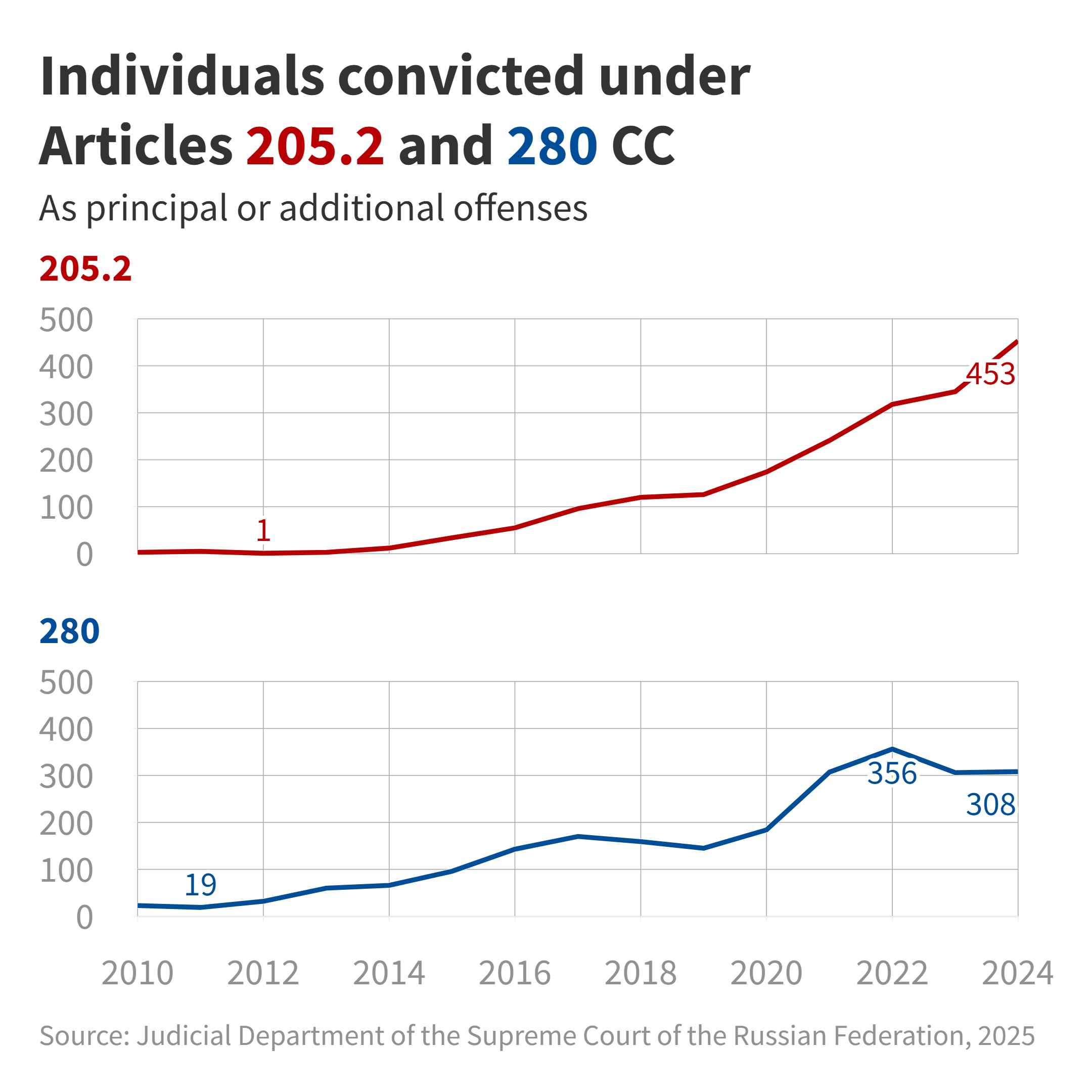
Of the total of 308 convicted offenders, 19 people were found guilty under Article 280 Part 1, that is, for offline statements, and 289 people – under Part 2 for statements on the Internet.
Of the 215 individuals convicted in 2024 under Article 280 CC as their principal offense, 34 people were sentenced to imprisonment, 140 people – that is the largest group – to suspended sentences, one to restriction of liberty, 26 to compulsory labor, one to corrective labor, and two to community service, 10 people received fines, one was released from punishment, nine cases were dismissed by the courts, and eight people were exempted from criminal liability for mental health reasons and referred for compulsory treatment.
The SOVA Center database contains 91 court decisions from 2024 under Article 280 CC against 93 people. One case was closed due to the defendant’s death, and one individual was released from punishment due to illness; thus, sanctions were imposed on 91 people. 87 individuals were convicted under Part 2, and four under Part 1. Nine of these sentences were issued in cases initiated in the same year. In total, we know of 52 cases opened in 2024 under Article 280 CC against 54 people.
30 sentences against 30 individuals were related to expressions of ethnic xenophobia. For 24 offenders, this was the only charge, for three people it was combined with Article 2052 CC, for one person – with Article 282, and in one more case – with paragraph “e” of Article 2073 Part 2 CC.
These people faced sanctions for posting comments on social media and public messenger chats with aggressive statements against people from the Caucasus (3), Central Asia (2), Ukrainians (1), Russians (9, including justification of the terrorist attack in Crocus City Hall), non-Russians (1), Jews (3) and unspecified ethnic groups (16). It should be noted that the same case could involve statements against several ethnic groups.
We learned that 20 new criminal cases under this article for expressions of ethnic xenophobia were opened in 2024 against 22 people; five of them were sentenced in the same year.
Seven sentences against seven people were issued under Article 280 CC for statements calling for violent and other illegal actions based on religious xenophobia. For three people, this was the only article in the conviction; for three others, it was combined with Article 2052 CC, and in the remaining cases, it was combined with other articles.[8]
All but one of the convicted offenders were found guilty of online calls for violent actions, such as violence against people who follow Judaism or do not follow Islam. The case of blogger Sofia Angel-Barokko, a follower of the “ancient gods,” stands out – she faced sanctions for a YouTube video in which she claimed to be using magic to combat the dominance of Abrahamic religions associated with the cult of “Yahweh the Occupier.” Specifically, she claimed to have facilitated the shelling of Israel and the fires in Christian churches in Russia and Europe.
We have information on four new criminal cases opened in 2024 under Article 280 CC for religious xenophobia, none of which resulted in a conviction during the same year.
32 sentences involving 34 individuals were issued for statements against the authorities under Article 280 CC. Of these, 20 people were convicted only under this article, ten were also convicted under Article 2052 and three – also under Article 214 Part 2 CC on vandalism motivated by hatred. Their sentences could also include other articles.[9]
Materials posted on social media that called for violence against government officials (law enforcement officers and civil servants) were the most frequent law enforcement targets.
We also recorded 14 new criminal cases opened under Article 280 CC for statements against the authorities. In three of them, the courts issued sentences in the same year.
21 sentences against 21 individuals were issued for statements concerning the armed conflict with Ukraine under Article 280; for 13 people, this was the only article in their sentence. Five people had it combined with Article 2052 and three others – with Article 2073 CC; other charges could be present as well.[10]
The charges were predominantly based on materials calling for violent actions against Russian military personnel, as well as “Russians” or “citizens of Russia” (not as representatives of an ethnic community, but as political opponents), or supporters of the special military operation and the government’s foreign policy. Most of the defendants were convicted for publications not on VKontakte (as is usually the case), but on Telegram.
We know of 10 criminal cases initiated under Article 280 CC in 2024 for statements related to the events in Ukraine, one of which resulted in a conviction that same year.
For the eight sentences issued in 2024 under Article 280 CC, we have no information about the basis of the cases. The same is true for the four new criminal cases opened in 2024 under this article.
The distribution of the offenders convicted for online and offline statements across our categories was as follows:
| Statement Category |
Online |
Offline |
Online and Offline |
Total |
| Ethnic Xenophobia |
30 |
0 |
0 |
30 |
| Religion |
6 |
1 |
0 |
7 |
| Against the Authorities |
31 |
3 |
0 |
34 |
| Pro-Ukrainian |
21 |
0 |
0 |
21 |
| Other |
1 |
0 |
0 |
1 |
| Unknown |
8 |
0 |
0 |
8 |
| Total |
1 |
87 |
3 |
91 |
Let us now examine the distribution of offenders convicted under Article 280 by type of penalty across all categories of incriminating statements (we have no information about the penalty in three cases).
| Statement Category |
Imprisonment |
Suspended Sentence |
Labor |
Fine |
Total Punished |
| Ethnic Xenophobia |
9 |
17 |
2 |
2 |
30 |
| Religion |
3 |
3 |
0 |
1 |
7 |
| Against the Authorities |
12 |
15 |
3 |
4 |
34 |
| Pro-Ukrainian |
12 |
2 |
5 |
1 |
20 |
| Other |
0 |
1 |
0 |
0 |
1 |
| Unknown |
1 |
4 |
0 |
1 |
6 |
| Total |
33 |
41 |
7 |
7 |
88 |
We determined that most sentences known to us under Article 280 CC were issued appropriately. Indeed, charges under this article are most often associated with aggressive propaganda of ethnic or religious xenophobia. However, as in the case of Article 2052, the assessment of many sentences under Article 280 CC is problematic due to the lack of relevant information. Therefore, here too, we rated a significant portion of the sentences as “we don’t know.” The rating “other,” which we assigned to aggressive anti-government and pro-Ukrainian statements of a political nature, took third place.
We classified several sentences under this article as inappropriate. These include, for example, the widely discussed sentence of Igor Strelkov for his post about the failure to pay salaries to soldiers of two DPR Armed Forces regiments. In the post, he wrote that “execution by firing squad would not be enough” to punish those responsible for such situations – though he was unlikely to have meant this literally as a call for reprisals against the military leadership. Also notable is the sentence against three anarchists from Chita for their “Death to the Regime” graffiti on a garage. They were charged not only with vandalism motivated by hatred but also with incitement to extremism. In our view, this slogan is a typical example of an abstract anti-government statement that does not contain explicit calls for violence and therefore poses no significant public danger.
| Statement Category |
Yes |
No |
Not Sure |
We Don't Know |
Other |
Total |
| Ethnic Xenophobia |
26 |
0 |
1 |
3 |
0 |
30 |
| Religion |
4 |
0 |
0 |
3 |
0 |
7 |
| Against the Authorities |
3 |
5 |
1 |
16 |
9 |
34 |
| Pro-Ukrainian |
3 |
4 |
1 |
9 |
9 |
21 |
| Other |
0 |
0 |
1 |
0 |
0 |
1 |
| Unknown |
0 |
0 |
0 |
9 |
0 |
9 |
| Total |
30 |
5 |
2 |
37 |
17 |
91 |
The cases known to us under Article 280 CC, initiated in 2024, are distributed across our categories as follows:
| Statement Category |
Number of Cases |
Number of Persons Involved |
| Ethnic Xenophobia |
20 |
22 |
| Religion |
4 |
4 |
| Against the Authorities |
14 |
14 |
| Pro-Ukrainian |
8 |
8 |
| Other |
0 |
0 |
| Unknown |
10 |
10 |
| Total |
52 |
54 |
Notably, we did not rate the charges as clearly inappropriate in any of these cases.
Article 2804 СС on Calls for Actions That Threaten State Security
Article 2804, introduced into the Criminal Code in 2022, establishes liability for public calls for various actions that are considered a threat to state security. These actions are so diverse that the grounds for combining calls for them within a single provision remains unclear. Some indeed relate to state security – such as treason or sabotage – while others concern war crimes, ranging from failure to follow an order to mercenarism, or fall under provisions addressing public statements and activities not formally included in the lists of extremist or terrorist offenses (dissemination of false information about the armed forces or their repeated discrediting, participation in the activities of an “undesirable organization,” and so on). At the same time, Article 2804 also penalizes incitement to ordinary criminal offenses of varying gravity, such as illegal possession of weapons, organized criminal activity, violation of export controls, etc., up to and including calls for receiving and giving bribes.
While in 2023, the Judicial Department of the Supreme Court reported four people convicted under Article 2804 CC, there were already 18 of them in 2024. 16 offenders were found guilty under Part 2 of this article (that is, with aggravating circumstances), and two – under Part 3 (that is, for a crime committed by an organized group).
Of the 14 individuals convicted under this article as their principal offense, six were sentenced to imprisonment, three received suspended sentences, and five were fined.
The SOVA Center database contains 12 relevant sentences from 2024 against 12 people. In six cases, Article 2804 CC was the only charge; in four cases, it was combined with Article 2052 CC. The offenders could have also faced charges under other articles.[11] Four of these sentences were issued in cases initiated in 2024. In total, we know of 11 cases opened in 2024 under this article.
In all 12 cases, paragraph “c” of Article 280 Part 4 CC was also applied, that is, the offenders faced punishment for disseminating their incitement on the Internet.
In the cases when we had at least partial information on the content of the incriminating statements, they pertained to the “special military operation” in one way or another, including calls for the destruction of military registration and enlistment offices, sabotage, informing Ukraine about the location of Russian troops, donations to the Armed Forces of Ukraine or the Freedom of Russia Legion, providing material support to Ukraine, violence against the Russian authorities (including employees of state security and law enforcement agencies), and refusal to be drafted or participate in military operations against Ukraine. Thus, the scope of this article’s application largely overlaps with the elements and coverage of Articles 205² and 280 CC, despite the text of the provision indicating otherwise.[12]
Eight of the 12 people were sentenced to imprisonment for a term of three years or more (the upper limit depended on other articles in the sentence), one received a suspended sentence, two were fined by the courts, and in one case, we have no information about the sanctions.
The six sentences for which we had sufficient information were not based on incitement to ethnic or religious xenophobia, but all involved calls for illegal activity. We therefore categorized them as “other” in terms of appropriateness. Insufficient information was available to evaluate the remaining six convictions.
Among the cases brought under Article 2804 CC in 2024, one seems clearly inappropriate – the case of the anti-war sermon of Nikolai Romanyuk, the pastor of the Holy Trinity Pentecostal church in Balashikha. In our opinion, Romanyuk did not call for any illegal actions. The 62-year-old pastor, arrested in the fall of 2024, remained in pre-trial detention at the time of writing this report.
Article 2824 СС on Displaying Prohibited Symbols
Article 2824 CC on repeated display of prohibited symbols was included in the Criminal Code in 2022. It establishes criminal liability for individuals previously sanctioned under Article 20.3 CAO[13] who commit a similar offense. According to Article 4.6 CAO, an offender is considered to have been punished within one year from the date the decision to impose the sanction enters into force or is executed.
In 2023, the Judicial Department of the Supreme Court reported 40 convictions under this article. In 2024, the number rose to 131. For comparison, in the same year courts of first instance sanctioned approximately 4,717 individuals under Article 20.3 of the CAO – an all-time high.
All offenders convicted under Article 2824 СС were sentenced under Part 1 in connection with the propaganda or display of prohibited symbols and not for their production or sale punishable under Part 2.
Of the 127 individuals convicted under Article 2824 as their principal offense, 66 people were imprisoned, 20 received suspended prison sentences, one person received a suspended sentence other than imprisonment, seven were sentenced to compulsory labor, 13 to corrective labor, 18 to community service, one was fined, and one individual was released from punishment by the court. One case was dismissed, and one person was referred for compulsory treatment.
The SOVA database for 2024 included 57 sentences under Article 2824 Part 1 CC against 56 people (one of them was sentenced twice under this article within a year). We know that the person referred for compulsory treatment was prosecuted for an anti-Semitic publication. The majority of the convicted offenders were sentenced under this article only; for three individuals it was combined with other articles.[14] 19 of the 57 sentences known to us were issued in cases initiated in 2024. In total, we have information on approximately 67 criminal cases opened in 2024 under Article 2824 CC.
Just over half of the sentences we recorded under this article concerned the display of symbols associated with the propaganda of ethnic xenophobia, for which 30 individuals were convicted. One person, an inmate of a penal colony in Kostroma, was convicted twice. Eighteen offenders were punished for displaying prohibited symbols offline – mostly tattoos with Nazi imagery – six of them while serving sentences in places of imprisonment. Twelve individuals displayed Nazi symbols on social media.
Among those convicted were well-known figures in the far-right community, including Yevgeny Breslavsky, former leader of the Novosibirsk Skinhead Unity association, and Andrei Razin (aka Chibis, Chinarik), leader of the neo-Nazi gang White Scouts from St. Petersburg – both were convicted of displaying their tattoos. The leader of a soccer fan group from Tula faced sanctions for the symbols displayed on his T-shirt, and far-right trash blogger Daniil Matsankov (Svarogov) – for a video with Nazi symbols posted on Telegram.
We know of 30 cases opened in 2024 for displaying far-right symbols.
22 people were convicted for demonstrating the symbols of Prisoners’ Criminal Unity (Arestantskoe Ugolovnoe Yedinstvo, AUE), most often an eight-pointed star (“a compass rose”). One of them was sentenced twice, as we already mentioned above. AUE is a criminal subculture recognized as an extremist organization on unclear grounds in 2020. Thus, both inmates and those already released can face prosecution for promoting the ideology of the criminal world and demonstrating the corresponding symbols. In 2024, inmates were punished mostly for repeatedly demonstrating their tattoos with the corresponding symbols in places of imprisonment to other inmates. It is quite difficult to hide tattoos in prison conditions, even if a person would like to do so; furthermore, jails and prisons provide no means of removing a tattoo. Only four people were convicted for demonstrating AUE symbols on social networks.
We have information about at least thirty criminal cases initiated in 2024 for displaying AUE symbols.
We know of only one criminal sentence for repeated display of the Ukrainian slogan “Glory to Ukraine,” which often incurred administrative sanctions in 2024 under Article 20.3 CAO. We recorded only one such case newly opened in 2024. We also know of one case initiated for repeated display of the anti-war white-blue-white flag (unrelated to promoting the Freedom of Russia Legion). Additionally, some displays of Nazi symbols were intended as criticism against the Russian authorities, in particular, for their military actions in Ukraine. For example, Nazi symbols could be shown next to the symbols of the “special military operation.” We know of at least two such convictions, and two new cases were opened in 2024.
Two people were convicted for displaying unspecified symbols, and two similar cases were reportedly opened in 2024.
The distribution of sentences for displaying symbols online and offline across our categories was as follows:
| Symbol Category |
Online |
Offline |
Online and Offline |
Total |
| Ethnic Xenophobia |
12 |
20 |
0 |
32 |
| Pro-Ukrainian |
3 |
0 |
0 |
3 |
| Other (AUE) |
4 |
18 |
1 |
23 |
| Unknown |
2 |
0 |
0 |
2 |
| Total |
22 |
34 |
1 |
57 |
Now let us review the distribution of sentences under Article 2824 CC by type of penalty and categories of incriminating statements (one person was convicted twice; the penalty is unknown in three cases). Notably, over half of those convicted were sentenced to imprisonment, most often because the offenses were committed while they were already serving a sentence and had prior criminal records.
| Symbol Category |
Imprisonment |
Suspended Sentence |
Labor |
Fine |
Total Punished |
| Ethnic Xenophobia |
17 |
5 |
6 |
0 |
31 |
| Pro-Ukrainian |
1 |
1 |
1 |
0 |
3 |
| Other (AUE) |
15 |
1 |
6 |
0 |
23 |
| Unknown |
0 |
0 |
0 |
1 |
2 |
| Total |
31 |
7 |
13 |
1 |
53 |
We classify sanctions for displaying Nazi and other far-right symbols for the purpose of Nazi propaganda as appropriate, while sanctions for displaying a swastika to criticize the authorities, as in the case of “citizen of the USSR” Vladimir Nesonov from Stavropol, are rated as inappropriate. We view sentences for AUE symbols as “other,” since the ideology of the criminal world is not xenophobic per se; however, in several cases, both Nazi symbols and AUE symbols were displayed simultaneously, and we rated the sentences in such cases as appropriate. A special case is the sentence issued to artist Vasily Slonov from Krasnoyarsk for creating and displaying tumbler dolls with prison tattoos. He received a year of corrective labor. In our opinion, this is an example of inappropriate sanctions for artistic expression.
Overall, according to suitability within categories, the 2024 sentences were distributed as follows:
| Symbol Category |
Yes |
No |
Not Sure |
We Don't Know |
Other |
Total |
| Ethnic Xenophobia |
28 |
0 |
2 |
2 |
0 |
32 |
| Pro-Ukrainian |
0 |
1 |
0 |
1 |
1 |
3 |
| Other (AUE) |
4 |
1 |
0 |
0 |
18 |
23 |
| Unknown |
0 |
0 |
0 |
2 |
0 |
2 |
| Total |
29 |
2 |
2 |
5 |
19 |
57 |
Of the 67 cases known to us that were opened in 2024, we classified at least six as inappropriate, including, for example, the case against Alexei Sokolov from Yekaterinburg, prosecuted for links with Facebook icons displayed on the “Human Rights Defenders of the Urals” website and Telegram channel.
The cases we recorded as initiated in 2024 under Article 2824 CC fall into the following categories:
| Symbol Category |
Number of Cases |
Number of Persons Involved |
| Ethnic Xenophobia |
30 |
30 |
| Pro-Ukrainian |
4 |
4 |
| Other (Including AUE) |
31 |
30 |
| Unknown |
2 |
2 |
| Total |
67 |
66 |
Article 2073 CC on the Dissemination of Fakes about the Activities of Armed Forces and Government Agencies
According to the Judicial Department of the Supreme Court, 90 individuals were convicted in 2024 under Article 2073 CC, which penalizes disseminating false information about the use of the Russian armed forces and the activities of its government agencies abroad. This marks an increase from 2023, when 65 people were convicted.
In 2024, according to the Judicial Department, 17 people were punished under Part 1 of Article 207³ CC, and 73 people under Part 2, which applies in cases involving aggravating circumstances.
Of the 15 individuals convicted under Part 1 of this article as the principal offense, one person received a suspended sentence, eight were sentenced to corrective labor, five to a fine, and one person was released from punishment. The criminal prosecution of another defendant was terminated, while two were exempted from liability and referred for compulsory treatment.
As for Part 2, 67 people were convicted under it as the principal offense. Among those, 62 offenders were sentenced to imprisonment, one received a suspended sentence, one was sentenced to compulsory labor, and three were fined. Three defendants were referred by the courts for forced treatment.
SOVA Center tracks for its database the use of paragraph “e” only of Article 2073 Part 2 CC – the dissemination of fakes about the activities of the army and government agencies motivated by hatred. We recorded 79 such sentences against the same number of people in 2024. Our number exceeds the one provided by the Judicial Department, since the latter only reports decisions that have entered into force. Two defendants were referred for compulsory treatment.
This norm constituted the only charge for 57 individuals. The sentences for 22 other defendants also included other articles, most often Article 2052 CC (ten people), other paragraphs of Article 2073 Part 2 CC (seven people), as well as Articles 280, 282, 2803, and 2804 CC.
17 out of 79 sentences issued in 2024 pertained to court cases initiated in 2024. In total, we recorded 61 new cases under this article opened against 67 defendants in 2024.
The charges under Article 2073 CC are based on disseminating information about armed actions in Ukraine that contradicts the official account provided by the Ministry of Defense, most often about the actions of Russian military personnel. Dissemination of such information, when combined with criticism of the special military operation – including allegations of war crimes by Russian military personnel or expressions of a negative attitude toward the Russian authorities, the state, or its citizens – falls under paragraph “e” of Part 2, Article 207³ CC. Such statements are interpreted by law enforcement agencies and courts as manifestations of ideological, political, or national hatred, regardless of their form or tone.
Defendants faced charges for sharing videos, various media materials, social media posts, comments, etc. In one case, the prosecution was triggered by publication of a book (a collection of interviews with Russians who hold anti-war views), and in several cases – by personal conversations, particularly, conversations with cellmates in places of imprisonment.
Of the sentences known to us, 73 were for online statements, three for offline statements, two for both, and one case lacked information.
73 individuals were sentenced to imprisonment, one received a suspended sentence, one was sentenced to compulsory labor, and one was fined (three million rubles); in three cases, we have no information on the penalty. Paragraph “e” of Article 2073 Part 2 CC provides for very severe sanctions – most often, convicted offenders faced eight to eight and a half years of imprisonment. Courts also imposed long terms of imprisonment on women, even elderly ones: for example, 59-year-old nurse Olga Menshikh was sentenced to eight years in a penal colony, and 68-year-old pediatrician Nadezhda Buyanova – to five and a half years.
On the other hand, it is worth noting that courts consider cases under Article 2073 Part 2 CC even if defendants are not present. Of the 79 sentences we know of, 38 – nearly half – were issued in absentia against individuals residing outside Russia, with the majority (33) handed down by Moscow courts. Four of the sentences concerned Ukrainian politicians and journalists. More frequently, however, they pertained to emigrants, including well-known public figures: politicians, public figures, journalists, and actors. Such decisions are likely intended to be demonstrative – to vilify Ukrainians and to send a message to those who have “left,” discouraging emigrants from publicly criticizing the Russian authorities.
Four people convicted in 2022–2024 under paragraph “e” of Article 2073 Part 2 CC were released in 2024. Politicians Ilya Yashin and Vladimir Kara-Murza (he was also found guilty under several other CC articles), journalist Alsu Kurmasheva and artist Alexandra Skochilenko were transferred to Western countries as part of a prisoner exchange.
We believe that the motive of ideological and political hatred has been used with Article 2073 CC in a clearly inappropriate manner. Those who publish information about military actions in Ukraine that diverges from the official version are, unsurprisingly, most often expressing ideological and political disagreement with the course pursued by the authorities. In most such cases, these statements constitute political criticism. Therefore, we consider sanctions under Article 207³ CC to be inappropriate in all cases where the charge is unrelated to violence or direct calls for it. We classified 75 sentences under paragraph “e” of Article 2073 Part 2 CC as inappropriate. We also found one case difficult to evaluate and classified three as “other,” since they dealt with calls for violence in the context of an armed conflict.
Article 2803 CC on Discrediting Armed Forces and Government Agencies
According to the Judicial Department of the Supreme Court, 68 people faced sanctions in 2024 under Article 2803 CC on repeated discrediting of the use of the Russian armed forces and the activities of its state agencies abroad, including five individuals who had this article as their additional charge. This total exceeds the numbers from 2023, when 50 people were convicted.
A person is held liable for a repeated offense under Article 2803 Part 1 CC, within a year after the imposition of a penalty under Article 20.3.3 CAO on discrediting the army or government agencies. The statistics on the application of this article in 2023–2024 can be found in our report on administrative law enforcement. We will only note that these numbers have been falling; courts of first instance imposed sanctions 1,805 times in 2024, compared to 4,440 in 2022 and 2,361 in 2023.
According to the Judicial Department, 66 people faced sanctions under Article 2803 Part 1 CC in 2024, and two individuals faced punishment under Part 2, that is, their actions caused harm to health or property. Of the 63 convicted under this article as their principal offense, 13 people were imprisoned, 12 individuals received suspended sentences, three were sentenced to compulsory labor, 32 were fined and three persons were released from punishment. The criminal prosecution of two defendants was terminated.
The SOVA Center database includes 81 court decisions against 84 people issued under Article 2803 CC in 2024. This number is higher than the one provided by the Judicial Department, since we include all sentences issued during the year, while the Department only includes the ones that have entered into force. 25 of the 2024 sentences known to us were issued in cases initiated in 2024. In total, we know of 63 cases opened in 2024 against the same number of people (the investigation dismissed one of them). 59 of these cases were initiated under Article 2803 Part 1 CC, and four under Part 2. Notably, the number of people known to have faced criminal charges under this article is significantly lower than a year earlier, when, according to the OVD-Info project, the total reached at least 107 individuals.
77 people faced punishment, the court dropped the charges against five individuals due to the expiry of the limitation period, one person only received a court fine (i.e., a fine without a criminal record), and one was referred for compulsory treatment. In addition to the convicted individuals reported by the Judicial Department, we know of twelve more who face prison terms and two who were sentenced to compulsory labor. The maximum penalty issued under Article 2803 Part 1 CC (in the absence of other charges and aggravating circumstances) was two years of imprisonment.
Article 2803 CC was the only charge in 57 cases, while in another 20 cases it was combined with other articles: in four cases with Article 2073, in six cases with articles on violence and/or destruction of property, and in three cases with Article 2824. In isolated cases, sentences also included Articles 2822 and 2823 on participation in an extremist organization and its financing, Article 3541, Article 213 on hooliganism, Article 214 CC on vandalism, etc.
All cases we recorded under Article 2803 CC are related to statements about the events in Ukraine. Most often, charges are brought for online anti-war statements. However, some cases involve offline remarks to audiences of various sizes, the display of posters, the distribution of printed propaganda materials, etc.
In practice, anti-war graffiti often result in liability under Article 280³ Part 2 of the Criminal Code; at the same time, charges may also be brought under Article 214 on vandalism. Liability under Part 2 occurs in case of bodily harm, and we know of one such sentence in 2024. Four people beat up a veteran of the special military operation and, in addition to articles on the use of violence, were convicted under Article 2803 Part 2 CC.
Of the sentences known to us, 59 were handed down for online statements, twelve (against 15 people) for offline statements, and five for both types of speech. We lack information on five other convictions.
We are aware of only one case in which a court factored in the motive of political and ideological hatred in its sentence for repeated discreditation. This decision was made by the Golovinsky District Court of Moscow during the retrial of Oleg Orlov, the co-chairman of the Memorial Human Rights Centre. He was sentenced to two and a half years of imprisonment but was later released as a result of a prisoner exchange between Russia and Western countries.
In general, we view sanctions for discrediting the actions of the Russian army and government agencies abroad as an unjustified restriction of freedom of speech aimed at suppressing criticism of these institutions. Therefore, we deem prosecution under Article 280³ CC inappropriate in all cases not involving violence or direct calls for it. There was one sentence under this article in 2024, which we did not consider inappropriate – against the above-mentioned four citizens who beat up a special military operation participant. Reportedly, the conflict arose “due to their hostility toward military actions in Ukraine.”
Article 282 CC on Incitement to Hatred
Article 282 CC was partially decriminalized in 2018,[15] and Article 20.3.1 appeared in the CAO to punish people for inciting hatred if the offense is committed for the first time in a year and without aggravating circumstances. Subsequently, the number of court cases under Article 282 CC fell from half a thousand a year to several dozen and has stayed at this level. According to the Judicial Department of the Supreme Court, 55 people were convicted under this article in 2024 vs. 67 the year before. At the same time, the number of administrative cases imposing sanctions under the new article approached a thousand by 2021 and fluctuated around this mark in the following years, reaching 1,100 in 2024.[16]
Of the 55 individuals convicted in 2024, 17 were found guilty under Article 282 Part 1 CC, i.e., for a repeated act committed within a year after punishment under Article 20.3.1 CAO; 38 were convicted under Part 2 for inciting hatred with aggravating circumstances.
Of the 42 people convicted under Article 282 CC as the principal offense, 18 offenders were sentenced to imprisonment, 16 received suspended sentences, three faced compulsory labor, four were fined, and one was released from punishment. The courts mandated compulsory treatment for five defendants.
The SOVA Center database reports 37 sentences issued in 2024 against 50 people, 11 of whom were found guilty under Part 1, and the remaining 39 – under Part 2 of Article 282 CC. One more case was dismissed due to the defendant’s death. The court referred two individuals for compulsory treatment. We know of 18 sentences against 18 people issued in 2024 for the cases initiated in 2024. In total, we know of 66 criminal cases initiated in 2024 under Article 282 CC against 75 people.
Of the convicted offenders known to us, twelve were found guilty for statements expressing ethnic xenophobia. For seven of these individuals, this was the sole offense.
Except for one instance of anti-Semitic propaganda on social media, the offenders were found guilty of inciting hatred towards Russians in all cases that provided information on the target of hostility. This observation is all the more remarkable, since administrative liability under Article 20.3.1 CAO, both in 2023 and 2024, was incurred most often for inciting hatred towards natives of the Caucasus and Central Asia.
Three individuals were convicted under Article 282 Part 1 CC for social media posts, after receiving administrative punishment under Article 20.3.1 CAO and committing a similar offense within a year.
Nine people were convicted under paragraph “a” of Article 282 Part 2 CC, i.e., for inciting hatred against Russians accompanied by violence or a threat of violence. In one of these cases, a member of a group that attacked pedestrians and published online videos of the attacks was also convicted under articles on hooliganism and attempted murder. Four cases can be described not so much as propaganda but rather as altercations accompanying ordinary conflicts. Thus, in Moscow, a native of Dagestan was punished under both paragraph “a” of Article 282 Part 2 and Article 119 CC (threats) for making xenophobic insults and threatening a bus driver who refused to open the door before reaching the designated stop.
In other cases, law enforcement and the courts have responded to online statements. For example, a teenage student in Kazan was sentenced to two and a half years in a penal colony for numerous comments in a closed Telegram group with over a hundred members, where he wrote, among other things, that Russians deserved to die “worse than pigs” and called for their castration, deportation, or murder.
We have information about 25 new criminal cases against 34 people opened in 2024 for expressions of ethnic xenophobia under Article 282 CC, but one of them was dismissed before the trial. We would like to specifically mention the case opened under a combination of Articles 282, 280, and 2052 CC against two administrators of the Telegram channel “Project Razgrom.” One of the most popular far-right channels, it published videos depicting hate-motivated attacks. The alleged offenders, now in custody, operated under the nicknames “Yan Rakin” and “Razgrom Pavlovich.”
SOVA Center is aware of only one 2024 sentence under Article 282 CC for a statement inciting religious hatred. According to law enforcement agencies and the court, a publication by Mari activist Yuri Blagodarov contained signs of inciting such hatred “between the social groups ‘pagan Mari’ and ‘dual-believing Mari.’”
We have information about four new such criminal cases, opened in 2024 under Article 282 CC. In one case, the charges were related to inciting hatred towards the Orthodox Christians, in another one – towards the Orthodox Christians and Jews, in the third, apparently, towards Muslims; in the fourth case, the object of hatred is unknown.
We know of ten sentences against 19 people issued for speaking out against the authorities, with four of them convicted under Article 282 Part 1 CC, and the rest under Part 2.
Three individuals had this article as the only one in their sentences. One convicted offender faced it in combination with Article 2052, two with 2073, and two with 2822 CC. Eleven people involved in the Chto-Delat! community case were convicted under paragraph “c” of Article 282 Part 2 CC (incitement of hatred by a group of persons), in combination with Article 212 Part 1.1 (incitement to mass riots); the charges stemmed from a protest campaign conducted via Telegram and TikTok channels and chats ahead of the 2021 State Duma elections. Eight others were convicted for statements ranging in harshness against representatives of the authorities and law enforcement, even when they did not contain calls for violence.
We know of eight new criminal cases initiated under Article 282 CC for statements against the authorities.
It is worth pointing out that we have classified the sentence against three authors of the YouTube channel “Don’t Be Inert,” the correspondents of the online publication Rosderzhava, into the “other” category. The YouTubers identified and covered various offenses committed by residents of Kemerovo and tried to combat the inaction and abuses perpetuated by local officials and law enforcement staff. In addition to posting the discrediting videos on their channel, they also engaged in provocative behavior, staging brawls and scandals in government agencies. All three were convicted under paragraph “c” of Article 282 Part 2 CC. Two were also convicted under paragraph “a” for the use of violence, as well as for group hooliganism with the use of objects as weapons. One person was also convicted for the use of violence against a government official. Although the bloggers were found guilty of inciting hatred towards law enforcement officials, they did not pursue a broad anti-government agenda.
Fourteen people whose sentences were included in the SOVA database were convicted for statements about the armed conflict with Ukraine. Only two cases involved Part 1 of Article 282 CC; the rest involved charges under Part 2, most often paragraph “a” – incitement of hatred with the threat of violence. Six people were convicted only under Article 282, four people – additionally under Article 2052, five – under Article 2073 CC. Some sentences also included other articles.[17]
Defendants faced charges such as inciting hatred towards Russian military personnel and government officials in connection with the military actions in Ukraine, towards Russian residents who support the special military operation, and towards Russians in general.
Nine in absentia convictions handed down to Ukrainian politicians, activists and journalists should be noted separately – among other charges, they were found guilty of inciting hatred due to their aggressive rhetoric in the context of an armed conflict.
In most cases, the charges were based on online statements. Only two cases deal with offline behavior: the sentences were issued for a slogan on a store wall and for a defendant’s last word in court.
We have information about 15 criminal cases initiated in 2024 under Article 282 for statements pertaining to the events in Ukraine.
For 19 criminal cases initiated under Article 282 CC in 2024 against 19 people, we have no information about specific statements that led to the criminal charges.
Overall, convicted offenders under Article 282 CC for online and offline statements were distributed across the categories as follows (we had no information in three cases):
| Statement Category |
Online |
Offline |
Online and Offline |
Total |
| Ethnic Xenophobia |
5 |
4 |
3 |
12 |
| Religion |
1 |
0 |
0 |
1 |
| Against the Authorities |
18 |
1 |
0 |
19 |
| Pro-Ukrainian |
12 |
2 |
0 |
14 |
| Other |
4 |
0 |
0 |
4 |
| Total |
38 |
6 |
3 |
47 |
Convicted offenders under Article 282 CC were distributed as follows across penalty types and categories of incriminating statements (we have no information about the sanctions in five cases):
| Statement Category |
Imprisonment |
Suspended Sentence |
Labor |
Fine |
Total Punished |
| Ethnic Xenophobia |
6 |
4 |
0 |
0 |
12 |
| Religion |
0 |
0 |
0 |
1 |
1 |
| Against the Authorities |
16 |
2 |
1 |
0 |
19 |
| Pro-Ukrainian |
13 |
1 |
0 |
0 |
14 |
| Other |
3 |
1 |
0 |
0 |
4 |
| Total |
35 |
8 |
1 |
1 |
45 |
As usual, when evaluating the appropriateness of charges under Article 282 CC, we classified sentences as appropriate if they were based on speech that, in our opinion, expressed explicit ethnic xenophobia and posed a public danger. We classified one sentence for ethnic xenophobia as inappropriate, since it was based on harsh remarks made during a rap battle; in this context, they were part of the genre and were not aimed at actually inciting hostility.
The “other” category included sentences for statements directed against the authorities and related to the armed conflict in Ukraine, but only if they contained extremely aggressive hate speech and calls for violence; otherwise, we considered the charges inappropriate. It is worth reminding that, in our opinion, representatives of the authorities and law enforcement agencies do not belong to vulnerable social groups and are sufficiently protected by other legal provisions, so they must be tolerant of criticism even if it takes harsh or offensive forms. For example, we view the sentence against lawyer Dmitry Talantov from Udmurtia as inappropriate. He was sentenced to seven years in a minimum-security penal colony for inciting hatred and for disseminating false information about the actions of the armed forces, both offenses committed with the use of his official position and motivated by hatred. The court found the incitement of hatred against representatives of the authorities expressed in “negative assessments of their activities.” The high-profile sentence against the head of the Uzbek community in Moscow, Usman Baratov, for a joke about rising egg prices – deemed insulting to participants of the special military operation – is another example of inappropriate prosecution. It is also worth noting that Baratov had no prior convictions under Article 20.3.1 CAO and was found guilty of group incitement of hatred under paragraph “c” of Article 282 Part 2 CC despite the absence of other defendants in the case.
| Statement Category |
Yes |
No |
Not Sure |
We Don't Know |
Other |
Total |
| Ethnic Xenophobia |
10 |
1 |
1 |
0 |
0 |
12 |
| Religion |
0 |
0 |
0 |
1 |
0 |
1 |
| Against the Authorities |
0 |
3 |
0 |
1 |
15 |
19 |
| Pro-Ukrainian |
1 |
2 |
1 |
1 |
9 |
14 |
| Other |
0 |
0 |
4 |
0 |
0 |
4 |
|
Unknown |
0 |
0 |
0 |
3 |
0 |
3 |
| Total |
11 |
5 |
5 |
6 |
23 |
50 |
Another specific problem in assessing the appropriateness of sentences under Article 282 CC – as well as under other articles where administrative measures precede criminal prosecution – deserves our attention. Our evaluation of the acts that initially resulted in administrative liability may differ from our assessment of those that later led to criminal charges. For example, Fail Alsynov, the former chairman of Bashkort, a Bashkir nationalist organization banned in 2020, initially faced sanctions under Article 20.3.1 CAO that we considered unfounded. His subsequent case under Article 282, however, was initiated over a genuinely xenophobic statement. In our view, the criminal prosecution and imprisonment, which sparked large-scale protests, clashes with police, and harsh reprisals, should not have occurred; an administrative penalty would have been appropriate.
Let us now examine the distribution of known cases under Article 282, initiated in 2024, across our categories:
| Statement Category |
Number of Cases |
Number of Persons Involved |
| Ethnic Xenophobia |
24 |
33 |
| Religion |
4 |
4 |
| Against the Authorities |
8 |
8 |
| Pro-Ukrainian |
15 |
15 |
| Other |
1 |
1 |
| Unknown |
19 |
19 |
| Total |
66 |
75 |
Of the 66 cases filed in 2024, we classified seven cases against seven people as inappropriate.
Article 3541 CC on “Rehabilitation of Nazism”
According to the Judicial Department, 64 people were convicted under Article 3541 CC in 2024, slightly fewer than the year before (73).
Of these 64 people, four faced sentences under Article 3541 Part 1 CC for denying or approving the crimes of the Nazis established by the Nuremberg Tribunal, disseminating false information about the activities of the USSR during World War II, or about veterans of the Great Patriotic War. 18 individuals faced charges under Part 2, i.e., for the same acts, but under aggravating circumstances, including the use of the Internet. Twelve offenders were convicted under Part 3 for disseminating disrespectful information about days of military glory and memorable dates associated with the defense of the Fatherland, desecration of symbols of military glory of Russia, insulting the memory of defenders of the Fatherland, and humiliating the honor and dignity of a veteran of the Great Patriotic War. Finally, 30 people received sentences under Part 4, i.e., for the same acts as under Part 3, but with aggravating circumstances, specifically, for acts committed using the Internet or by a group of persons.
Of the 52 people convicted under Article 3541 CC as their principal offense, 19 individuals (convicted mostly under Part 4) were sentenced to imprisoned, 11 received suspended sentences, nine people were sentenced to compulsory labor, two to corrective labor, ten people were fined, and one was released from punishment. In addition, two defendants were acquitted, and two others were released from criminal liability with a court fine. The courts ordered compulsory treatment for five defendants.
Our database contains 58 court decisions issued under Article 3541 CC against 64 people in 2024. They include 51 sentences against 57 people; 23 of these sentences against 27 people pertain to cases initiated in 2024. We know of one acquittal, the court closed one case due to the defendant’s death, and, similarly to the Judicial Department, we know of five people referred for compulsory treatment.
We recorded 90 new cases under Article 3541 CC, initiated against 106 individuals – nearly twice as many as those who were convicted during the same period. The investigation also closed one such case.
For 49 of the 57 convicted individuals, Article 3541 CC was the only charge. Eight people were also found guilty under other articles, such as Articles 2052, 2073, 280, 2803, 282, Article 148 Part 1 on insulting the feelings of believers, Article 329 CC on desecration of the flag, etc.
Most of the court decisions we know under Parts 1 and 2 of Article 3541 – 17 sentences against 17 people – were issued for various statements that expressed ethnic xenophobia, “justifying the ideology of Nazism,” and “denying the facts established” by the Nuremberg Tribunal. Five of the cases pertained to the Holocaust: four individuals denied the facts of the mass murder of Jews during the Second World War, and the fifth person approved of such murders. Some statements could also touch on other episodes of the Second World War, for example, approval of the activities of Cossack collaborators or the occupation of Poland by Nazi Germany provided the grounds for criminal charges.
It is worth noting that only four sentences against four people were issued under Part 1, i.e., for offline acts, all of them for conversations in places of detention. The remaining 13 offenders were punished under paragraph “c” of Part 2, i.e., for statements made on the Internet.
Disorderly conduct at war monuments or vandalism against them usually results in sanctions under Part 3. Part 4 covers the same acts committed by a group or online, that is, distributing videos of such actions or making various critical online statements about military symbols or dates, and much less often, about veterans.[18] We included only three sentences under these two parts of Article 3541 CC in the category of sanctions for expressing ethnic xenophobia. In the first case, the offender scattered memorial wreaths at the Cranes monument in Vidnoye, near Moscow, and performed a Nazi salute. The second shouted Nazi slogans and obscenities from a window during a Victory Day parade involving schoolchildren in Krasnoyarsk. The third posted a photo online of himself standing on the barrel of a captured howitzer at the Mount Sapun defense of Sevastopol memorial complex, raising his hand in a Nazi salute.
The majority of sentences we know under Parts 3 and 4 of Article 3541 CC were issued for acts that the authorities regarded as violations of “traditional Russian” values or desecration of corresponding symbols. Most often, these acts involved the Eternal Flame, a central feature of memorial complexes in many Russian cities. The Eternal Flame frequently attracts homeless or unemployed individuals who use it to stay warm, drink alcohol nearby, cook food over it, or burn insulation off wire to sell as scrap metal. It also attracts intoxicated people and teenagers. We are aware of ten sentences issued against 15 individuals under Article 3541 Parts 3 and 4 CC for non-ideological disorderly conduct near the Eternal Flame and other monuments and installations dedicated to the Great Patriotic War. The offenses included lighting a cigarette, using various liquids to extinguish the flame, throwing snow at it, using it as a barbecue grill, burning wreaths, dancing near monuments, walking on pedestals, creating obscene snow sculptures, etc.
We also placed a number of other sentences in the same category of sanctions for attacks against traditions. Five people were convicted under paragraph “c” of Part 2 for arguing that the Soviet Union and the Third Reich jointly uunleashed the Second World War and other critical statements about the USSR during the war. In addition, 14 individuals were convicted under Part 4 for online attacks against symbols and dates, in particular, for criticizing the Victory Day celebrations and the use of the St. George ribbon as a symbol of military glory, for a video depicting desecration of the St. George ribbon, and for disrespectful statements about Great Patriotic War veterans.
Six people faced sanctions under Article 3541 Parts 3 and 4 CC for acts and statements related to the events in Ukraine: a Bakhchisarai resident who urinated on an installation with the letters Z and V; two Oryol residents who painted over patriotic graffiti; a Kazan activist who installed an anti-war poster near the Eternal Flame; a resident of Buryatia who (apparently following instructions from a Ukrainian curator) poured paint on a Great Patriotic War hero monument; and an animal rights activist from Ryazan who left a comment under a post about a Russian serviceman killed in Ukraine.
In general, the 2024 sentences under Article 3541 we are aware of were distributed across the categories and grouped into online and offline acts as follows:
| Categories |
Online |
Offline |
Online and Offline |
Total |
| Ethnic Xenophobia |
13 |
6 |
1 |
20 |
| In Support of Ukraine |
1 |
5 |
0 |
6 |
| Violation of Traditional Values |
17 |
19 |
0 |
36 |
| Total |
30 |
26 |
1 |
57 |
Below is a distribution of offenders convicted under Article 3541 by type of punishment and category of incriminating statements (we have no information about the punishment in one case):
| Act Category |
Imprisonment |
Suspended Sentence |
Labor |
Fine |
Total Punished |
| Ethnic Xenophobia |
7 |
6 |
5 |
2 |
20 |
| In Support of Ukraine |
3 |
1 |
0 |
2 |
6 |
| Violation of Traditional Values |
18 |
6 |
7 |
4 |
35 |
| Total |
26 |
12 |
10 |
8 |
56 |
In assessing the appropriateness of sentences under Article 3541 CC, we are guided by the following considerations. First of all, we believe that there was no need to add this article to the Criminal Code. Justification or approval of Nazi crimes connected with incitement to hatred was already punishable under Article 282 CC in force at that time (although analogous provisions exist in the criminal codes of many democratic countries); vandalism was covered by Article 214 CC; desecration of burial sites by Article 244 CC; and disorderly conduct near war monuments by Article 20.1 CAO. We regard prosecution under Article 3541 CC for actions truly related to the propaganda of Nazi ideology or the justification of Nazi crimes as appropriate. However, we consider the use of this criminal article (which prescribes very severe sanctions) inappropriate for acts unconnected to Nazi ideology. In practice, it has been misapplied to expressions of historical views that diverge from the official narrative, to criticism of how certain dates are commemorated, to the rejection of particular symbols, and to actions that cause no material damage to monuments or other objects. The legal framework contains alternative provisions, as noted above, for addressing disorderly conduct unconnected to ideological motives. In addition, civil remedies are available to protect the honor and dignity of veterans.
Based on this, we assess the appropriateness of the sentences as follows:
| Act Category |
Yes |
No |
Not Sure |
We Don't Know |
Other |
Total |
| Ethnic Xenophobia |
17 |
0 |
1 |
1 |
1 |
20 |
| In Support of Ukraine |
0 |
5 |
0 |
0 |
1 |
6 |
| Violation of Traditional Values |
3 |
30 |
0 |
2 |
1 |
36 |
| Total |
17 |
34 |
1 |
3 |
2 |
57 |
Thus, we consider the overwhelming majority of 2024 sentences under Article 3541 inappropriate. Among them are such high-profile decisions as the sentence to singer Eduard Sharlot from Moscow for disrespecting the St. George Ribbon and Victory Day; the sentence to Alyona Agafonova from Samara for a video, on which she pretended to tickle the “Motherland Calls!” monument; the sentence to student Tionga Zibe from Zambia for dancing near the Eternal Flame in Khanty-Mansiysk, and others.
We would like to point out the only acquittal we recorded under this article in 2024. The case was related to an altercation in a garage cooperative chat. A participant in the chat appended a portrait of Alexander Kolchak, leader of the White Movement during the Russian Civil War, to his February 23 (Defender of the Fatherland Day) holiday greetings. In response, another participant posted an image of a soldier of the collaborationist Vlasov Army to express his disapproval, and subsequently became subject to criminal prosecution. The photo was not intended to promote Nazism and, in our view, the prosecution was unfounded – as in many similar cases. However, this time the defendant was the brother of a judge at the Primorsky Regional Court.
The distribution across categories of cases known to us under Article 3541, initiated in 2024, across the categories is as follows:
| Act Category |
Number of Cases |
Number of Persons Involved |
| Ethnic Xenophobia |
25 |
26 |
| In Support of Ukraine |
6 |
7 |
| Violation of Traditional Values |
63 |
67 |
| Unknown |
1 |
1 |
| Total |
90 |
106 |
We believe that 56 of these cases against 70 people were inappropriate; one additional case was dismissed before trial.
Article 148 CC on Insulting the Religious Feelings of Believers
According to the Judicial Department, in 2024, 33 people were convicted under Article 148 Part 1 CC for publicly insulting of religious feelings of believers, and ten people were convicted under Part 2 on the same actions committed in places specially designated for worship, religious rites, and ceremonies. In total, 43 people were convicted of insulting religious feelings.
Of the 33 individuals convicted under these parts of Article 148 CC as the principal offense, eleven people were sentenced to community service, and 22 were fined. The courts dismissed one case due to reconciliation of the parties, two for other reasons, and referred six people for compulsory treatment.
Our database includes 35 court decisions from 2024 under Article 148 Parts 1 and 2 CC, including 28 sentences against 31 individuals, 18 of whom had the cases against them initiated in 2024. One case known to us was likely dismissed due to the expiry of the limitation period, two – due to reconciliation of the parties, and five people were referred for compulsory treatment. It is worth noting that in 2024, a significant proportion of cases on insulting the feelings of believers was considered by courts of Crimea – at least nine such cases are known to us.
We have classified the acts that served as grounds for prosecution under Article 148 CC in all known cases as violation of “traditional Russian” values or desecration of corresponding symbols.
As in previous years, according to our observations, charges under Article 148 Part 1 CC often stemmed from social media posts. Atheistic and anti-clerical texts, memes, and comments, as well as artwork, attracted the attention of law enforcement agencies. In addition, the destruction, damage, and other blasphemous actions toward religious literature, religious objects, or symbols, including their use for interior design, became grounds for prosecution. Criminal cases were often initiated following complaints from patriotic vigilantes, for example, activists of the Russian Community (Russkaia obschina) or the Forty Forties (Sorok sorokov) movement.
Our data agrees with that of the Judicial Department, since we also know of 10 people convicted under Article 148 Part 2 for actions near or inside temples or cemeteries (including for nude filming and dancing). The latter, notably, do not have the status of places specially designated for the performance of religious rites, as Part 2 suggests.[19] At least five out of ten were convicted of pogroms in places of worship; these are people with mental illnesses or hooligans under the influence of alcohol. Some of them faced other charges as well – under Article 213 CC on hooliganism and Article 319 CC on insulting a government official. Two more individuals guilty of pogroms were referred for compulsory treatment.
If the actions of the convicted individuals exhibited clear signs of religious hostility, as, for example, in cases of pogroms in temples or particularly harsh statements, we also categorized the sentences as “sanctions for religious xenophobia.”
It must be noted that, except for several isolated cases where the feelings of Muslims or Jews were at issue, the overwhelming majority of sentences were issued for insulting the feelings of Orthodox Christians or Christians in general.
The highest-profile sentences of 2024 include the decisions in the cases of Nikita Zhuravel from Volgograd, who was tried in Chechnya for burning the Koran, singer Eduard Sharlot, Khavier Yarmagomedov from Moscow, and artist Kholtov from Ulyanovsk.
Depending on whether the convicted offenders acted offline or online, their sentences were distributed as follows (in four cases, we do not know what actions served as the basis for the charges):
| Act Category |
Online |
Offline |
Online and Offline |
Total |
| Violation of Traditional Values |
13 |
5 |
9 |
27 |
| Religious Xenophobia |
1 |
4 |
0 |
5 |
| Total |
13 |
5 |
9 |
27 |
According to our database, the distribution of convictions under Parts 1 and 2 of Article 148 by type of penalty and category of incriminating statements is as follows (sanctions are unknown in seven cases):
| Act Category |
Imprisonment |
Suspended Sentence |
Labor |
Fine |
Total Punished |
| Violation of Traditional Values |
8 |
3 |
7 |
6 |
24 |
| Religious Xenophobia |
1 |
1 |
2 |
1 |
5 |
| Total |
8 |
3 |
7 |
6 |
24 |
All individuals, known to us, who were sentenced to imprisonment under Parts 1 and 2 of Article 148 CC were also found guilty under some other articles of the CC.
In assessing the appropriateness of prosecutions under this article, we classified charges as appropriate only in cases involving pogroms in places of worship or explicit calls for aggression against believers. In our opinion, the concept of “insulting the religious feelings of believers” in Parts 1 and 2 of Article 148 CC has no clear legal meaning and should be excluded from the legislation. We see no need to prosecute people for the distribution of “blasphemous” materials – in our opinion, such publications pose no danger to society and sanctions for their distribution can be viewed as unjustified interference with freedom of expression. As for literature and objects or religious veneration, the law protects them under Article 5.26 Part 2 CAO (intentional public desecration of religious or liturgical literature, objects of religious veneration, signs or emblems of world religious beliefs; their damage or destruction). Finally, it is important to know that decisions under Article 148 CC are issued by magistrates. The websites of their precincts work irregularly, and decisions are rarely published. Therefore, in some cases, we have no information about specific actions that served as a basis for charges and cannot assess the appropriateness of the sentence.
| Act Category |
Yes |
No |
Not Sure |
We Don't Know |
Total |
| Violation of Traditional Values |
4 |
19 |
2 |
6 |
31 |
| Religious Xenophobia |
4 |
0 |
1 |
0 |
5 |
| Total |
4 |
19 |
2 |
6 |
31 |
The distribution of known cases under Article 148 Parts 1 and 2 CC, initiated in 2024, looks as follows across the categories:
| Act Category |
Number of Cases |
Number of Persons Involved |
| Violation of Traditional Values |
39 |
48 |
| Religious Xenophobia |
4 |
4 |
| Total |
40 |
49 |
We believe that 29 of these cases against 38 people were opened inappropriately.
Vandalism
As we have seen above, Article 3541 Parts 3 and 4 and Article 148 Parts 1 and 2 CC apply not only to statements, but also to acts that can be characterized as acts of ideologically-motivated vandalism. We do not include these and other similar actions when calculating the total number of people punished for public speech in the next chapter, but we believe that, in a certain sense, such actions are still a way of publicly declaring one’s ideological position, so we will examine them separately here.
We know of three people convicted in 2024 for vandalism under the article on insulting the feelings of believers – this involved pogroms in a church in Zelenograd and a monastery in the Tula Region, as well as the smashing of a cross, apparently broken off from a roofed Orthodox cross in an Old Believers’ cemetery in Tatarstan.
Under the article on the “rehabilitation of Nazism,” 19 people were convicted, primarily for various actions near Great Patriotic War monuments, which were qualified as an attack on symbols of military glory, and in several cases, for damage to installations or graffiti honoring participants of the special military operation in Ukraine.
However, damage to structures related to the armed actions in Ukraine – pouring paint, setting on fire, or otherwise damaging patriotic banners and installations – also resulted in charges under other articles: sometimes under Article 2803 Part 2 on discrediting the use of armed forces with property damage, but much more often under Article 214 Part 2 CC on vandalism motivated by political hatred. Various anti-government graffiti were also punished under this article. In addition, opponents of the special military operation and the government's course faced sanctions for desecrating the Russian flag under Article 329 CC. In one case, for damaging flags installed at the fallen soldiers’ burial site, the penalty was imposed simultaneously under Article 329 and paragraph “b” of Article 244 Part 2 CC on desecration of burial sites motivated by political and ideological hatred. Ideological vandalism also faced sanctions under Article 167 Part 2 for the intentional destruction of property with risk of safety.
Information on instances of xenophobic vandalism and sanctions for it can be found in SOVA’s previously published report on hate crimes.[20]
Using statistics from the Judicial Department to estimate the total number of people convicted of ideological vandalism is practically impossible. Article 214 CC, under which 71 people were convicted in 2024, covers not only vandalism motivated by hatred, but also ordinary vandalism committed by a group. Estimating the number of individuals convicted of ideological vandalism under Article 167 Part 2 CC is even more difficult, given the large number of people sanctioned under this provision each year. For example, 1,636 individuals were convicted in 2024, while in the pre-war year 2021, the corresponding number reached 1,892.[21] Acts of hazardous vandalism related to the events in Ukraine, for example, arson of military registration and enlistment offices, can also be classified under Article 205 CC (terrorist act), and the number of such sentences cannot be isolated from the general statistics for this article. The Mediazona independent media outlet, based on media and law enforcement reports and judicial databases, recorded 89 attacks on various material objects organized by fraudsters in 2023 and only 21 launched for anti-war reasons. In 2024, 92 attacks were initiated by fraudsters, and only one arson took place for political reasons (however, Mediazona does not know the motive in all such cases).[22] At the same time, it cannot be assumed that such acts are classified under a more or less serious provision solely based on motive; for example, even fraud victims may be charged under Article 205 CC. The OVD-Info project knows of only a few sentences in 2024 under Article 205 CC for attacks against material objects motivated specifically by anti-war beliefs and not organized by fraudsters.[23]
The SOVA database contains 42 sentences issued in 2024 for ideological vandalism against 52 convicted offenders, including 16 sentences against 20 individuals in cases opened in 2024. One additional case was dismissed due to the death of the defendant; in another one, a minor was referred for educational intervention; in three cases, the courts referred the defendants for compulsory treatment.
The distribution of convicted offenders across categories and various criminal provisions was as follows (in some cases, individuals could be held liable under multiple articles and for acts falling into different categories):
| Act Category |
Article 214 Part 2 |
Article 3541 Parts 3 and 4 |
Article 329 |
Article 167 Part 2 |
Article 2803 Part 2 |
Article 148 Parts 1 and 2 |
Total |
| Ethnic Xenophobia |
1 |
0 |
0 |
1 |
0 |
0 |
2 |
| Religion |
0 |
0 |
0 |
0 |
0 |
2 |
2 |
| Against the Authorities |
10 |
1 |
1 |
0 |
0 |
0 |
12 |
| Pro-Ukrainian |
12 |
3 |
3 |
3 |
3 |
0 |
22 |
| Violation of Traditional Values |
3 |
17 |
3 |
0 |
0 |
3 |
25 |
| Total |
22 |
19 |
4 |
4 |
3 |
3 |
52 |
The penalties for ideological vandalism were distributed across the categories as follows (note that many of the sentences included more serious charges; in one case, we have no information about the penalty):
| Act Category |
Imprisonment |
Suspended Sentence |
Restricted Freedom |
Labor |
Fine |
Total Punished |
| Ethnic Xenophobia |
2 |
0 |
0 |
0 |
0 |
2 |
| Religion |
0 |
0 |
0 |
1 |
1 |
2 |
| Against the Authorities |
6 |
1 |
4 |
1 |
0 |
12 |
| Pro-Ukrainian |
16 |
3 |
0 |
0 |
3 |
22 |
| Violation of Traditional Values |
16 |
3 |
0 |
3 |
2 |
24 |
| Total |
32 |
6 |
4 |
4 |
5 |
51 |
In assessing the appropriateness of each case, we proceed from several considerations. Firstly, ideologically motivated vandalism is punished more severely than ordinary vandalism, so if, in our opinion, the convicted person was not guided by an ideological motive, we classified their charges as inappropriate. Secondly, an ideological motive should not always be treated as an aggravating circumstance. A manifestation of political hostility, in and of itself, is not criminalized, and if political vandalism, which is essentially a form of political criticism, is not associated with the propaganda of violence and xenophobia, its level of social danger is low. Next, in some cases, prosecution for vandalism is altogether inappropriate, since no property damage was inflicted, and the infraction was, in fact, disorderly conduct that falls under Article 20.1 CAO. Finally, when damage was caused, but was not too serious, cases under Article 214 CC should be terminated due to its insignificance (for borderline cases, an article, similar to Article 7.17 CAO on the destruction of or damage to someone else's property, could be introduced into the CAO, or Article 7.17 could be amended by including vandalism that did not cause major damage). We classified the sentences for xenophobic vandalism as appropriate. The cases without such motives, but where the objects suffered significant damage, were rated “other.”
| Act Category |
Yes |
No |
Not Sure |
We Don't Know |
Other |
Total |
| Ethnic Xenophobia |
2 |
0 |
0 |
0 |
0 |
2 |
| Religion |
2 |
0 |
0 |
0 |
0 |
2 |
| Against the Authorities |
0 |
11 |
0 |
1 |
0 |
12 |
| Pro-Ukrainian |
1 |
13 |
3 |
1 |
6 |
22 |
| Violation of Traditional Values |
2 |
17 |
2 |
2 |
3 |
25 |
| Total |
4 |
38 |
3 |
3 |
6 |
52 |
The table below shows the details of the cases filed in 2024 (nine of these cases against 10 people also included charges other than vandalism). We preliminarily rated about three-quarters of these cases as inappropriately initiated.
| Act Category |
Number of Cases |
Number of Persons Involved |
| Ethnic Xenophobia |
3 |
4 |
| Religion |
2 |
2 |
| Against the Authorities |
7 |
8 |
| Pro-Ukrainian |
11 |
12 |
| Violation of Traditional Values |
32 |
49 |
| Total |
47 |
66 |
Summary Data for Articles on Public Speech
To conclude our analysis of the enforcement of criminal articles on public speech, we will provide some aggregated statistics based on the full set of data processed by SOVA.[24]
According to the Judicial Department of the Supreme Court, 1,039 individuals were punished under the above-listed speech-related articles in 2024, considering only those for whom these provisions constituted the primary charge. The total figure is somewhat higher if one includes defendants for whom speech-related articles were applied in addition to primary charges such as violent crimes, participation in terrorist organizations, treason, and other serious offenses.
Below we provide a table that allows us to track the trends of recent years for individual articles, including both the principal offense and additional charges (we have divided the data into different parts of Articles 2073 and 3541 CC for the reasons explained below).
|
|
2019 |
2020 |
2021 |
2022 |
2023 |
2024 |
| Calls for or justification of terrorism |
||||||
| 2052 |
126 |
174 |
241 |
318 |
345 |
4 53 |
| Calls for extremist activity |
||||||
| 280 |
145 |
184 |
307 |
356 |
306 |
308 |
| Repeated display of prohibited symbols |
||||||
| 2824 |
|
|
|
|
40 |
1 31 |
| Military “fakes” |
||||||
| 2073 Part 1 |
|
|
|
8 |
31 |
17 |
| 2073 Part 2 |
|
|
|
6 |
34 |
73 |
| “Rehabilitation of Nazism” |
||||||
| 3541 Parts 1-2 |
1 |
7 |
27 |
18 |
30 |
22 |
| 3541 Parts 3-4 |
1 |
3 |
8 |
24 |
43 |
42 |
| Discrediting the army and officials abroad |
||||||
| 2803 |
|
|
|
3 |
50 |
6 8 |
| Incitement to hatred |
||||||
| 282 |
36 |
18 |
50 |
51 |
67 |
55 |
| Insulting the religious feelings of believers |
||||||
| 148 Parts 1-2 |
3 |
2 |
16 |
14 |
13 |
4 3 |
| Calls for action against state security |
||||||
| 2804 |
|
|
|
|
4 |
18 |
| Calls for separatism |
||||||
| 2801 |
4 |
4 |
2 |
0 |
0 |
1 |
| Total for articles on speech, the principal offense only |
||||||
|
|
244 |
318 |
541 |
646 |
723 |
1039 |
As the table shows, the number of sentences rose sharply in 2021 – by 70 % compared to the previous year – after which the growth rate slowed. In 2022, the increase was 19 %, followed by 12 % in 2023. However, in 2024, there was another sharp rise, with the number of sentences increasing by 44 % compared to the previous year.
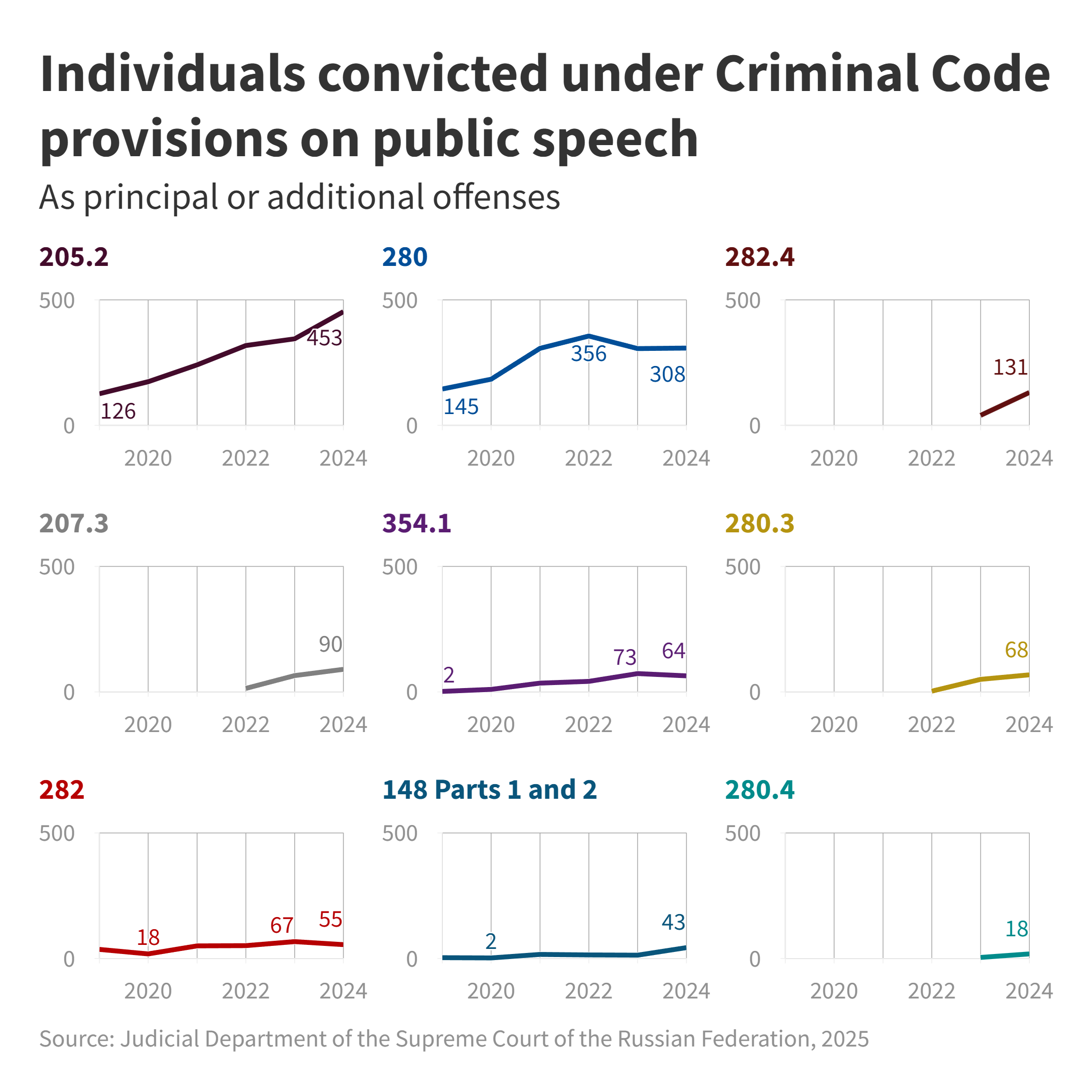
The Judicial Department takes into account only those sentences that have entered into force. By contrast, SOVA includes sentences issued at the first-instance level but excludes from its calculations those later overturned on appeal, once such information becomes available. It should also be noted that the Judicial Department’s data does not provide accurate counts of offenders convicted for public statements. If all primary and ancillary charges across the relevant articles are added together, offenders sentenced under multiple articles will inevitably be counted more than once. Conversely, if only principal offenses are counted, those whose sentences also included more serious articles are omitted.
SOVA’s monitoring further differs in scope: we do not include all parts of the articles concerning public speech. For Article 148 CC, only Parts 1 and 2 are considered, and for Article 2073, only paragraph “e” of Part 2. In addition, within the category of sanctions for speech, we exclude charges which can be classified as acts of vandalism. As a result, several sentences under Article 148, Part 2, nearly all under Article 354¹, Part 3, and some under Part 4 of the same article have been excluded from SOVA’s overall calculations.
According to the SOVA Center database, 511 individuals were convicted in 2024 for public statements. Given the discrepancies with the statistics of the Judicial Department, we estimate that our data reflect approximately half of all convictions issued during the year, with the degree of completeness varying across different articles. Nevertheless, the available information allows for certain general observations.
In particular, we can observe the changes in the distribution of sentences and convicted offenders across Russia’s regions in recent years. We provide data for 15 regions that had the greatest number of convicted offenders in prior years or the greatest number of individuals who faced charges in 2024.
|
|
Sentences 2022 |
Sentences 2023 |
Sentences 2024 |
New Cases
|
Sentences 2025 (As of 12.06) |
|||||
| Regions |
Cases |
Persons |
Cases |
Persons |
Cases |
Persons |
Cases |
Persons |
Cases |
Persons |
| Moscow |
7 |
7 |
26 |
29 |
51 |
63 |
77 |
84 |
15 |
16 |
| Saint Petersburg |
12 |
12 |
11 |
15 |
21 |
22 |
22 |
24 |
11 |
11 |
| Krasnoyarsk Region |
4 |
4 |
11 |
12 |
16 |
17 |
18 |
19 |
3 |
4 |
| Crimea (and Sevastopol) |
8 |
8 |
11 |
14 |
16 |
16 |
11 |
11 |
5 |
5 |
| Omsk Region |
5 |
7 |
1 |
1 |
15 |
15 |
7 |
7 |
2 |
2 |
| Stavropol Krai |
5 |
5 |
3 |
3 |
12 |
14 |
16 |
17 |
10 |
10 |
| Udmurt Republic |
8 |
8 |
6 |
6 |
11 |
11 |
13 |
13 |
10 |
10 |
| Samara Region |
9 |
11 |
3 |
3 |
10 |
11 |
9 |
9 |
2 |
2 |
| Tula Region |
2 |
2 |
13 |
14 |
10 |
10 |
5 |
5 |
1 |
1 |
| Republic of Tatarstan |
4 |
4 |
6 |
6 |
9 |
9 |
15 |
17 |
5 |
5 |
| Krasnodar Region |
5 |
7 |
7 |
7 |
9 |
9 |
15 |
15 |
11 |
13 |
| Sverdlovsk Region |
3 |
3 |
2 |
2 |
8 |
8 |
21 |
21 |
8 |
8 |
| Kemerovo Region |
10 |
10 |
13 |
13 |
7 |
9 |
17 |
17 |
2 |
2 |
| Moscow Region |
3 |
3 |
3 |
3 |
6 |
6 |
24 |
24 |
3 |
4 |
| Kirov Region |
0 |
0 |
9 |
10 |
6 |
6 |
13 |
13 |
3 |
3 |
| All of Russia |
247 |
261 |
372 |
409 |
485 |
511 |
578 |
602 |
217 |
226 |
As you can see, St. Petersburg has been consistently close to the top of the list in recent years, and the Kemerovo Region has maintained a consistently high level, at least until 2025. On the other hand, Moscow became a leader in the number of sentences only in 2023 and has kept its first place ever since, partly because the majority of in absentia sentences for emigrants have been issued there. Krasnoyarsk Krai, the Tula Region, and Crimea moved to the top at the same time. In 2024, the Samara and Omsk Regions, Stavropol Krai, and the Udmurt Republic joined the list of leaders. For new cases of 2024, the Moscow Region and the Sverdlovsk Region stand out in addition to the two capitals; other prominent areas in this respect include the Kirov Region, Krasnodar Krai, and Krasnoyarsk Krai, as well as Tatarstan.
Turning to the statistics on penalties under criminal provisions related to public speech, it is worth noting that, according to data from the Judicial Department, the most frequently imposed sanctions were imprisonment (366 individuals, or 36 %), fines (341 individuals, or 34 %), and suspended sentences (203 individuals, or 20 %).
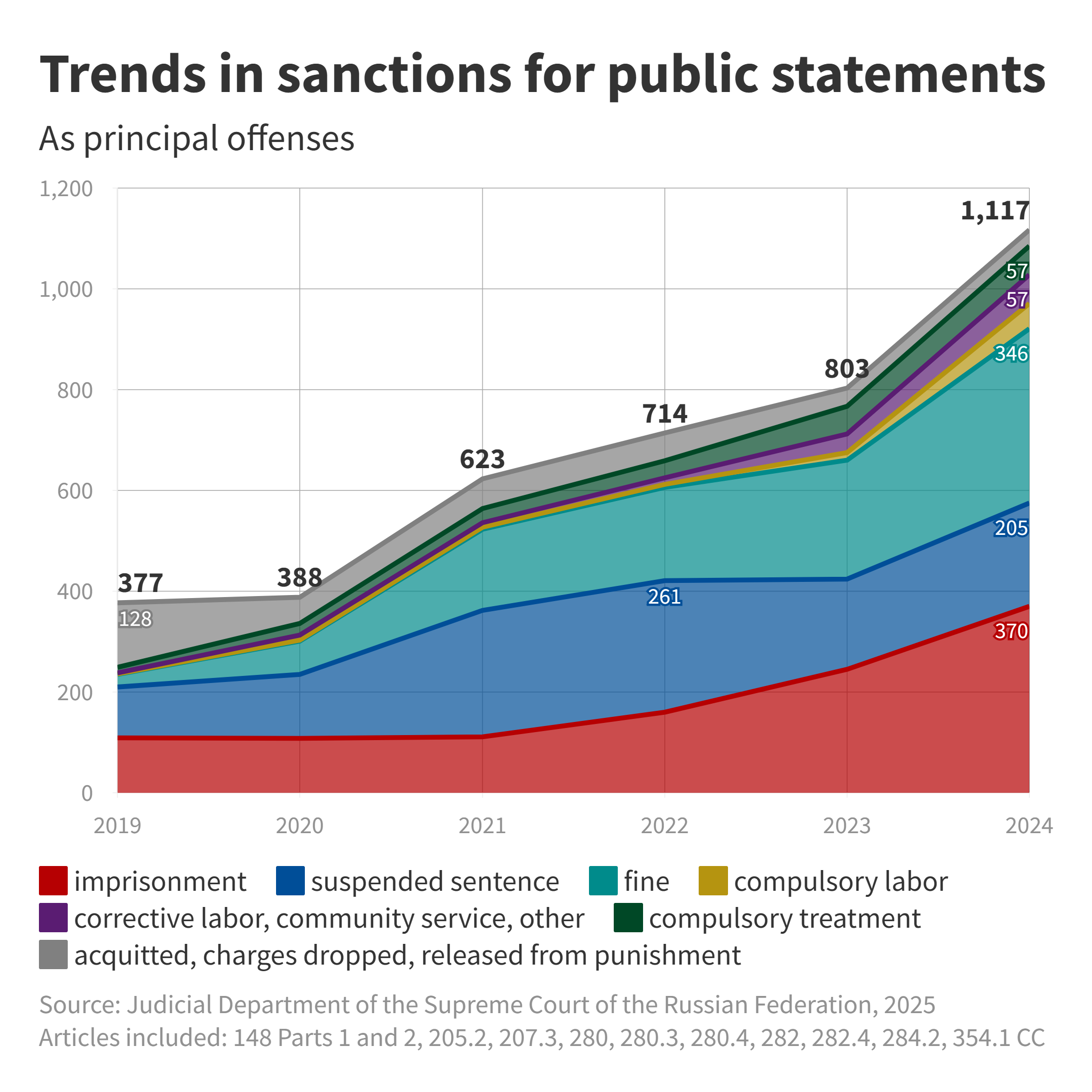
SOVA receives information about imprisonment far more frequently than about fines, but the table below allows us to at least estimate the proportion of those sentenced to imprisonment relative to the total number of those convicted for public statements in a given category. It is worth reminding that a convicted person can be assigned to more than one category, depending on what statements were included in the sentence.
| Statement Category |
Imprisonment |
Suspended Sentence |
Labor |
Fine |
Unknown |
Total Punished |
| Ethnic Xenophobia |
41 |
30 |
15 |
6 |
4 |
96 |
| Religion |
18 |
3 |
1 |
3 |
0 |
25 |
| Against the Authorities |
55 |
19 |
5 |
14 |
0 |
93 |
| Pro-Ukrainian |
163 |
14 |
11 |
55 |
9 |
252 |
| Violation of Traditional Values |
18 |
8 |
11 |
8 |
7 |
52 |
| Other |
19 |
3 |
6 |
0 |
1 |
29 |
| Unknown |
4 |
4 |
0 |
4 |
6 |
18 |
| Total |
283 |
77 |
43 |
84 |
24 |
511 |
Of convicted offenders known to us, the following percentages faced imprisonment: 43 % of those punished for expressions of ethnic xenophobia, 72 % of those punished for statements on religion, 59 % of those punished for statements against the authorities, 65 % of those punished for statements about events related to Ukraine, and 35 % of those punished for attacks on traditional values.
The table above also clearly shows that the majority of persons convicted in 2024 were found guilty of commenting on the events in Ukraine. This group accounts for nearly half of all those convicted (49 %). Individuals convicted of ethnic xenophobia and for statements against the authorities are tied for second place, each representing 19 %. Another 10 % were punished for violation of traditional values, and only 5 % for statements related to religion.
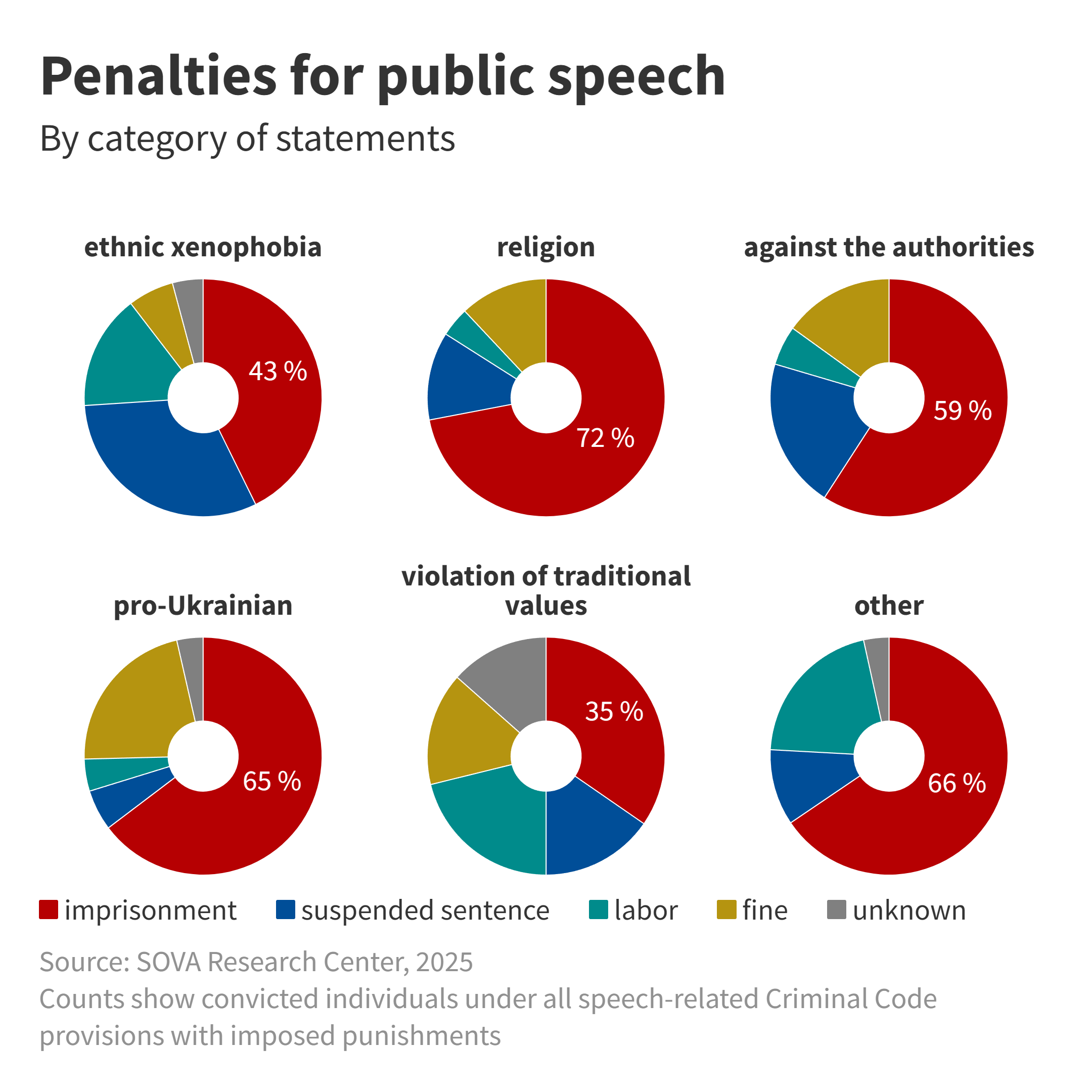
Per our calculations, 18 % more people faced new charges in 2024 than received sentences in the same year.
| Statement Category |
Number of Cases |
Number of Persons Involved |
| Ethnic Xenophobia |
101 |
111 |
| Religion |
32 |
34 |
| Against the Authorities |
71 |
71 |
| Pro-Ukrainian |
271 |
290 |
| Violation of Traditional Values |
70 |
81 |
| Other |
42 |
41 |
| Unknown |
50 |
51 |
| Total |
578 |
602 |
As the table indicates, the proportion of individuals charged in 2024 with statements regarding events in Ukraine, ethnic xenophobia, and religion remained largely unchanged compared with 2024 convictions, at 51 %, 19 %, and 6 %, respectively. However, the share of offenders prosecuted for statements against the authorities was lower – 12 %, while the percentage of those prosecuted for violation of traditional values increased to 13 %.
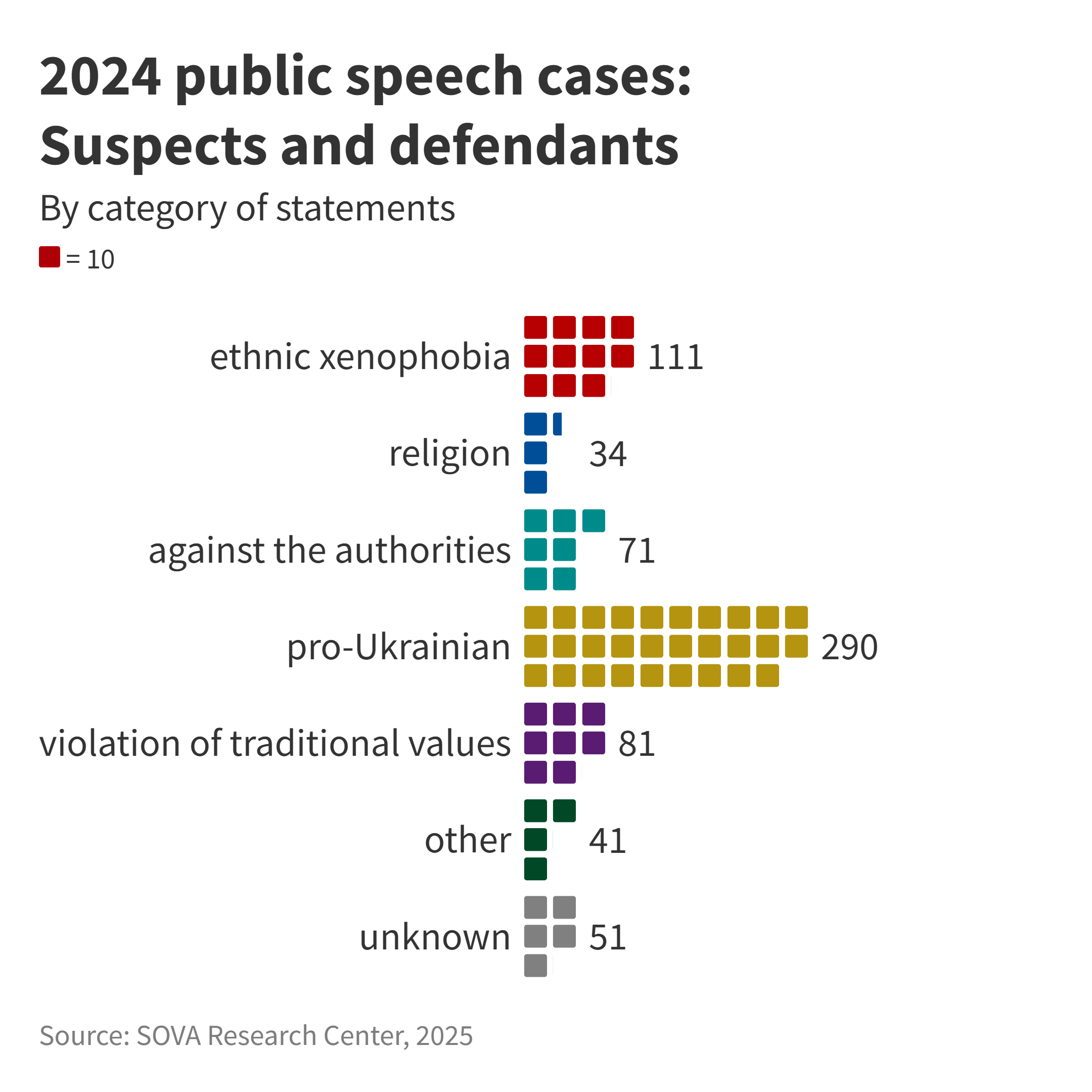
Let us now compare the number of people convicted in 2024 for online and offline statements.
| Statement Category |
Online |
Offline |
Online and Offline |
Unknown |
Total |
| Ethnic Xenophobia |
63 |
29 |
4 |
0 |
96 |
| Religion |
12 |
11 |
2 |
0 |
25 |
| Against the Authorities |
83 |
6 |
4 |
0 |
93 |
| Pro-Ukrainian |
206 |
33 |
8 |
5 |
252 |
| Violation of Traditional Values |
30 |
8 |
10 |
4 |
52 |
| Other |
10 |
18 |
1 |
0 |
29 |
| Unknown |
15 |
0 |
0 |
3 |
18 |
| Total |
379 |
92 |
2 8 |
12 |
511 |
The majority of convictions – 74 % of those sentenced – concerned statements made online, reflecting the predominance of public discourse on the Internet. The relatively high proportion of individuals punished for offline offenses in the “other” category, as well as their significant share in the ethnic xenophobia and religion categories, can be attributed to the above-mentioned widespread practice of penalizing the display of prohibited symbols and communications with other prisoners within places of detention.
Next, let us explain our method for evaluating the overall appropriateness of the cases. Summarizing the previous chapters, we can say that we have classified as inappropriate almost all the sentences known to us under Article 2803, most of the sentences under paragraph “e” of Article 2073 Part 2 and Article 148 Parts 1 and 2, a significant part of the sentences under Article 3541, and only a small part of the sentences under Articles 2052, 280, 282 and 2824 CC. These last four articles mainly contributed to “yes,” “other,” and “unknown” categories.
When considering specific categories, we can generally say that the bulk of law enforcement we view as inappropriate came from sentences for peaceful political statements against the government's course and in defense of Ukraine or for statements about history, religion, the church, and symbols, which pose no public danger. We found 40 % of defendants to be inappropriately convicted. We categorized 19 % as justifiably punished for ethnic and religious xenophobia. 20 % of those sentenced were classified as “other” – mainly people convicted of aggressive political statements and those who promote the values of the criminal underworld. In 21 % of cases, we were unable to evaluate the appropriateness of the sentences due to a lack of information about the court decisions.
| Statement Category |
Yes |
No |
Not Sure |
We Don't Know |
Other |
Total |
| Ethnic Xenophobia |
80 |
4 |
5 |
8 |
1 |
96 |
| Religion |
11 |
3 |
2 |
11 |
0 |
25 |
| Against the Authorities |
5 |
20 |
2 |
30 |
45 |
93 |
|
Pro-Ukrainian |
7 |
153 |
7 |
44 |
58 |
252 |
| Violation of Traditional Values |
7 |
37 |
3 |
8 |
1 |
52 |
| Other |
4 |
2 |
6 |
0 |
18 |
29 |
| Unknown |
0 |
1 |
0 |
18 |
0 |
18 |
| Total |
96 |
202 |
18 |
107 |
109 |
511 |
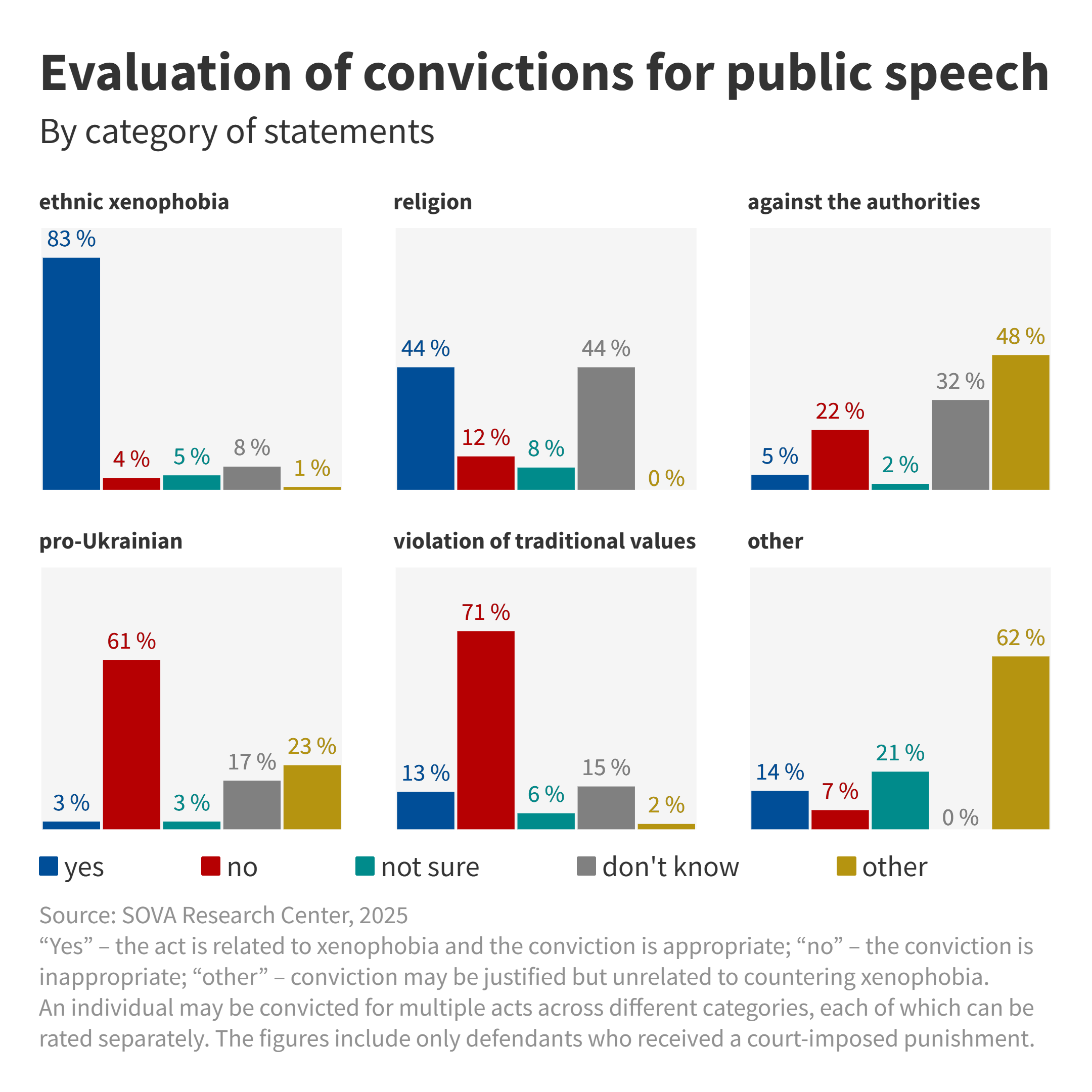
Separately, we must note that we know of 13 defendants under articles on public speech referred for compulsory psychiatric treatment by the courts in 2024. We believe that only two of these cases were appropriately initiated as criminal proceedings. In our view, five lacked compelling grounds for prosecution, while the remaining six were difficult to assess.
Finally, according to our preliminary estimates, at least 35 % of the defendants in cases initiated in 2024, or approximately 200 individuals, were prosecuted inappropriately.
The graph below illustrates our assessment of the appropriateness of sanctions for public speech over the past six years. In 2023, following the introduction of criminal provisions discreditation and the dissemination of false information about the armed forces, the proportion of convictions we deemed inappropriate increased sharply. In 2024, fewer individuals faced charges under these articles, a shift that will influence our evaluations of sentences in 2025.
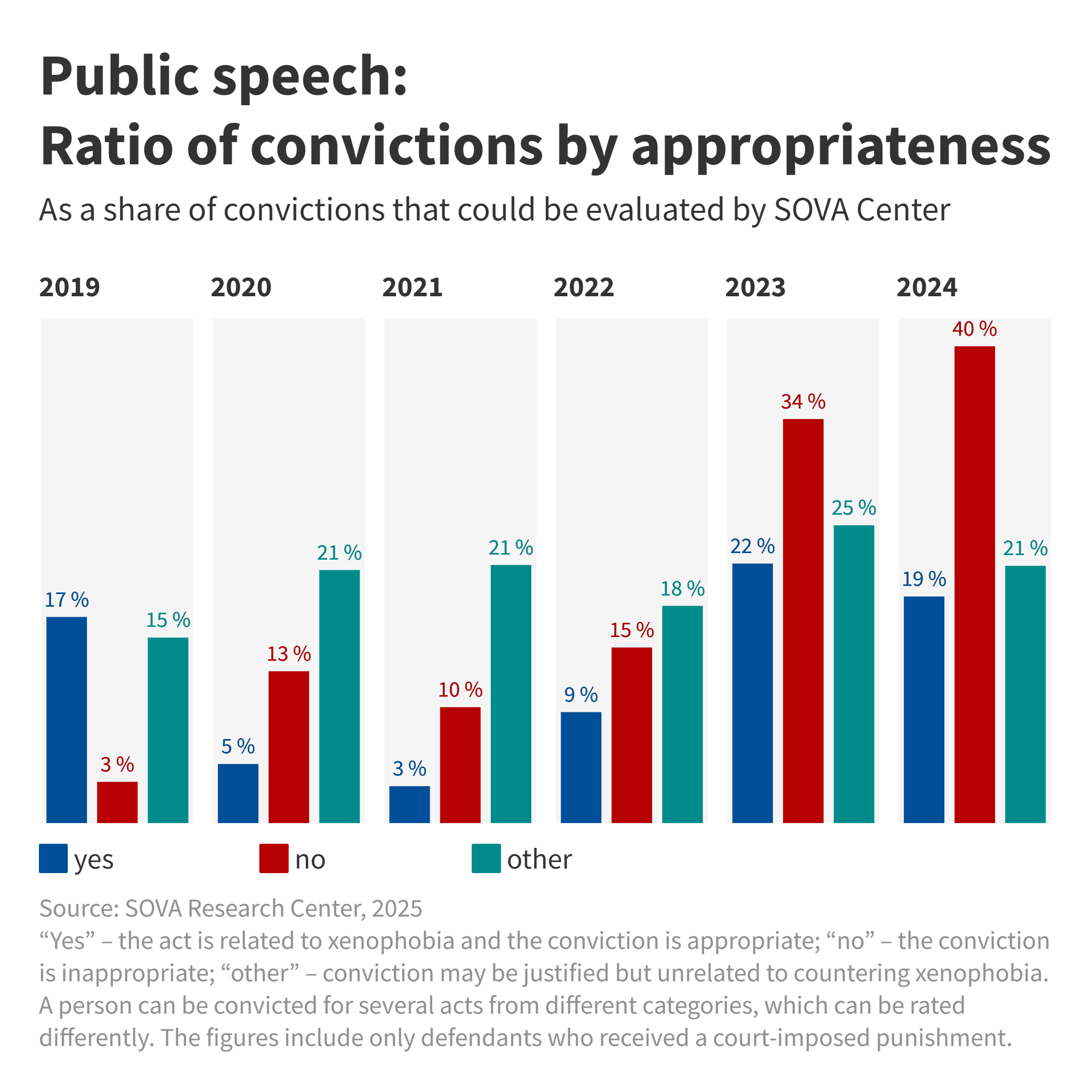
Regulation of Organized Activities
In this part of the report, we discuss the 2024 court cases for involvement in organizations recognized as extremist or terrorist. We have grouped information about such charges not by articles of the CC, as we did in the section on sanctions for public speech, but using the same categories as in the previous section. First, we will talk about the 2024 sentences and newly filed charges for involvement in organizations that are ideologically close to ethnic xenophobia, next about organizations that participate in the armed conflict on Ukraine’s side, and then we’ll turn our attention to peaceful opposition organizations. Next, we will discuss the ongoing pressure against peaceful religious organizations and, finally, the sanctions for involvement in communities that do not fit into the concept of “traditional values.”
It should be noted that SOVA’s monitoring does not include charges related to participation in jihadist Islamic organizations – primarily due to the limited availability of information in this area of law enforcement. Court rulings are generally unpublished, and reports from law enforcement agencies and the media often do not specify the individuals charged or the organizations involved. For the same reason, the figures presented below exclude cases involving participation in Muslim or other religious organizations for which information is insufficient,[25] as well as cases related to religious associations not identified in official reports or court decisions.
For each category, we will indicate the number of individuals known to have faced sanctions for involvement in the respective organizations, the criminal articles under which they were prosecuted, the penalties imposed, the number of new cases, and our assessment of whether the charges were appropriate. We will discuss the application of the following articles of the CC:
- Article 2821 on involvement in the activities of an extremist community;
- Article 2822 on involvement in the activities of an extremist organization;
- Article 2823 on financing of extremist activities;
- Article 2054 on involvement in the activities of a terrorist community;
- Article 2055 on involvement in the activities of a terrorist organization.
Finally, we will present general statistics from the Judicial Department of the Supreme Court, along with our overall observations on prosecutions related to involvement in the activities of banned associations.
Nationalist Associations
In 2024, 21 people were convicted of participating in the activities of Russian ethnic nationalist groups, some of which could be characterized as neo-Nazi. Some groups were prosecuted as extremist entities, others as terrorist.
The SOVA database includes 18 members of far-right associations convicted in 2024 under Article 2821 CC (organizing an extremist community or participating in it). For comparison, we know of 24 individuals convicted in 2023.
These 18 people belonged to three groups: seven members of a certain community from Novocherkassk, which, according to the investigation and the court, followed the ideology of the banned NS/WP network; seven members of the ultra-right community of Klim Shirokov from Krasnoyarsk; and four members of the Community (Obschina) group from Temryuk in Krasnodar Krai.
Only the Obschina members faced Article 2821 CC as their sole charge. The other offenders were found guilty under articles on violent crimes (for example, Article 116 CC on assault motivated by hatred) and vandalism (Article 214 Part 2 CC)[26]. According to the Investigative Committee, the Obschina members planned to commit attacks against migrants from the Caucasus, but likely never managed to carry out these intentions; at least, the relevant articles were not included in the sentence.
14 of the 18 convicted offenders were sentenced to imprisonment, two received suspended sentences, one was sentenced to corrective labor, and one to forced labor.
We know of three criminal cases opened in 2024 against 12 people for participating in the activities of the far-right communities Sparta 88, Made with Hate, and one more, whose name has not been reported.
We know of three far-right individuals found guilty in 2024 under Article 2055 CC (participation in the activities of a terrorist organization). Our database for 2023 also contains three individuals convicted under such charges.
All three were sentenced to lengthy terms of imprisonment for participating in the far-right MKU network, banned in Russia[27] (one of them was also convicted of participating in the “Columbine” movement, recognized as terrorist), as well as for violence, vandalism, and preparation for a terrorist attack.
We have information about eight criminal cases opened in 2024 under Article 2055 CC against 10 individuals for their involvement in the activities of the NS/WP and MKU networks and a group (recognized as terrorist) of supporters of Vyacheslav Maltsev, the leader of the Artpodgotovka movement. We have no information as to whether these four supporters of Maltsev were nationalists; while the Artpodgotovka movement, banned as extremist, was founded on nationalist ideas, Maltsev’s followers represent a wide spectrum of views.
We are aware of only one case in 2024 involving criminal prosecution for participation in an association of non-Russian nationalists. The Karmaskaly interdistrict court of Bashkortostan sentenced the remaining defendant in the riot case in the village of Karmaskaly, Marat Sharafutdinov, for preparing hooliganism motivated by ethnic hatred (Article 213 Part 2 with Article 30 CC) and for his role as a leader in the Bashkort organization (Article 2822 Part 1 CC) recognized as extremist in 2020. Bashkort members from Karmaskaly were found guilty of planning to hold a “mass gathering” in the village and to organize an Armenian pogrom. Sharafutdinov was sentenced to nine years of imprisonment. However, in April 2025, the Supreme Court of Bashkiria overturned the sentence and sent the case for a new trial. The remaining participants in the riots were convicted back in 2023.
“Citizens of the USSR”
The activities of “Citizens of the USSR”[28] have long attracted the attention of Russian law enforcement agencies. This interest is understandable – representatives of this movement, which became widespread in Russia and neighboring countries in the 2010s, believe that the Soviet Union never ceased to exist de jure, and, therefore, the Russian Federation is an illegitimate structure. They generate many conspiracy theories, including xenophobic ones, and regularly call on citizens and officials to obey their self-created bodies rather than the Russian authorities.
Nine different associations of “Citizens of the USSR” were recognized as extremist from 2019 to 2024. They are included on the List of Extremist Organizations published on the website of the Ministry of Justice, as entries No. 74, 89, 93, 95, 103, 105, 110, 111, and 116 (the last four associations were added to the list during 2024; see the chapter on the ban on organizations below).
As far as we know, in 2024, out of nine “Citizens of the USSR” associations recognized as extremist, only three appeared in reports from investigative bodies and law enforcement sources on criminal cases under Article 2822 CC: the so-called “Union of Slavic Forces of Russia” (USSR) founded by Sergei Taraskin; a group with its center in Novokuibyshevsk in the Samara Region that repeatedly changed its name; and the “People’s Council of Citizens of the RSFSR USSR of the Arkhangelsk Region.”
The SOVA database includes 36 “Citizens of the USSR” convicted under Article 2822 CC in 2024. For 32 of them, Article 2822 CC was the only charge. Four offenders were also found guilty under other CC articles, such as 282, 280, 2824, 2221 (illegal storage of explosives). For comparison, in 2023, we added to the database 19 individuals convicted of participating in “Citizens of the USSR” organizations.
Activists are often prosecuted in group cases. Thus, in Yekaterinburg, 11 followers of Sergei Taraskin were found guilty under Article 2822 CC in a single trial and sentenced to varying terms of imprisonment in a minimum-security penal colony.
In total, 27 “Citizens of the USSR” convicted in 2024 were sentenced to imprisonment. “The (acting) head of the Rostov region of the RSFSR within the USSR,” Oleg Kolesov, received seven and a half years of imprisonment, the rest – from one to six years. The courts issued suspended sentences to seven defendants and sentenced two to community service.
“Citizens of the USSR” faced charges for participating in meetings, giving lectures on their ideology, “calling for refusal to fulfill civic and legal obligations” (since they do not recognize the Russian Federation as a state), distributing propaganda leaflets and brochures, posting videos on the Internet, and “preparing and sending to government bodies documents aimed at obstructing the lawful activities of government bodies.”
We consider the convictions of 27 individuals to have been likely justified, as they or their organizations were actively engaged in xenophobic propaganda. In two cases, our assessment remains uncertain, and in seven cases, we lack sufficient information to draw a conclusion.
We know of five criminal cases opened in 2024 against six “citizens of the USSR.” Five were charged under Article 2822 CC (in one case, also under Article 2823 CC on financing extremism). One “citizen of the USSR” became a defendant under Article 2821 CC.
“Citizens of the USSR” face charges not only under articles for participation in banned organizations, but also under articles on public speech. Sentences against the four people mentioned above contained articles on public statements in addition to Article 2822 CC. In total, 14 “citizens of the USSR” were convicted of public statements in 2024, and we wrote about them in the preceding section of the report. We view the sentences issued to nine of them as inappropriate.
Banned Ukrainian Organizations
We have information about 26 individuals convicted in 2024 for involvement in the activities of Ukrainian organizations banned in Russia. This number includes members of associations of Russian citizens fighting on the side of Ukraine. In 2023, we identified 12 people convicted on similar grounds, all of whom were found guilty of participating in the Right Sector.
In all cases, individuals in question did not participate in military actions and were charged with assisting these organizations through propaganda, data collection, sabotage, etc. In fact, the total number of people convicted of such assistance is significantly higher, not only because our data is incomplete, but also because some of them have faced charges under articles on treason, terrorist acts, participation in an illegal armed formation, etc., rather than articles on involvement in prohibited associations monitored by SOVA.
The 26 known offenders were convicted of involvement with organizations banned as terrorist. One exception is the Right Sector, which was recognized as extremist in 2014 and as terrorist only in 2025. Three people were convicted of participating in the Right Sector in 2024, all of them under Article 2822 CC, one of them also under Article 167 CC. All three were sentenced to imprisonment for terms ranging from one to three years. We are not aware of any such cases newly opened in 2024.
The remaining 23 people were convicted under Article 2055 CC. All of them were sentenced to imprisonment for terms ranging from five to 19 years.
22 of them were convicted for participating in the activities of the Freedom of Russia Legion, a paramilitary formation recognized as a terrorist organization in Russia; moreover, two individuals were also punished for participating in the activities of the Russian Volunteer Corps – another paramilitary formation recognized as a terrorist organization in Russia. Only two offenders were charged solely under Article 205.5 CC for their ties to the Freedom of Russia Legion. In the other cases, it was combined with CC articles 2073, 275, 205 Part 1, 281, 167, or 322 (illegal border crossing).
One person was convicted for participating in the activities of the Azov Regiment (in conjunction with Article 2052 Part 2 CC). The other two people were convicted under Article 205.5 for participation in the activities of unidentified Ukrainian organizations.
In our opinion, two people were clearly inappropriately convicted of their ties to the Freedom of Russia Legion: teenager Arseny Turbin from Livny of the Oryol Oblast, and Ukrainian citizen Kristina Lyubashenko. Neither of them committed or prepared violent crimes, and even their involvement in the Freedom of Russia Legion is highly questionable. Turbin received five years in a correctional colony, and Lyubashenko, who was also found guilty of spreading fake news about the army, received 12 years of imprisonment. We classified other sentences for participation in Ukrainian organizations as “other,” since these organizations are participants in the armed conflict and thus practice violence. For some sentences, we lacked information to assess their appropriateness.
We have information about 31 cases under Article 2055, initiated in 2024 against 45 people for involvement in the Freedom of Russia Legion, Russian Volunteer Corps, and Azov. Some of these people also faced charges of preparing terrorist attacks, treason, terrorist propaganda, etc. In two of these cases the sentences were already issued in 2024.
Another case was opened under Article 2054 (and Article 2052 CC) against two people – leader of the Chechen separatists Akhmed Zakayev and his associate, Murad Yusupov – for creating a certain Chechen battalion within the Ukrainian Armed Forces.
Banned Opposition Organizations
Throughout 2024, the authorities continued to prosecute people for involvement in the activities of Alexei Navalny's structures. Let us recall that the structures associated with Navalny – Anti-Corruption Foundation (Fond borby s korruptsiyey, FBK), the Foundation for the Defense of Citizens’ Rights (Fond zaschity prav grazhdan, FZPG), and the Navalny Headquarters – were recognized as extremist organizations in the summer of 2021. Since September 2021, even the activities that Navalny's structures and supporters carried out before the ban have been considered the activities of an extremist community. At that time, the Main Investigation Department of the Investigative Committee opened a case under Article 2821 CC against Navalny and a number of his supporters, stating that the extremist community came into existence no later than 2014. Subsequently, regional activists who had previously participated in Navalny's organizations, his lawyers, and journalists who had collaborated with his structures became defendants in cases under Article 2821 CC..
In 2024, according to our information, four sentences under Article 2821 were issued against five people for participating in the activities of Navalny's organizations. Two of them were simply found guilty of involvement in the activities of Navalny's “underground” headquarters. One person posted leaflets about the judge, who had sentenced Navalny, and transferred money to the FBK (for this, he was also convicted under Article 2823). The remaining two painted graffiti in support of Navalny and against the special military operation (they were also found guilty under Article 214 Part 2 CC). All these people were sentenced to various terms of imprisonment, from two and a half to seven years.
Three activists from regional Navalny Headquarters – Liliya Chanysheva, Ksenia Fadeeva, and Vadim Ostanin – who had been convicted under Article 2821 a year earlier, were released in 2024 as part of a prisoner exchange. Rustem Mulyukov, who was convicted alongside Chanysheva, was released due to illness.
Meanwhile, new cases under Article 2821 were initiated during the year – against Navalny’s wife Yulia; Nina Volokhonskaya, producer of the Navalny LIVE YouTube channel; Alexandra Frolova, a media creator from Navalny’s team; and five journalists who had collaborated with his organizations: Olga Komleva, Antonina Favorskaya, Konstantin Gabov, Sergei Karelin, and Artyom Kriger. The first three, who had left Russia, were placed on the wanted list, and the others – in detention.
According to SOVA’s data, at least 13 people were convicted under Article 2823 for making donations to the FBK after Navalny’s organizations were declared extremist. Some received heavy fines, while others were sentenced to prison—for example, Moscow cardiac surgeon Ivan Tishchenko was sentenced to four years of imprisonment without any additional charges. In total, we documented 32 such cases initiated against 32 individuals in 2024, with six of them resulting in convictions within the same year.
In 2024, a resident of Ulyanovsk was convicted under Article 2822 Part 2 of the CC for posting leaflets of the Vesna youth movement recognized as extremist. In 2024, one such case was opened – a resident of Obninsk in the Kaluga Region was charged under Article 2822 Part 2 for his involvement in the activities of both Navalny's structures and Vesna. Six of the two dozen Vesna activists charged in a high-profile case opened in the summer of 2023 under a number of articles went on trial a year later, but have not been sentenced yet.
We view the charges of involvement in an extremist community or an organization banned for extremism, brought against supporters of Navalny’s structures and Vesna, as inappropriate, since, in our opinion, there were no grounds for recognizing these organizations as extremist.
Overall, our database for 2024 contains 18 convictions against 19 supporters of peaceful opposition organizations, and we know of 41 such cases opened in 2024 against 41 individuals.
Banned Religious Organizations
With regard to the application of Criminal Code articles on participation in prohibited religious associations, SOVA’s monitoring covers only part of the spectrum (see above). Almost all of the information presented in this chapter concerns inappropriate sanctions.
Jehovah’s Witnesses
In 2024, the authorities continued to persecute Jehovah's Witnesses,[29] whose organizations registered in Russia were banned as extremist in 2017. Religious worship (including online), reading and discussing religious literature together, preaching, and collecting money for community needs have become the grounds for charging believers with continuing the activities of banned organizations.
In 2024, at least 55 convictions were handed down against 126 Jehovah’s Witnesses under Article 282² CC, as well as under Article 282³ CC. The latter was applied in conjunction with Article 282² in the cases of 24 believers and served as the sole basis of conviction in one case. One believer, Kirill Gushchin from Kabardino-Balkaria, was acquitted, and another case was dismissed by the court due to the death of the defendant. In 2023, according to our calculations, 71 convictions against 149 believers were issued and have remained in force.
Of the 126 convicted offenders, 37 individuals were sentenced to imprisonment. 25 of them were sent to penal colonies for terms of six to seven years, and one, Alexander Chagan from Tolyatti, for eight years. The courts sentenced ten believers to compulsory labor: nine received terms ranging from two to two and a half years, while one individual was sentenced to four and a half years. Meanwhile, 55 defendants received suspended sentences, 14 of them for terms of six to seven and a half years. For 23 people, the principle punishment was a fine, with 11 of them fined between 600,000 and 650,000 rubles. We have no information about the punishment assigned to one person.
According to the calculations of the SOVA Center, at least 49 believers became defendants in new criminal cases on the continuation of the activities of banned organizations of Jehovah’s Witnesses and their financing (Articles 2822 and 2823 CC) in 2024. The corresponding number in 2023 reached 107, so the rate of prosecution dropped 55 %.
According to Jehovah’s Witnesses, whose method of calculation differs somewhat from ours, criminal cases were initiated against 100 believers in 2023. As of February 2024, charges had been brought against 41 individuals in the new year – representing a 60 % decrease compared to the previous year.
At the same time, the practice of filing group cases and charging several family members at once continued (Jehovah's Witnesses reported nine new such families in 2024). Elderly believers (more than eight people were over 60 years old) and people with disabilities continued to face criminal charges. Jehovah's Witness Alexander Lubin, who suffered from serious illnesses, died a few days after the pronouncement of his sentence.
Followers of Said Nursi
We know of only one sentence for studying the books of Islamic theologian Said Nursi[30] – two Muslims were sentenced in Moscow under Part 1 and Part 2 of Article 2822 to six years and two years and nine months, respectively. We have no information about any new criminal cases initiated in 2024; the sanctions imposed during the year were limited to several administrative fines for storing prohibited literature.
Tablighi Jamaat
We know of four sentences issued in 2024 under Article 2822 CC against 17 people for continuing the activities of the Islamic religious movement Tablighi Jamaat, which is recognized as extremist (not a single such sentence was issued the year before).[31] Two sentences were issued in Moscow against ten natives of Kyrgyzstan. All of them were sentenced to imprisonment, but we have no information about the terms assigned to them. Two more citizens of Kyrgyzstan were convicted in Sakhalin: one of them was sentenced to six years’ imprisonment under Article 2822 Part 1, and the other – to two and a half years of imprisonment under Part 2 of the same article. The court issued suspended sentences to five Muslims convicted in Penza. We are aware of one similar criminal case opened in 2024 – against four Muslims in the Rostov Region; according to the investigation, “under the guise of a religious group,” they “involved local Muslims in extremist activities, held secret meetings of their followers, and instilled a false opinion about the non-compliance with Russian legislation, including denying the need for Russian Muslims to participate in the special military operation.”
Hizb ut-Tahrir
In 2024, prosecutions continued against Muslims accused of involvement in the Islamic religious party Hizb ut-Tahrir, under criminal charges for organizing, participating in, and recruiting for a terrorist organization. The party has been banned in Russia as a terrorist organization, despite the lack of evidence of its involvement in violent activities.[32]
Our position is as follows: when we know that people who continue (or allegedly continue) their participation in a banned organization are charged only under Article 2055 CC without any additional terrorist offenses, we consider such cases inappropriate – particularly because they involve disproportionately severe punishment.
Those involved in criminal cases of involvement with Hizb ut-Tahrir face charges for conducting meetings and discussing party literature and ideology. Such activities are prosecuted under Article 2055, which provides for particularly severe penalties. The Hizb ut-Tahrir followers are also charged with preparing for a violent seizure of power simply because the party promotes the idea of creating a global caliphate – law enforcement and the courts do not require evidence of any real preparations. In recent years, the majority of believers facing sanctions have been from Crimea. Charges of involvement in Hizb ut-Tahrir appear to serve as a convenient instrument for suppressing opposition activity among the Crimean Tatar population of the peninsula.
We know of five sentences issued in 2024 against seven Hizb ut-Tahrir supporters: only one believer received seven years’ imprisonment, while the others were sentenced to terms ranging from 10 to 18 years’ imprisonment, with part of the term to be served in prison and various additional restrictions. For comparison, a year earlier, we knew of 10 sentences against 21 people. Of the seven convicted individuals, five were sentenced under Article 2055. Two of these were additionally found guilty of incitement to terrorist activity under Article 2051 Part 1.1, and three – under Article 2052. Two individuals were convicted of promoting party ideology in penal colonies. Rais Mavlyutov from Tolyatti, previously sentenced to 23 years in prison for involvement in Hizb ut-Tahrir, received additional 10 years under Article 2051 Part 1.1, so that his total term of imprisonment reached 27 years. We do not know how much was added under Article 2051 Part 1.1 and Article 2052 to the term of Azat Gataullin from Kazan, previously sentenced to 19 years of imprisonment.
Notably, while in 2023, 17 out of 21 convicted persons were Crimeans, not a single resident of the peninsula was convicted in 2024. However, one of the three new cases of 2024 was initiated in Crimea – against ten residents of Dzhankoy and Bakhchisarai at once. Two more cases were opened in Kazan, one of them involving four members of a “women’s cell.” They were placed in pre-trial detention despite having young children. Until then, throughout the entire history of Muslims prosecuted for involvement in Hizb ut-Tahrir, a woman had faced charges only once. In total, 17 people became defendants in new cases in 2024.
Allya-Ayat
In 2024, we noted only two cases initiated against sun worshipers who follow the Allya-Ayat teaching. The believers advocate a cure for all illnesses through the use of special tea, saying the “life formula,” invoking the sun energy, repeatedly reading and applying to sore spots the issues of the Zvezda Selennoy magazine published by the doctrine’s founders. Seven issues of this magazine were recognized as extremist materials for promoting the superiority of the Allya-Ayat teaching over others. Several regional groups of believers were gradually banned based on the charges of distributing the magazine, which, in turn, led to the charges against the adherents under Article 2822 CC. In Rostov-on-Don, five followers of the Allya-Ayat teaching became defendants in such a case – two men and three women; the 65-year-old leader of the group was charged with creating a “cell” of an extremist organization, and the others – with participating in it. New search raids were conducted in Altai Krai in connection with a criminal case initiated back in 2022. It is unknown whether any local believers faced charges. The Allya-Ayat groups do not encourage their members to display religious intolerance and do not use violent coercion to impose obedience to the teachings, so we see no signs of extremism in their activities.
Summary Data on Cases of Involvement in Banned Religious Organizations
To conclude the section on inappropriate sanctions for involvement in banned religious organizations, we present our data on the penalties imposed on those convicted under several criminal articles (it is worth remembering that charges under Article 2823 CC were most often filed simultaneously with charges under Article 2822 CC).
|
|
Imprisonment |
Suspended Sentence |
Compulsory Labor |
Fine |
Total |
| Organizing the activities of an extremist organization and participating in it |
|||||
| 2822 Part 1 |
31 |
13 |
0 |
16 |
60 |
| 2822 Part 1.1 |
0 |
7 |
1 |
0 |
8 |
| 2822 Part 2 |
19 |
47 |
10 |
8 |
85[33] |
| Financing extremist activities |
|||||
| 2823 Part 1 |
7 |
4 |
0 |
14 |
25 |
| Organizing the activities of a terrorist organization and participating in it |
|||||
| 2055 Part 1 |
1 |
0 |
0 |
0 |
1 |
| 2055 Part 2 |
4 |
0 |
0 |
0 |
4 |
| Total wrongful convictions under the articles on banned religious organizations |
|||||
|
|
57 |
60 |
10 |
23 |
151 |
In total, we know of 36 new cases filed inappropriately against 100 people in 2024 for involvement in banned religious organizations.
Two of these cases are worth mentioning separately, since they involve groups committing crimes motivated by religious hatred. In Kabardino-Balkaria, at least 25 people were charged under Article 2821 CC for creating so-called “Sharia patrols” in the city of Baksan and the village of Tyrnyauz. The patrols identified fellow believers whom they considered to be insufficiently observant of religious standards and subjected them to physical violence and psychological pressure. For example, in Tyrnyauz, at least 16 local residents suffered from these patrols’ actions, including being beaten with sticks. “Sharia patrols” have emerged in Russia on prior occasions, but, as far as we know, group criminal cases are rarely initiated. The previous such group of 11 people was convicted in Kabardino-Balkaria in 2022.
Associations Deemed Contrary to “Traditional Values”: LGBT
The International LGBT Movement was banned at the end of November 2023. The ban came into force in February 2024, and on March 1, the Russian Ministry of Justice included the movement and its structural divisions on the List of Extremist Organizations. While administrative sanctions for displaying LGBT symbols began in January, the first criminal case under Article 2822 CC was opened in March – against the owner, art director, and administrator of Pose, an Orenburg LGBT club. According to the investigation, “the defendants, being persons of a non-traditional sexual orientation, acting as a group of persons by prior conspiracy,” organized and supported the work of the LGBT establishment, promoting non-traditional sexual relations among the bar’s visitors.
In total, according to our information, at least nine similar cases against 15 individuals were initiated under Article 2822 CC in 2024. Five of them against ten persons were opened against the owners and employees of gay clubs. Another one was opened against two people for organizing gay dating in Vladikavkaz. In the Kemerovo Region, an inmate, who was serving an 18-year sentence in a maximum-security penal colony for sexualized violence against a child, was charged with participating in the activities of an “international LGBT movement” cell and involving other prisoners in it. In Inza of the Ulyanovsk Region, the director of a dialysis center and a center for massage and traditional oriental medicine was charged with coercion to homosexual act under both Article 2822 Part 2 and Article 133 Part 1 CC. According to the investigation, he proposed to his subordinate “engaging in non-traditional sexual relations” and threatened to fire him or create unbearable conditions if refused. Allegedly, he also, “being a supporter of Satanism, promoted the idea of same-sex relations among his subordinates as a way of introducing them to devil worship.” A defendant in another case, Andrei Kotov, the director of travel agency Men Travel in Moscow, died in a pretrial detention center, possibly by suicide. He had been charged with “organizing trips for LGBT supporters around Russia and abroad for money.” Kotov complained of violence and degrading treatment in detention.
We believe that the ban on the LGBT movement as an extremist organization was an unjustified and clearly discriminatory measure that deprived part of society of the opportunity to defend their rights and peacefully express their views. We regard prosecutions for involvement in the “international LGBT movement” as inappropriate.
Other Banned Associations: AUE
SOVA Center recorded 43 sentences issued in 2024 against 99 people for their involvement in the public movement Prisoners Criminal Unity (Arestantskoe Ugolovnoe Yedinstvo, AUE) recognized as extremist in 2020. We counted at least 34 new cases of this kind, opened in 2024 against at least 95 defendants, and we believe that our information is far from complete.
The defendants in AUE involvement cases are prosecuted under various parts of Article 2822 (we know of 19 individuals convicted under Part 1, 72 under Part 2, and two under Part 1.1 of this article in 2024), and often also under Article 2823 Part 1 CC for financing the activities of “cells” (22 convicted offenders). In addition, some sentences include Article 2101 CC on occupying a high position in the criminal hierarchy, Article 163 CC on extortion, Article 1712 CC on illegal organization of gambling, and some others. As a rule, the defendants are inmates of penal colonies. They are charged with promoting “criminal traditions, the prestige of committing crimes, and hatred and aggression towards law enforcement officials” on the territory of correctional institutions, “controlling the actions of other inmates, collecting money, distributing prohibited items” or organizing gambling tournaments among inmate groups in the colony, and transferring the proceeds to criminal authorities. Most often, criminal cases are initiated against those currently serving their sentence in a colony, but sometimes former inmates end up on trial, charged for the activities they had carried out while serving their sentences or for involving others in such activities after their release.
We believe that the ideology of the criminal underworld and the AUE subculture is oriented towards illegal activity and is, by its nature, incompatible with the constitutional rights of citizens. While the dissemination of such an ideology may legitimately be prohibited and subject to criminal liability, the ideology itself is neither political in character nor directed at altering the constitutional order. Therefore, in our opinion, it should not fall under the anti-extremist legal framework. Moreover, there is no compelling evidence to suggest that AUE is a structured movement rather than a subculture. We do not assess the appropriateness of charges related to involvement in AUE, instead categorizing such sentences as “other” in our database.
Overview of Convictions under Articles on Participation in Prohibited Organizations
To conclude our analysis of the use of the CC articles on participation in prohibited organizations, we present some aggregated data.
According to the Judicial Department of the Supreme Court, 473 people were convicted under the above-mentioned articles on involvement in banned organizations in 2024 as their principal offense.
Below we provide a table that shows the trends of recent years for individual articles, taking into account both the principal offense and additional charges.
|
|
2019 |
2020 |
2021 |
2022 |
2023 |
2024 |
| Creating an extremist community and participating in it |
||||||
| 2821 |
17 |
20 |
27 |
34 |
58 |
24 |
| Organizing the activities of an extremist organization and participating in it |
||||||
| 2822 |
67 |
100 |
138 |
259 |
320 |
317 |
| Financing extremist activities |
||||||
| 2823 |
5 |
4 |
6 |
26 |
28 |
58 |
| Creating a terrorist community and participating in it |
||||||
| 2054 |
29 |
29 |
59 |
32 |
58 |
88 |
| Organizing the activities of a terrorist organization and participating in it |
||||||
| 2055 |
131 |
108 |
80 |
105 |
171 |
146 |
| Total for articles on banned organizations, for the principal offense only |
||||||
|
|
188 |
186 |
233 |
345 |
491 |
473 |
As the table shows, the number of individuals sentenced has increased each year since 2020. However, in 2024, not only did this number fail to rise compared to 2023 – it actually decreased by about 4 %. This decline was due to the reduced application of Articles 2821 and 2055. The most frequently used Article 2822 also failed to show an increase. Compared to 2023, the number of convicted offenders increased only under Article 2823 (which more than doubled) and showed a noticeable increase under Article 2054.

The table below presents data from the Judicial Department on the penalties imposed in 2024 under the relevant articles. In addition, one individual was acquitted, while five were referred by the courts for compulsory treatment. Six cases were dismissed: one for lack of elements of the offense, one for “other reasons,” and four – based on the note to Article 2822, according to which a person who has committed a crime for the first time and voluntarily ceased participating in the activities of an extremist organization is exempt from criminal liability unless their actions contained other offenses. Five people were exempted from punishment.
|
|
Imprisonment |
Suspended Sentence |
Compulsory Labor |
Fine |
Total |
| Creating an extremist community and participating in it |
|||||
| 2821 Part 1 |
5 |
1 |
0 |
0 |
6 |
| 2821 Part 1.1 |
2 |
0 |
0 |
0 |
2 |
| 2821 Part 2 |
13 |
1 |
0 |
0 |
14 |
| 2821 Part 3 |
1 |
0 |
0 |
0 |
1 |
| Organizing the activities of an extremist organization and participating in it |
|||||
| 2822 Part 1 |
62 |
12 |
0 |
9 |
83 |
| 2822 Part 1.1 |
9 |
2 |
0 |
0 |
12 |
| 2822 Part 2 |
92 |
69 |
8 |
7 |
179 |
| 2822 Part 3 |
0 |
0 |
0 |
0 |
0 |
| Financing extremist activities |
|||||
| 2823 Part 1 |
17 |
8 |
0 |
11 |
38 |
| 2823 Part 2 |
0 |
0 |
0 |
0 |
0 |
| Creating a terrorist community and participating in it |
|||||
| 2054 Part 1 |
7 |
0 |
0 |
0 |
7 |
| 2054 Part 2 |
37 |
0 |
0 |
0 |
37 |
| Organizing the activities of a terrorist organization and participating in it |
|||||
| 2055 Part 1 |
7 |
0 |
0 |
0 |
7 |
| 2055 Part 2 |
87 |
0 |
0 |
0 |
87 |
| Total for articles on banned organizations, for the principal offense only |
|||||
|
|
339 |
93 |
8 |
27 |
473 |
Since these cases mostly involve grave or especially grave crimes, the majority of convicted offenders (72 %) were sentenced to imprisonment. Another 20 % received suspended sentences, 6 % were fined substantial amounts by the court, and 2 % were sentenced to compulsory labor.

SOVA Center is familiar with only a subset of 2024 sentences for involvement in banned organizations. Our database lacks data on the application of Article 2055 and, especially, 2054 CC – because we do not track sanctions for participation in jihadist organizations and because our information on the number of sentences for involvement in Ukrainian organizations is incomplete.[34] Nevertheless, we shall provide information we have on the distribution of convicted offenders by articles and categories.
| Act Category |
Article 2821 |
Article 282 2 |
Article 2823 |
Article 2055 |
Total |
| Ethnic Xenophobia |
18 |
2 |
0 |
3 |
23 |
| Religion |
0 |
145 |
25 |
5 |
152 |
| Against the Authorities |
6 |
38 |
14 |
0 |
57 |
| Pro-Ukrainian |
0 |
3 |
0 |
23 |
26 |
| Other |
1 |
99 |
23 |
2 |
102 |
| Unknown |
0 |
1 |
0 |
0 |
1 |
| Total |
25 |
285 |
61 |
32 |
358 |
As the table shows, the largest number of convicted individuals in our records faced punishment for belonging to banned religious organizations, the AUE subculture (“other” category), and peaceful opposition organizations (“against the authorities” category).
Accordingly, we consider the majority of sentences issued to these individuals inappropriate. In second place are offenders whose cases, in our view, are unrelated to manifestations of ethnic xenophobia – such as involvement in AUE or paramilitary Ukrainian organizations – but we do not view their sentences as inappropriate. Offenders convicted for involvement in organizations promoting an ideology of ethnic xenophobia rank only third in number.
| Act Category |
Yes |
No |
Not Sure |
We Don't Know |
Other |
Total |
| Ethnic Xenophobia |
21 |
0 |
0 |
2 |
0 |
23 |
| Religion |
0 |
151 |
0 |
1 |
0 |
152 |
| Against the Authorities |
27 |
19 |
3 |
8 |
4 |
61 |
| Pro-Ukrainian |
2 |
2 |
0 |
9 |
13 |
26 |
| Other |
0 |
0 |
0 |
1 |
101 |
102 |
| Unknown |
0 |
0 |
0 |
0 |
1 |
1 |
| Total |
50 |
172 |
3 |
18 |
119 |
362 |

We know of 169 new cases against 311 individuals opened in 2024 under the articles on membership in banned organizations. Their distribution across categories is as follows:
| Act Category |
Number of Cases |
Number of Persons Involved |
| Ethnic Xenophobia |
10 |
19 |
| Religion |
39 |
100 |
| Against the Authorities |
49 |
57 |
| Pro-Ukrainian |
32 |
47 |
| Violation of Traditional Values |
9 |
15 |
| Other |
34 |
95 |
| Unknown |
2 |
4 |
| Total |
174 |
336 |
Our preliminary estimates suggest that at least 87 of these cases against 131 individuals were initiated inappropriately.
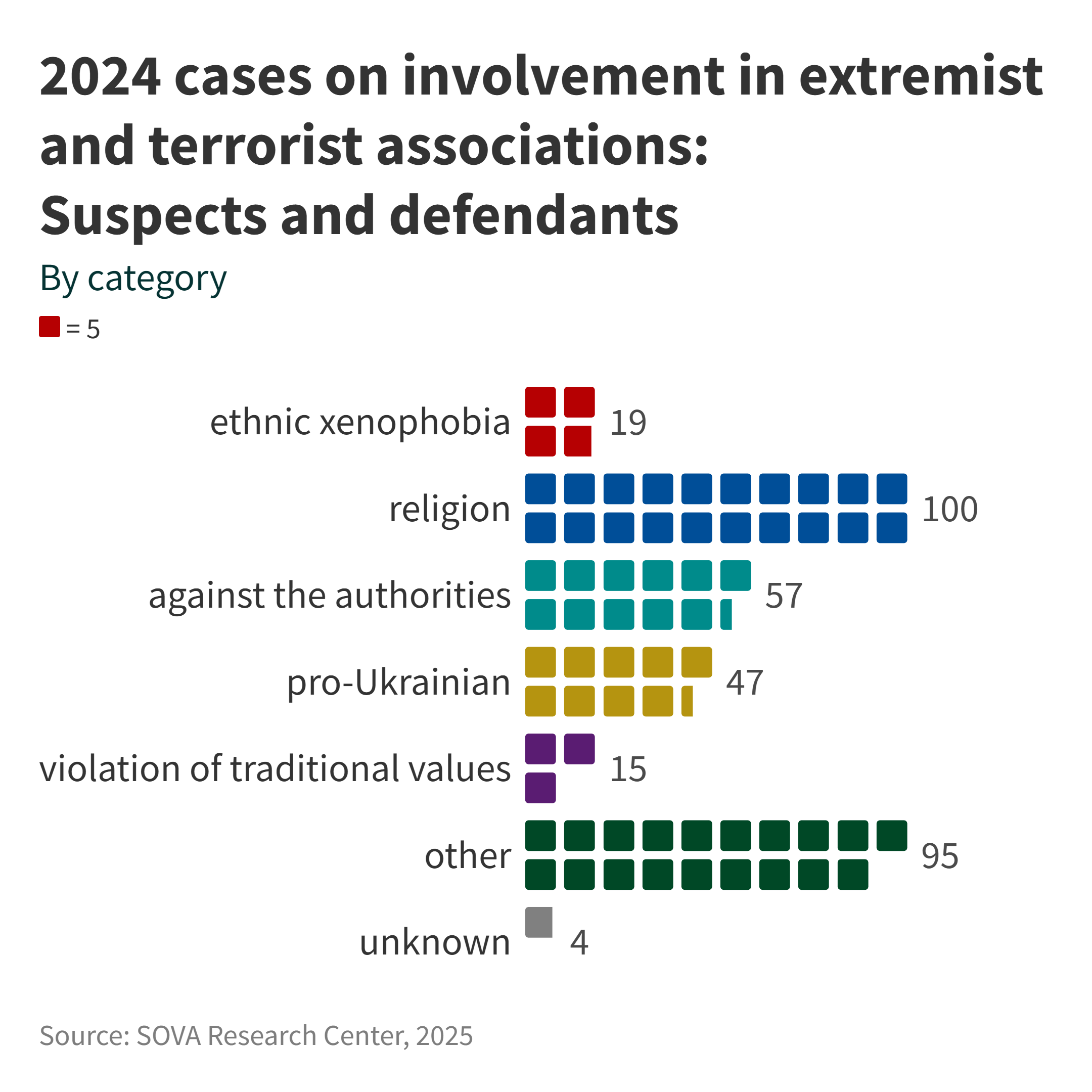
Federal List of Extremist Materials
In 2024, the growth rate of the Federal List of Extremist Materials (FLEM) decreased by over fifty percent compared to the previous year. The list was updated 18 times, and 38 entries were added to it (vs. 82 the year before).[35] By the end of 2024, the list contained 5454 entries (5470 as of July 1, 2025). Notably, the annual growth of the list has been slowing down since 2018, in an apparent indication that the authorities are aware of the FLEM’s ineffectiveness as a mechanism for countering extremism.
Thematically, the additions were distributed as follows:
- Xenophobic materials of modern Russian nationalists (songs, pictures) – 2 entries;
- “Citizens of the USSR” leaflet – 1 entry;
- An article from the “Bulletin of the Balkar People” collection about the 2008 conflict between Kabardians and Balkars in the village of Kyondelen – 1 entry;
- Radical Ukrainian materials calling for the annihilation of Russians (book, songs) – 12 entries;
- Other Ukrainian materials (books by Ukrainian authors) – 9 entries;
- A book from the “Sensei оf Shambhala” series, published by the Ukrainian movement Allatra, and its electronic version – 2 entries;
- Satanist books – 5 entries;
- A militant Islamists’ material (“Who has diverted?!” (Kto zhe otklonilsya?!), a book about the differences between Al-Qaeda and the Islamic State) – 1 entry;
- Songs about school shootings – 3 entries;
- Unknown materials – 2 entries.
Thus, deviating from usual patterns, materials from Russian nationalists and neo-Nazis made up only a small portion of new FLEM entries in 2024, while various materials from Ukraine constituted the majority.

We believe that at least five of these materials were banned inappropriately. In three cases, the works in question were Ukrainian historical studies that contained no aggressive rhetoric. Another was “The Satanic Bible” by American occultist Anton Szandor LaVey, which, while including elements derogatory toward non-Satanists – Christians in particular – did not contain calls for violence. In addition, we consider the banning of the track “Columbine” by rappers Slava KPSS and Zamai to be unfounded. Upon closer examination, the song does not pertain to school shootings but rather addresses the balance of power in Russian hip-hop culture. It is worth noting that the share of inappropriately banned materials in 2024 was slightly lower than the year before – 13 % (5 out of 38) vs. 16 % (13 out of 82) in 2023.
Two materials are described so vaguely that their nature remains unclear. The list includes two audio files, labeled only by identification numbers, with accompanying information stating that they were posted on a VKontakte page and feature a male voice singing in a foreign language.
Recognizing Organizations as Extremist or Terrorist
In 2024, courts recognized 11 organizations as extremist.
They included three additional “citizens of the USSR” organizations:
- People’s Council of Citizens of the USSR/RSFSR of the Amur Region (also known as: People’s Council of the Amur Region on the territory of the Amur Region of the RSFSR within the USSR, or People’s Council of the Amur Region);
- People’s Council of the RSFSR/USSR of the Kemerovo Region;
- The Union of Soviet Socialist Republics – the Renewed Federation of Equal Sovereign Socialist Republics Secretariat of the Presidium of the Supreme Soviet of the USSR (also known as: Presidium of the Supreme Soviet of the USSR or PSS RSFSR).
Regarding the first two entities, we know that their members had previously been prosecuted, among other charges, for anti-Semitic propaganda and calls for violence against government officials. We have no such information about the third organization, best known as the Presidium of the Supreme Soviet of the USSR, based in Vereshchagino, Perm Krai. Although its members had previously faced administrative and criminal liability, they are generally known for conducting peaceful activities and showing no inclination toward violence.
Two more organizations were recognized as extremist after being charged with attempting to “undermine the constitutional order of the Russian Federation” and “seize power in the country by violent means.” However, in our view, neither organization called for the violent overthrow of the government or promoted violence against government officials.
In February, the Khabarovsk Regional Court recognized the interregional public movement “I/WE Sergei Furgal” as extremist. The prosecutor’s office stated that the “extremist ideology” of the movement was that of “inciting hatred and hostility towards representatives of government institutions” and seeking to destroy “the legal foundations and values of society.” The prosecutor’s office believes that the movement’s goal is “to create conditions for changing the foundations of the constitutional system,” and to achieve these goals, the movement allegedly “calls for carrying out extremist and terrorist activities, organizing mass riots, and committing violent acts against government officials, etc.” Ex-governor’s supporters did hold protests without permits (mainly in 2020), but these were generally peaceful. We believe that such actions cannot be interpreted as attempts at a violent change of power in the country and do not fall under the definition of extremist activity. There are only five known cases of criminal prosecution against participants in pro-Furgal rallies in different regions under the article on repeated violation of the regulations for holding public events (three cases were dismissed) and one court case on the use of violence against a government official. There were no criminal cases against Furgal’s supporters under “extremist” articles; few of them faced administrative charges, but we classified these as inappropriate.
In June, the Omsk Regional Court recognized the Omsk Civic Association (Omskoye grazhdanskoye obyedineniye, OGO) as an extremist organization. The OGO described itself as an “association of free citizens from Omsk.” Its Telegram channel published news on issues such as corruption in the Omsk Region and the special military operation in Ukraine, and provided human rights guidance, including information on accessing alternative civilian service. One of the association’s founders was activist Nikolai Rodkin, who had left Russia. A criminal case against him was opened in August of the previous year under Article 282 Part 1 CC for “humiliating the dignity of a group of persons united by serving on the Supreme Court” (previously, he was improperly fined under Article 20.3.1 CAO for harsh statements against the police). According to the prosecutor’s office, the association held mass events, including some without official permits, and could allegedly be used by “anti-Russian forces” to bring about regime change. Additionally, the OGO was charged with continuing the activities of Alexei Navalny “under the guise of” anti-corruption efforts. In effect, the movement was punished for its anti-corruption investigations and political criticism.
In June, the Anti-Russian Separatist Movement and 55 of its structural divisions were declared extremist. The Ministry of Justice, which filed a lawsuit to ban the movement, accused it of activities “to destroy the multinational unity and territorial integrity of Russia.” The case mainly involved organizations operating outside of Russia at the time. Among them were the Free Russia Foundation (previously recognized as an “undesirable organization”), the Free Nations League, the Asians of Russia Foundation, the Human Rights Center Ichkeria, the International Committee of Indigenous Peoples of Russia, and other movements and associations. Obviously, there is no single organization called the “Anti-Russian Separatist Movement” and linked by a common structure. Instead, the authorities banned a range of organizations and activist initiatives – separatist, regionalist, or those advocating for the protection of the cultural rights of Russia’s peoples. Such bans allow law enforcement to prosecute a wide array of activists remaining in Russia by charging them with involvement in a supposed common structure. In our view, restrictions are only justified in cases of calls for violent separatism; peaceful discussions concerning the status of a particular territory should not be subject to limitation.
In August 2024, the Supreme Court of the Republic of Tatarstan declared the Tatar People's Party “Renaissance’ (Yanarysh Tatar Halyk Partiyase) an extremist organization. Its members allegedly advocated armed struggle for the independence of Tatarstan, operated several Telegram groups, and published videos online calling for resistance (their YouTube channel had approximately one thousand subscribers). The court’s decision also noted that criminal and administrative cases had previously been initiated against the party’s leader and members. According to the court, several former members of the All-Tatar Public Center (Vsetatarsky Obshchestvenny Tsentr, VTOTs), recognized as an extremist organization in 2022, were also members of Yanarysh. The VTOTs leadership had established the Independent Government of Tatarstan (in exile), which was likewise designated as extremist in 2024 as part of the above-mentioned “Anti-Russian Separatist Movement.”
In December, the St. Petersburg City Court recognized the local Scientology Church as an extremist organization (still not included on the List of Extremist Organizations by mid-2025). In its claim, the prosecutor’s office indicated that the activities of the St. Petersburg Scientology Church were aimed at “inciting hatred and enmity, humiliating the dignity of individuals identified on the basis of their belonging to social groups, and calling for the refusal to comply with social norms and laws.” The claim was related to a sentence in an extremist community case issued against Scientologists in St. Petersburg, which, in our opinion, was inappropriate. One of the convicted individuals, Ivan Matsitsky, head of the local Church of Scientology, was also listed as a defendant in the banning case. In court, representatives of the Scientologists pointed out that their St. Petersburg organization had ceased to exist back in 2022, and that its members, who were found guilty in the extremist community case, had left Russia. Nevertheless, the prosecutor’s claim was upheld. In our assessment, assertions of exclusive spiritual authority are inherent to virtually all religious traditions, and the imposition of sanctions against Scientologists, or the prohibition of their literature on this ground, cannot be regarded as legitimate. The teachings of Scientology’s founder, L. Ron Hubbard, indeed recommend that, for the welfare of the broader community of believers, certain individuals exhibiting particular attitudes should be excluded from offering consultations or instruction, and that close contact with them should be avoided, and they are best ignored. However, most religious denominations impose comparable restrictions on participation in religious practices and rituals. Such guidance to avoid or refrain from engagement with specific individuals should not, in itself, be construed as incitement to hatred or as a violation of human dignity.
In 2024, the List added three more extremist “associations of individuals.” Two were banned in 2023: Entry No. 117 included Ukrainian entrepreneurs and politicians Rinat Akhmetov and Boris Kolesnikov, their relatives and business partners, and Entry No. 113 included Ukrainian entrepreneur and official Konstantin Yefimenko and his sister Yelizaveta Andreeva. The third “association,” banned in 2024, included former Ukrainian President Petro Poroshenko, his son Oleksiy, and business partner Oleg Kazakov (No. 112).
Two more similar “associations” were banned in 2024 and added to the list in 2025: Ukrainian businessman Yevhen Cherniak and his business partners, and journalist Alexander Nevzorov and his wife Lidia. Another similar “association,” involving vodka magnate Yuri Shefler and banned in 2024, has not yet been included in the list.
The legality of this practice of recognizing such groups of business partners and relatives as “extremist associations” raises a number of concerns.[36]
In total, 13 organizations were added to the Federal List of Extremist Organizations in 2024, as published on the Ministry of Justice’s website (compared to three in the previous year); three of them had been banned earlier, in addition to those already mentioned.[37] Thus, by the end of 2024, the list contained 117 entries (122 entries as of July 1, 2025).
The Forum of Free States of Post-Russia and its structural divisions were banned in November 2024. In January 2025, they were included in the list of organizations recognized as terrorist, published on the FSB website, which now includes 172 entries. The Forum itself is an amorphous structure that brings together paramilitary groups fighting on the side of Ukraine, as well as separatist and nationalist organizations, including Russian nationalist groups such as the Northern Brotherhood, Zalesskaya Respublika, Smolenskaya Respublika, etc.). Some of the organization names listed in the decision do not correspond to any known groups, and some entities have denied any involvement with the Forum.[38]
Nine entries were added to the list of terrorist organizations in 2024 (vs. four the year before). Some of these organizations were banned in 2024, and some in 2023, including:
- Four Ukrainian armed formations: the Georgian Legion (banned on April 18, 2024), Dnipro-1 Regiment (December 14, 2023), Donbas 46th separate assault battalion (October 22, 2024) and a certain terrorist community created by employees of the Main Directorate of Intelligence of the Ministry of Defense of Ukraine and operating in Enerhodar, Zaporizhzhia Region (August 08, 2024). In December 2024, the 2nd Donbass battalion was recognized as terrorist; it was added to the list in January 2025.
- Three Islamist associations, two of which were created in penal colonies: the Jamaat community, created in Penal Colony No. 7 of the Federal Penitentiary Service of Russia for Dagestan (September 22, 2023), and “Ahlus Sunnah Wal Jamaat” formed in Penal Colony No. 2 of the Federal Penitentiary Service of Russia for Kalmykia (October 22, 2024), as well as the “Islamic State (Jamaat) Islamic Bakkiya” [sic. as of December 14, 2023).
- Russian branch of the neo-religious syncretic movement Aum Shinrikyo (May 14, 2024).[39]
- Anarchist group Concept ANV (Vanguard of the People's Will) (Kontseptsiya A.N.V. (Avangard Narodnoy Voli)), whose members are suspected of plotting to blow up a thermal power station in Tyumen in 2022 (May 16, 2024).
By the end of 2024, the list of terrorist organizations included 59 entities (67 as of July 1, 2025).
Summary
In 2024, the legislation on combating extremism and terrorism did not undergo significant changes. The amendments were made to refine existing mechanisms and expand their scope. As for general trends in regulating the expression of opinion and the activities of public associations, we can note the increasingly restrictive legal status of migrants, as well as sanctions against “foreign agents” and “undesirable organizations” that reflect the growing mistrust of the authorities towards any foreign presence and influence. New measures were also adopted to regulate Internet traffic and the dissemination of information online.
The Federal List of Extremist Materials added only three dozen items in 2024 – much more modest gains than in previous years. Prosecutors are likely losing interest in this instrument due to its ineffectiveness. Bans against organizations accused of extremism and terrorism, by contrast, appear to be an effective tool for expanding liability to a broad range of individuals connected to these groups – and for intimidating an even wider circle. In 2024, the authorities were particularly active in targeting separatist organizations: first, they banned 55 alleged separatist associations under the collective label “Anti-Russian Separatist Movement”; later, they designated a subset of these, along with other groups (172 in total), as terrorist organizations under the umbrella of participants in the Free Nations of Post-Russia Forum.
In criminal law enforcement, we noted a sharp increase (44 %) in the number of people sentenced under articles on public speech. The charges were most commonly based on various statements about the military actions in Ukraine, harsh criticism of the authorities and law enforcement agencies, or manifestations of ethnic xenophobia. Article 2052 CC on the propaganda of terrorism and its justification was the most frequently applied relevant provision. Law enforcement agencies thus continue to prioritize potential liability under the gravest article on public speech – calls for violence directed at influencing state authorities. At the same time, as in previous years, investigators and courts concentrate on the literal content of statements, disregarding their actual degree of public danger. The number of convictions under Article 205² CC has shown steady growth year by year, and available data on cases initiated in 2024 indicate that this trend persists.
However, in 2024, the overall increase in new defendants was significantly smaller – an 18% rise – compared with the growth in convictions. There was a drop in the number of new cases under Articles 2073 and 2803 CC on “fakes” about the army and its discrediting, respectively, while Article 280 CC on calls for extremism did not show any growth.
It is also noteworthy that the application of CAO provisions related to countering extremism in 2024 remained generally consistent with the previous year, notwithstanding the fact that such measures have traditionally shown more dynamic growth, given the preventive function ascribed to the CAO.

The proportion of individuals sentenced to imprisonment on the basis of public statements in 2024 showed only a marginal increase compared to 2023: 36 % versus 34 %. It should also be noted that a considerable share of these convictions was issued in absentia, with their number in 2024 exceeding that of the previous year. By contrast, the growth observed between 2021 and 2023 was much more substantial. At the same time, if we shift the focus from relative figures to absolute numbers, the upward trend appears far more pronounced: the number of individuals actually deprived of liberty for speech has risen steadily from 108 in 2020 to 370 in 2024.
As for involvement in prohibited associations, data from the Judicial Department of the Supreme Court on individuals convicted under the relevant articles of the CC indicate that, after four consecutive years of annual growth, their number decreased in 2024 by 4 % compared to the previous year. It is difficult to assess the number of defendants in newly initiated criminal cases in 2024 due to incomplete information, but it can be assumed that the increase was minimal or even negative relative to 2023. This shift is primarily attributable to a decline in the number of prosecutions under the most frequently applied provision of this kind – Article 282² CC on involvement in extremist organizations. Over the past decade, this article has been applied most often against Jehovah’s Witnesses; however, their prosecution declined significantly in 2024. Consequently, the share of individuals prosecuted under this article for involvement in the AUE criminal subculture, militant Islamist groups, opposition structures, and pro-Ukrainian organizations has likely increased.
The graph below shows the aggregated Judicial Department data on the law enforcement trends in our area of interest over the past six years. We see that after a large increase in 2021, the number of people convicted under the relevant articles of the CC demonstrated an almost linear annual increase in 2022–2024; it reached 25 % in 2024.
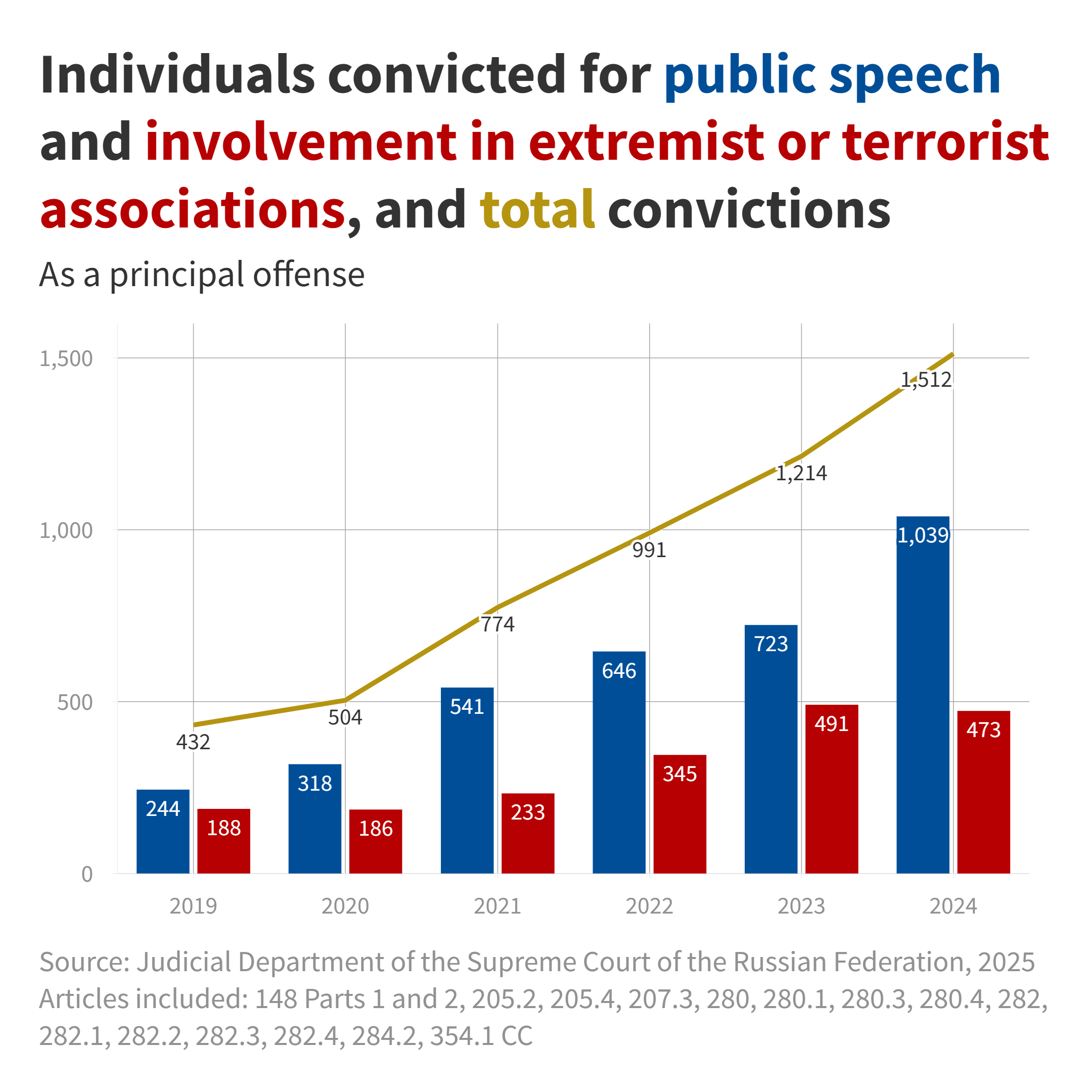
Our data is still significantly incomplete, so we cannot provide the exact number of people facing new charges for public statements or involvement in extremist and terrorist organizations. We can only assume that in 2025, the increase in convictions will be smaller than in 2024.
When summing up the new cases reported in 2024, they are distributed across the categories as follows:
| Act Category |
Number of Cases |
Number of Persons Involved |
| Ethnic Xenophobia |
112 |
132 |
| Religion |
74 |
143 |
| Against the Authorities |
117 |
127 |
| Pro-Ukrainian |
296 |
320 |
| Violation of traditional values |
79 |
90 |
| Other |
72 |
132 |
| Unknown |
2 |
4 |
|
Total |
743 |
937 |

It would be premature to conclude that, in 2024, the law enforcement system had reached a plateau in legal actions against prohibited public statements and participation in banned organizations. At the same time, it is evident that the growing incidence of terrorist acts and sabotage amid the ongoing armed conflict, together with the rise in hate crimes, has diverted law enforcement agencies from fully enforcing the system of societal control measures carefully developed over many years – namely, the Russian anti-extremist legislation.
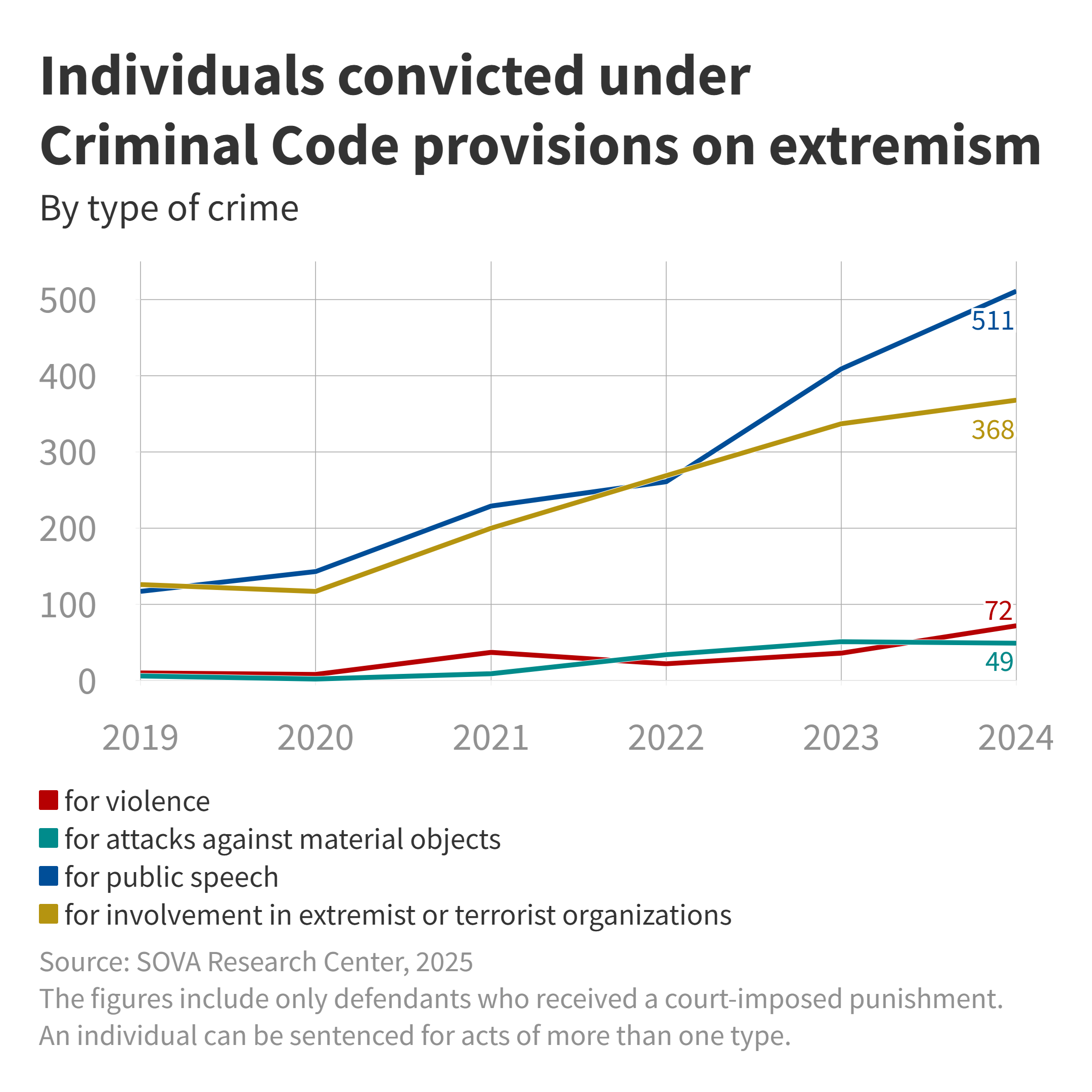
[*] The information presented in the report is based on the materials from “Russian Nationalism and Xenophobia” ( https://www.sova-center.ru/racism-xenophobia/) and “Misuse of Anti-Extremism” (https://www.sova-center.ru/misuse/) sections of the SOVA Center website. The operating principles of the sections are available at: “About the “Russian Nationalism and Xenophobia” Section. SOVA Center. 2022 (https://www.sova-center.ru/static-pages/racism-about/) and “About the “Misuse of Anti-Extremism” Section. SOVA Center. 2022 (https://www.sova-center.ru/static-pages/anti-about/).
[1] Murder, grave and moderate injury, torture and threat of murder: paragraph “k” of Article 105 Part 2; paragraph “f” of Part 2, Parts 3 and 4 of Article 111; paragraph “f” of Article 112 Part 2; paragraph “h” of Article 117 Part 2, paragraph “a” of Article 119 Part 2 CC.
[2] Established following the instructions of the Prosecutor General’s Office and the Ministry of Internal Affairs. See Lists No. 20 and No. 22 in: Instruction of the Prosecutor General’s Office of Russia No. 462/11 and the Ministry of Internal Affairs of Russia No. 2 of June 25, 2024 “On introducing lists of articles of the Criminal Code of the Russian Federation used for statistical reporting,“ Consultant (https://www.consultant.ru/document/cons_doc_LAW_483902/).
[3] A detailed review of the Strategy is presented on our website: The President approved a new Strategy for countering extremism // SOVA Center. 2024. December 28 (https://www.sova-center.ru/misuse/news/lawmaking/2024/12/d50858/).
[4] The Criminal Code also includes Article 2801 on calls to violate the territorial integrity of the Russian Federation. In 2024, only one sentence was issued under this article, about which no information is available. Accordingly, this report does not address prosecution under Article 280¹ separately.
[5] Summary statistical information on the state of criminal convictions in Russia for 2024, Judicial Department of the Supreme Court of the Russian Federation. 2025. April 17 (https://cdep.ru/index.php?id=79&item=8946).
[6] CC Article 208 on participation in an illegal armed formation, Article 2803 on6 repeated discrediting of the army, paragraph “c” of Article 2804 Part 2 on public calls for activities against state security made on the Internet, Article 282 on inciting hatred, Article 148 Part 1 on insulting the feelings of believers, Article 3541 on the “rehabilitation of Nazism,” Article 214 Part 2 on vandalism motivated by hatred, Article 329 on desecration of the state flag, Article 222 Part 1 on the illegal acquisition and storage of ammunition, etc.
[7] In addition to the articles listed in the preceding note (with the exception of Article 329), the charges also included Article 205 Part 1 with Article 30 Part 1 CC on preparation for a terrorist act, Article 275 on high treason, Article 2751 on cooperation with a foreign state, etc.
[8] Specifically, with Article 148 Part 1, Article 2055 Part 2, Article 2051 Part 1.1, and Article 3541 Part 4 CC.
[9] Article 2822 on involvement in an extremist organization, Articles 2073 and 2803 CC.
[10] In particular, under Articles 2803, 282, and 3541 CC.
[11] Article 2073, 2803, 2824, 214 and Article 208 Part 3 (participation in an illegal armed formation abroad) CC.
[12] The body of the article, that is, Article 2804 Part 1 CC, reads as follows: “public calls to carry out activities directed against the security of the Russian Federation, or to obstruct the exercise by government bodies and their officials of their mandate to ensure the security of the Russian Federation (in the absence of elements of offenses provided for in Articles 2052 , 280, 2801 , 2803 , 2842 and 354 CC).”
[13] On the application of Article 20.3 CAO, see: Kravchenko M., Yudina N. Sanctions for Administrative Offenses Related to Extremism in 2023–2024, SOVA Center. 2025. July 25 (https://www.sova-center.ru/en/misuse/reports-analyses/2025/07/d47113/).
[14] Including Articles 280, 2052, 2803, 2804 CC.
[15] Putin signed laws on partial decriminalization of Article 282 CC, SOVA Center. 2018. December 28 (https://www.sova-center.ru/misuse/news/lawmaking/2018/12/d40472/).
[16] For more information on the application of Article 20.3.1 CAO, see: Sanctions for Administrative Offenses Related to Extremism in 2023–2024, SOVA Center. 2025. July 25 (https://www.sova-center.ru/en/misuse/reports-analyses/2025/07/d47113/).
[17] Including Articles 354, 3541, 280, 214, 148 CC.
[18] It is worth noting that 19 individuals convicted under Parts 3 and 4 of Article 3541 CC were punished for acts that, in our opinion, can be regarded as vandalism, so we do not take their sentences into account when calculating the total number of people convicted for speech in 2024.
[19] In three cases, we categorized the actions of offenders convicted under Parts 1 and 2 of Article 148 CC as vandalism, so they are not included below in the overall count of 2024 cases on speech.
[20] Natalia Yudina. Neo-Nazis on the Rise: Hate Crimes and Countering Them in Russia in 2024, SOVA Center. 2025. February 28 (https://www.sova-center.ru/en/xenophobia/reports-analyses/2025/02/d47102/).
[21] Summary statistical information on the state of criminal convictions in Russia for 2021, Judicial Department of the Supreme Court of the Russian Federation. 2022. April (https://cdep.ru/index.php?id=79&item=6121).
[22] Mediazona reported 187 arson attacks organized by fraudsters since the beginning of the invasion, Mediazona, 2025. January 15 (https://zona.media/news/2025/01/15/burn).
[23] Database of politically motivated criminal prosecutions, OVD-Info. 2025. June (https://ovd.info/politpressing).
[24] Vandalism charges are not included in this chapter.
[25] For instance, we do not have sufficient information about the activities of Muslim groups that the authorities consider followers of Takfir wal-Hijra or about the activities of the Altai pagan movement Ak Jang.
[26] For more information on violent acts, see: Yudina N. Neo-Nazis on the Rise….
[27] The MKU network organization, created by neo-Nazi Yegor Krasnov in 2017, operated in Russia and Ukraine. Its supporters held racist and misanthropic views, recording videos of attacks on homeless people, drug addicts, and people of non-Slavic appearance, which they then shared with their comrades. Since 2021, dozens of far-right activists have been detained on suspicion of involvement in the MKU. On January 16, 2023, the Supreme Court of Russia recognized the movement as terrorist.
[28] For more information on “citizens of the USSR,” see: Akhmetyev Mikhail. Grazhdane bez SSSR. Soobshchestva «sovetskikh grazhdan» v sovremennoy Rossii [Citizens without the USSR. Communities of “Soviet citizens” in modern Russia], Moscow: SOVA Center, 2022.
[29] We believe that Jehovah's Witnesses face prosecution under criminal law, followed by severe sanctions, for peaceful religious activity that poses no danger to society. In our assessment, the ban on Jehovah’s Witnesses’ organizations lacks a legitimate legal basis and constitutes an act of religious discrimination. Accordingly, we regard all prosecutions of Jehovah’s Witnesses for participation in, or financing of, banned organizations as inappropriate.
[30] In 2008, following the unjustified bans on the writings of Said Nursi – a Kurdish religious scholar who adhered to a moderate interpretation of Islam – an alleged group of his followers, Nurcular, was declared extremist by the Supreme Court on the grounds that it promoted the superiority of Islam over other religions. However, Russian Muslims who studied Nursi’s teachings had never formed a unified organization, meaning that a non-existent association was effectively outlawed. As a result, authorities were able to charge Muslims who read and discussed Nursi’s works under Article 2822 of the Criminal Code. In 2018, the ECHR issued a ruling that, by banning Nursi's books, Russian courts violated Article 10 of the European Convention, which guarantees freedom of expression. However, the sanctions against Muslims who study this literature have continued.
[31] The Tablighi Jamaat movement was banned in Russia in 2009 – without, in our view, sufficient legal justification. While the movement engages in the propagation of fundamentalist Islamic beliefs, it has never been implicated in advocating violence. Accordingly, we consider sanctions against its adherents to be inappropriate. It is also noteworthy that the movement is not banned in Kyrgyzstan, where it remains highly popular, which explains the presence of its followers among Muslims entering Russia.
[32] Our position regarding the activities of Hizb ut-Tahrir is based, in particular, on the ECHR ruling, issued as an addendum to the decision based on the complaint of two convicted members of the organization against the actions of the Russian authorities. The European Court of Human Rights has stated that, although the teachings and practices of Hizb ut-Tahrir do not provide sufficient grounds to classify it as a terrorist organization and it does not explicitly advocate violence, a ban on other grounds could nevertheless be justified. Specifically, Hizb ut-Tahrir promotes the overthrow of certain existing political systems to establish a Sharia-based dictatorship, engages in anti-Semitic and radical anti-Israeli propaganda (leading to its ban in Germany in 2003 and in the United Kingdom in early 2024 following its support for the attack on Israel on October 7), categorically rejects democracy and human rights, and asserts the legitimacy of violence against states it considers aggressors against the “lands of Islam.” The objectives of Hizb ut-Tahrir are clearly incompatible with the values enshrined in the European Convention on Human Rights, particularly the commitment to the peaceful settlement of international conflicts, the inviolability of human life, and the recognition of civil and political rights and democratic governance. Activities undertaken to advance such objectives are therefore not protected under the Convention.
[33] We have no information on the penalty imposed on one convicted offender.
[34] Let us also remind you once again that our database does not contain data on law enforcement in the territories annexed to Russia in 2022–2024.
[35] On prosecution for dissemination of materials from the FLEM under Article 20.29 CAO (dissemination of extremist materials) in 2024, see: Kravchenko M., Yudina N. Sanctions for Administrative Offenses Related to Extremism in 2023–2024…
[36] For more details, see: Family Values. Anniversary of One Innovation in Russian Anti-Extremist Policy, SOVA Center. 2024. November 2 (https://www.sova-center.ru/misuse/publications/2024/11/d50612/).
[37] These are the Executive Committee of the Council of People’s Deputies of Krasnoyarsk Krai (No. 105), the Ethnic National Association (ENA, No. 106), and the LGBT International Public Movement (No. 107).
[38] The Free Nations of Post-Russia Forum and its divisions added to the list of terrorist organizations, SOVA Center. 2025. January 13 (https://www.sova-center.ru/racism-xenophobia/news/counteraction/2025/01/d50882/).
[39] The international movement Aum Shinrikyo was recognized as terrorist back in 2016. The Russian branch was banned after its head Mikhail Ustyantsev was convicted in 2020 and sentenced to 15 years in prison under Article 2054 Part 1 Article 2055 Part 1, and Article 239 Part 1 CC. He was charged with providing health services to citizens, specifically, yoga and qigong classes, supplying them with relevant religious items and literature, and collecting donations from them, which he sent to Aum Shinrikyo leaders in Japan.