Summary
Anti-extremism and related legislation in Russia have been aimed primarily at restricting freedom of speech and freedom of association in the name of security. The use of this legislation increased very rapidly in 2025. Contrary to expectations, no “plateauing” occurred. Instead, the growth rates accelerated in many respects, compared to the previous year. This applies to nearly all types of law enforcement examined in this report.
Although the authorities’ understanding of what may threaten state and public security has long been excessively broad, it expanded even further over the past year to include measures such as prohibiting even the search for information and pursuing a systemic campaign against Satanism.
Accordingly, we would like to point out a significant percentage of cases aimed at protecting security in a purely symbolic sense – against encroachments on patriotic symbols, religious feelings, and so on.
As expected, a substantial portion of law enforcement activity is connected in one way or another to the ongoing armed conflict with Ukraine; however, such cases still account for less than half of all cases involving public expression and an even smaller share of those involving organized activity, and this share is gradually decreasing. At the same time, sanctions in this category are noticeably harsher.
A significant percentage of cases that pertained to public speech involved countering ethnic xenophobia. A substantial percentage of cases involving organized activity pertained to individuals associated with various religious and religious-political organizations. To some extent, such cases resulted in clearly excessive or debatably harsh restrictions on civil liberties; however, many of them, undeniably, stemmed from the need to protect society from the spread of ethnic or religious hatred and the preparation of related acts of violence.
Most law enforcement cases under review have been targeting individuals who oppose the authorities – some through peaceful, albeit harsh, criticism, and others through calls for the overthrow of the authorities or actions directly aimed at achieving that goal. The share of the latter has surpassed that of the former and is growing rapidly.
Overall, the law enforcement practice shows an increasing share of the most serious articles of the Criminal Code (CC), such as Article 2052 and Article 2055. In addition, the ratio between the number of criminal convictions issued by courts and the decisions imposing administrative sanctions has, for the first time in many years, begun to shift in favor of the former.
Table of Contents
Introduction
The purpose of this report is to analyze the changes observed in 2025 in state policy concerning politicized law enforcement, focusing only on the segment within SOVA Center’s scope.
Politicized law enforcement should be understood as the application of legal norms that are predominantly or entirely used for political purposes, that is, to achieve the political objectives of the authorities and/or to punish certain actions motivated by political or ideological considerations.[1]
Only some of these norms have been explicitly designed to impose clearly excessive restrictions on civil rights and freedoms and thus contradict the Constitution and recognized norms of international human rights law. Most of them, however, have been designed as legitimate protection against attacks by groups and individuals on the security of the state and society, but often applied improperly or against actions of minor social danger that are too insignificant to warrant prosecution. Thus, politicized law enforcement is not synonymous with political repression; unlike the latter, its appropriateness might vary.
SOVA’s primary focus is anti-extremism legislation and its application, since this body of law was, by its nature, constructed specifically as a universal mechanism of politicized law enforcement. However, it has not become fully universal. SOVA also includes in its analysis certain closely related legal provisions – on “rehabilitating Nazism,” “justifying terrorism,” and so forth. However, we do not analyze other provisions, including those related to treason, “undesirable organizations,” and the like, for various reasons. The specific legal norms examined in this report are listed in the relevant chapters below.
In general, SOVA’s monitoring, presented in this report, adheres to two self-imposed thematic limitations. The first one stems from our limited resources. We have currently chosen either not to study certain forms of politicized law enforcement at all, relying on the work of other organizations (as in the case of provisions on “undesirable organizations” and “foreign agents”), or forego their detailed analysis (this applies to the article of the Code of Administrative Offenses (CAO) on prohibited symbols, the most widely used politicized administrative norm).
The second self-imposed limitation concerns the law enforcement primarily connected with the ongoing armed conflict with Ukraine, which would be difficult to analyze from the perspective of constitutional law enforcement constraints developed for peacetime. For these reasons, we do not analyze law enforcement practices in the territories that came under Russian jurisdiction in 2022–2025.
Taking all of the above into account, this report focuses on two major themes: (1) politicized sanctions (both criminal and administrative) for public speech, and (2) sanctions for the creation of associations that the state regards as extremist or terrorist, or for participation in them. Another major area of SOVA’s monitoring – sanctions for hate crimes, whether against individuals or material objects – has been analyzed in a separate report.[2]
The purpose of this report is to analyze relevant law enforcement in 2025 and identify any significant changes compared to 2024 and previous years. Rather than discussing all observable quantitative correlations, we focus only on those we consider significant.
The monitoring and analytical methodology used by SOVA was described in sufficient detail in two reports published last year,[3] so we will try to avoid repetition here. We collect information on court decisions and new cases under a number of articles of the CC and the CAO (see below for more details), when such information is available, and its availability varies for different legal provisions. We systematize this information using several parameters, two of which are not purely factual but evaluative and thus require clarification.
The first parameter pertains to the act’s focus. For this purpose, we introduce the following categories for a statement or an association’s activity:
ethnic xenophobia;
religion;
events in Ukraine;
other criticism of the authorities or their supporters;
attacking “traditional values.”
Naturally, in some cases, an act does not fit into these categories, or it is described by more than one category, or we do not have sufficient information to assign a category. Therefore, the totals of the category-based data presented in the report do not match the overall figures, such as the total number of individuals sentenced under a given provision.
The second evaluative parameter reflects the extent to which we consider the charges appropriate. For this purpose, we use the following classification:
“Yes” – if we view the act as related to xenophobia and the sanctions imposed as generally justified;
“No” – if we believe that the prosecution excessively restricted civil rights, that is, was inappropriate, according to our terminology;
“Other” – if the prosecution could have been appropriate but was unrelated to countering xenophobia;
“Not sure” – if we cannot choose between the above values for any reason;
“Do not know” – if we lack adequate data for making our assessment.
It is often the case that we assess different charges within a single case differently. Therefore, the data on appropriateness likewise do not sum to the total number of convicted individuals.
The data we collect on criminal convictions is available in our public database,[4] although not in full detail. We also use our internal databases on the application of articles of the CAO and new criminal cases, data from the OVD-Info human rights media project, statistical data from the Judicial Department of the Supreme Court of Russia (SC),[5] and other sources.
All data in the report is presented as of April 1, 2026.
Each of the above data sets has its own limitations. The data of the Judicial Department of the Supreme Court does not indicate to what extent and which CC articles are combined within sentences, which can significantly distort the overall picture. The data we have on convictions is substantially incomplete; therefore, qualitative analysis (for example, on the relative percentages of different case categories or varying degrees of appropriateness) can only be approximate. This is even more true for the information on new cases. Meanwhile, the data on decisions under CAO articles is available with a high degree of completeness and accuracy.
At the time of preparing this report, official data from the Judicial Department of the Supreme Court for 2025 had not yet been released; only the data for the first half of the year was available. Simply doubling the half-year figures to estimate the full year would be too inaccurate. In our experience of comparing first and second half-year data across various articles of the CC, typically, somewhat more convictions are issued in the second half. The degree to which second-half figures exceed those of the first half varies by article and, of course, changes from year to year. Therefore, for a conservative estimate of the annual number of convicted individuals in 2025 for each article of the CC, we used the minimum of the excess observed in 2023, 2024, and the average excess for 2022–2024.[6] As for the number of rulings imposing sanctions under CAO articles for 2025, we relied on data collected by OVD-Info: based on the experience of recent years, for the articles of interest to us, these figures closely match the final official data.
Regulation of Public Speech
As before, the application of counterterrorism, anti-extremism and related provisions of the Criminal Code to public speech significantly exceeds their use in cases involving organizational activity. At the same time, enforcement of CAO provisions related to more or less ideologized speech is also expanding.
In this section, we will review the use of the following legal norms:
- Article 148 Parts 1 and 2 CC (insulting the religious feelings of believers) and Article 5.26 Part 2 CAO (intentional public desecration of objects of religious veneration);
Article 2052 CC (public calls for terrorism, justification of terrorism, or propaganda of terrorism);
Article 2073 Part 2 paragraph “е” CC (dissemination of knowingly false information about the use of the armed forces and the activities of state bodies abroad, motivated by hatred);[7]
Article 280 CC (public calls for extremist activity);
Article 2801 CC (public calls to carry out actions aimed at violating the territorial integrity of the Russian Federation), as well as the corresponding Article 20.3.2 CAO;
Article 2803 CC (discrediting the use of the armed forces of Russia and the exercise by state bodies of their powers abroad), as well as the corresponding Article 20.3.3 CAO;
Article 2804 CC (public calls to carry out activities directed against the security of the state);
Article 282 CC (incitement of hatred or enmity, as well as the humiliation of human dignity), as well as the corresponding Article 20.3.1 CAO;
Article 2824 CC (repeated display of prohibited symbols), as well as the corresponding Article 20.3 CAO;[8]
Article 3541 CC (“rehabilitation of Nazism”) and Article 13.48 CAO (equating the goals, actions, and decisions of the USSR and Nazi Germany);
Article 20.29 CAO (mass distribution of extremist materials) and Article 13.53 CAO (searching for knowingly extremist materials and gaining access to them).
We do not include other legal norms related to public speech.[9] You can find more detailed information on the articles that fall within the scope of the SOVA Center’s monitoring and the principles guiding their selection on our website.
Calls for Terrorism, Justification and Propaganda of Terrorism
We know of 271 court decisions against 285 individuals in cases involving charges of calls for terrorism, its justification, or propaganda (Article 2052 CC). Four individuals were referred for compulsory psychiatric treatment, one was released from punishment due to illness, and the rest were sentenced. In 2024, we recorded 144 decisions against 149 individuals (two of them were referred for treatment, one was released due to illness).
Thus, the number of convictions known to us under this article almost doubled in 2025. This may not be fully accurate. However, even under the most conservative estimate, no fewer than 580 individuals were sentenced under Article 2052 CC in 2025, compared to 453 the previous year. This figure may end up being even higher in the final statistics of the Judicial Department of the Supreme Court of Russia. According to data from the Ministry of Internal Affairs, the number of recorded crimes under Article 2052 CC related to online activity also increased by over 50%, and the number of solved crimes in this category increased by 90%.[10]
According to data from the Judicial Department of the Supreme Court for recent years and for the first half of 2025, in cases where Article 2052 CC is the primary charge, the majority of defendants still face fines rather than imprisonment. The SOVA Center database includes many cases in which more serious charges were also present; therefore, it shows a significantly higher percentage of custodial sentences than the SC data: 73% of cases in 2025, and 64% of the cases in 2024. However, the SC data for the first half of 2025 also shows a drop in the percentage of fines.[11]
The overwhelming majority – 248 individuals, or 87% – were charged in connection with statements made on the Internet (primarily under Article 2052 Part 2); the cases of 17 individuals involve statements made both online and offline, and 19 individuals made only offline statements. A year earlier, the percentage of online statements was somewhat lower at 79%.
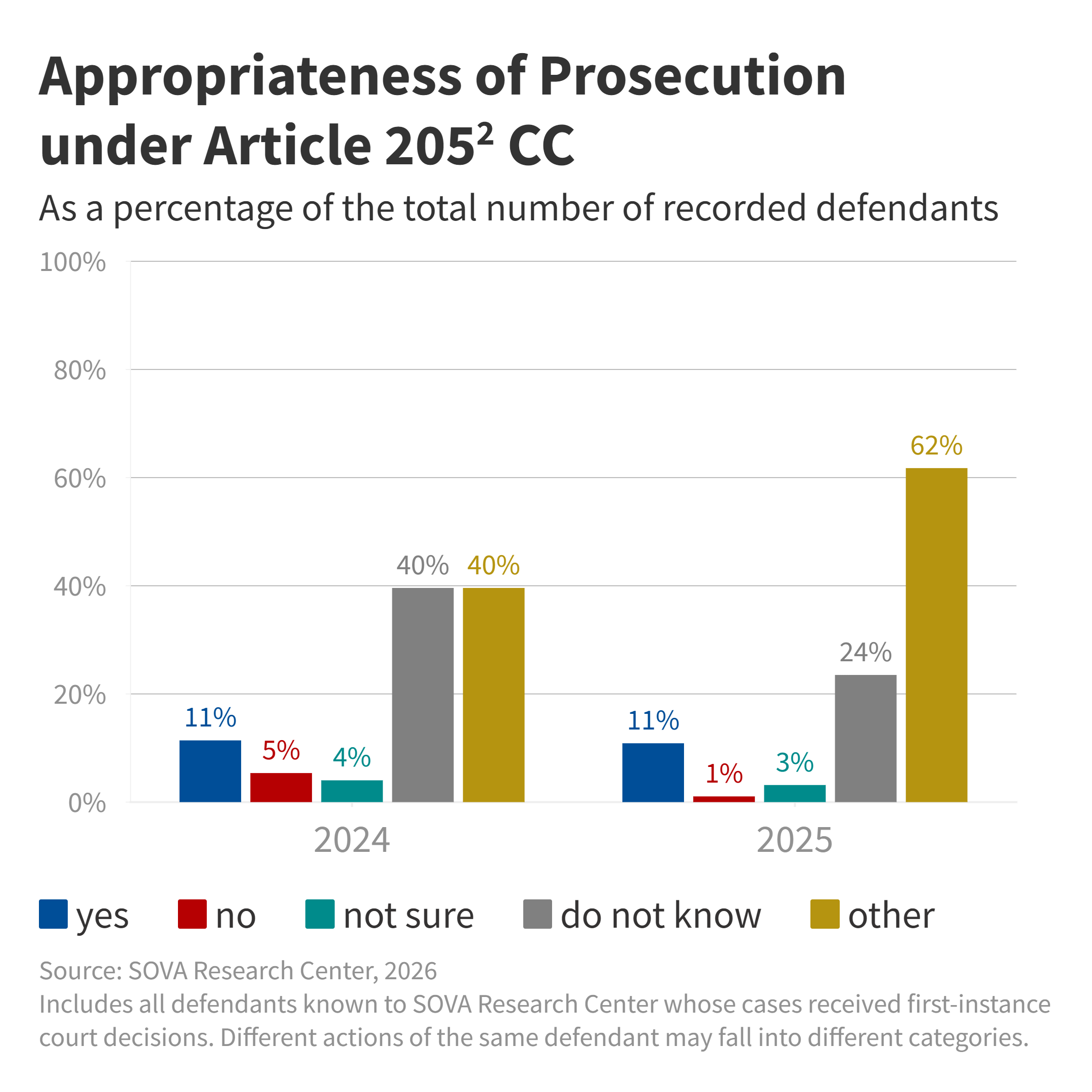
Examining court decisions under Article 2052 CC by category, we observed a stable percentage of approximately 55% facing charges for statements related to the armed conflict with Ukraine (155 defendants in 2025 vs. 82 in 2024). The majority of such verdicts pertained to publications approving actions and disseminating propaganda materials of various Ukrainian organizations recognized as terrorist in Russia – primarily the Freedom of Russia Legion (Legion “Svoboda Rossii,” LSR) and the Russian Volunteer Corps (Russkiy dobrovolcheskiy korpus, RDK), and, less frequently, Azov. Another group of verdicts in this category is associated with approving the bombing of the Crimean Bridge, drone or missile attacks on Russian territory, attacks on military enlistment offices, assassination attempts against high-ranking military officials, and so on. Many of these sentences also involve charges under other articles of the CC.[12]
Verdicts to 58 individuals (20%) pertained to other statements directed against the authorities (18 of the defendants were also sentenced under Article 280 Part 2 CC). These were mainly comments that approved using violence against the president, deputies, governors, and other public officials. In 2024, this category accounted for 26% of charges.
In 9% of cases, the charges involved religious xenophobia (in most cases, support for the terrorist Islamic State); a year earlier, this category accounted for 12%. In 5% of cases, the charges under Article 2052 CC were related to ethnic xenophobia (vs. 3% in the preceding year).
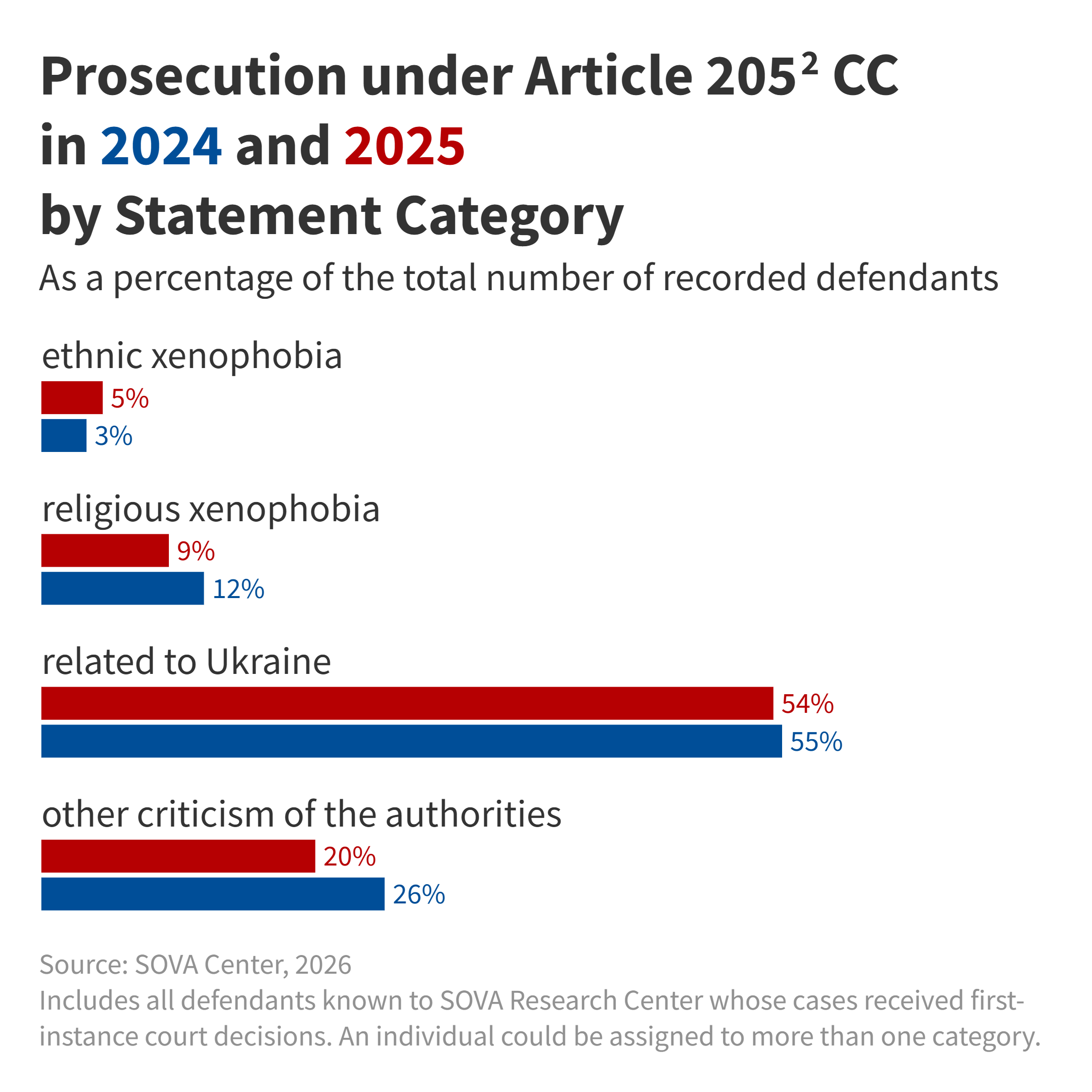
Assessing the appropriateness of prosecutions under Article 2052 of the Criminal Code continues to present difficulties, particularly because in many cases we do not know even the approximate content of the incriminating statements. However, revised data for 2024 shows that 40% of convicted individuals in our database fell into the “do not know” and “other” categories, whereas in 2025, the “other” category became predominant (reaching as much as 62%), while “do not know” accounted for only 24%. This shift is due to the increase in the number of the above-mentioned convictions for approving comments about the Freedom of Russia Legion and the Russian Volunteer Corps, for which we know the approximate – and sometimes exact – content.
We identified fewer clearly inappropriate sentences than in the previous year – only three defendants (1%) vs. eight (5%) in 2024. One of these decisions was a conviction in absentia of human rights defender Sergei Davidis for sharing an assessment of the sentence imposed on captured fighters of the Azov regiment (recognized as a terrorist organization in Russia) issued by the “Support for Political Prisoners. Memorial” project. Politician Sergei Udaltsov was convicted for his publications about the criminal prosecution of five Marxists from Ufa on terrorism-related charges, which he considered unfounded. Finally, we classified as definitely inappropriate the verdict against Yevgeniya Rogozina, a resident of Udmurtia, for her comment suggesting to “burn the witch” under a post featuring a statement by the Russian Minister of Agriculture.
We know of 233 suspects in cases initiated in 2025 under Article 2052 CC. At least 138 of these cases are related to Ukraine, 37 involve other statements directed against the authorities, 14 – religious xenophobia, and five – ethnic xenophobia.
We believe that charges under Article 2052 CC are inappropriate in at least seven cases. These include the cases of Aruna Arna and Vasilya Vershinina, supporters of Svetlana Lada-Rus (Peunova), who faced charges for their vague calls to struggle against injustice; publicist Anatoly Nesmiyan, who, in our opinion, did not justify terrorist acts but merely commented on their causes and consequences; and rap enthusiast Bogdan Portnenko, who had posted a provocative music video on his social media page while still a minor.
Calls for Extremist Activity
According to our records, Article 280 CC appeared in 187 verdicts against 191 individuals in 2025; of these, 188 individuals faced charges under Article 280 Part 2 (for statements made online) and only three under Part 1 (offline).
A year earlier, our database showed only 94 convictions against 100 individuals; thus, based solely on our data, the number of convictions under Article 280 CC has increased drastically, almost doubling in 2025. However, calculations based on the Supreme Court data for the first half of the year indicate that the number is not increasing and may even decline by the end of the year (from more than 300 to approximately 280). If this is indeed the case, a possible explanation is the sharp increase in our awareness of convictions under Article 280 of the Criminal Code. At the same time, according to the Ministry of Internal Affairs, the number of recorded crimes under Article 280 CC committed online increased by 58% in 2025, and the number of crimes solved increased by 64%.[13]
Our data shows an increase in the percentage of those sentenced to imprisonment under this article. Of the 188 convicted offenders, 46% received custodial sentences, while only 32% received suspended sentences. A year earlier, based on the cases we recorded, 36% of convicted defendants were sentenced to imprisonment, compared to 45% who received suspended sentences. The increase in the percentage of custodial sentences is explained by the fact that the majority of defendants faced charges not only under Article 280 CC, but also under other articles; notably, as many as 25% of convicted offenders were charged simultaneously under Articles 280 and 2052 CC.
Approximately 39% of defendants charged under Article 280 CC were prosecuted for expressing ethnic xenophobia, most often directed against Jews, people from Central Asia and the Caucasus, Russians, and Roma (vs. 36% in 2024). 25% of cases involved harsh statements related to the conflict in Ukraine (vs. 22% the previous year); 22% were related to other calls for action directed against the authorities (vs. 28% in 2024); and 5% involved religious hatred (vs. 7% the previous year).
In most cases, we found no grounds to consider convictions under Article 280 CC inappropriate. We classified only one such verdict as inappropriate – to Anton Zhukov from Saratov Region, who, in 2021, posted a comment stating that the State Duma and the Kremlin should be “burned down” because the authorities were not lifting coronavirus restrictions. We believe that his comment was worded in such a way that it can hardly be interpreted as a genuine call for arson; moreover, since most coronavirus restrictions have been lifted, its potential public danger has further diminished.
We know of at least 147 cases against 153 individuals that were initiated in 2025 and involved charges under Article 280 CC. At least 49 of these are related to expressing ethnic xenophobia, 38 to pro-Ukrainian statements, 34 to other calls directed against the authorities, and six to expressing religious xenophobia. The charges we classified as inappropriate include the case of blogger Tatyana Montyan, who, during one of her YouTube streams, agreed with a viewer that it was necessary to “wipe out the security thugs [loyalists] without any regrets.” We view this statement as an endorsement of harsh criticism of her political opponents, rather than a call to violence.
Calls for Separatism
For several consecutive years, we have had no information about convictions under Article 2801 CC for public calls to carry out actions aimed at violating the territorial integrity of the Russian Federation, if such calls were made within one year after the corresponding administrative liability. It is quite possible that no verdicts were issued under this article in 2025 (according to the Supreme Court, there was one verdict in 2024).
We are aware of 16 rulings under the corresponding Article 20.3.2 CAO, which is two fewer than in 2024. Thirteen cases were related to statements made online, and three to offline statements. Fifteen individuals faced sanctions, and one case was dismissed by the cassation court. We consider 11 of the 16 instances of prosecution clearly inappropriate.
The majority of cases were based on statements about the status of Crimea. Several also involved the “liberation of the Caucasus,” the creation of an independent Circassia, armed struggle for a “Smolensk Republic,” the restoration of the USSR, and even the Ural Federal District joining the United States (the latter proposal was, of course, merely a joke). Pavel Andreev, a co-founder of the media outlet 7x7 – Horizontal Russia, faced sanctions for his post about the designation of the Free Nations of PostRussia Forum (Forum Svobodnykh Gosudarstv PostRossii) as a terrorist organization. The post was accompanied by a “Free Nations of PostRussia map.”
Calls for Actions Threatening State Security
The scale of application of Article 2804 CC (public calls to carry out activities directed against the security of the state) has been gradually increasing. (This provision was introduced in 2022 and slightly expanded in 2024; in particular, Part 2 was supplemented with the qualifying element of committing the offense motivated by hatred.)
According to the Supreme Court data, 18 individuals were sentenced under this article in 2024 and 15 in the first half of 2025. At this growth rate, the total number of convicted individuals for the year may exceed 50.
Our database includes 29 court decisions against 31 individuals issued in 2025. Thirty defendants were sentenced, and one was released from punishment due to illness. A year earlier, we were aware of 14 cases against 14 defendants.
The cases of 14 individuals convicted in 2025 under this article also involved charges under Article 2052 CC, including four cases with charges under both Articles 2052 and 280 CC, and six cases under other articles, frequently more serious ones. Thus, in more than half of the cases, Article 2804 CC was not the primary charge.
Out of the 30 individuals sentenced under this article, 26 received prison sentences (87%); however, only 12 of them were convicted solely under Article 2804.
We recorded no convictions under Article 2804 Part 1. Three individuals were sentenced under Part 3 (committing the offense by an organized group). Twenty-eight known convicted individuals were found guilty under paragraph “c” of Article 2804 Part 2, that is, for actions carried out on the Internet; in eight cases, these charges were combined with paragraph “e” (hate-motivated), and in one, with paragraph “b” (use of official position).
This latter case also represents the only verdict under Article 2804 CC that we view as clearly inappropriate – to pastor Nikolai Romanyuk, who was prosecuted for an anti-war sermon.
We are aware of 22 cases initiated in 2025 against 25 individuals, which include Article 2804 CC. The verdicts in at least two of them were issued in the same year, and three more resulted in verdicts in 2026.
Charges under Article 2804 CC are associated almost exclusively with the Ukrainian conflict, both for the 2025 verdicts and for the newly opened cases. This article is used to prosecute calls for treason (including the financing of Ukraine’s armed forces), calls to defect to the enemy’s side, to commit acts of sabotage, or for military personnel to stage a mutiny.
Display of Prohibited Symbols
The application of Article 2824 CC on the repeated display of prohibited symbols grew at an impressive rate in 2025. This growth is entirely logical given that, under the corresponding Article 20.3 CAO, courts sanctioned more than 4,200 individuals for a first such violation in 2023, more than 4,700 in 2024,[14] and no fewer than 4,900 in 2025.[15]
According to data provided by the Judicial Department of the Supreme Court, 96 individuals were sentenced under Article 2824 CC only in the first half of 2025; at the same growth rate, their number may reach around 230 or even more by the end of the year. In the preceding year, 131 individuals were convicted.
We were able to analyze information on 157 individual court decisions issued in 2025 under Article 2824 CC. One conviction for disseminating prohibited paraphernalia was issued under Part 2 of this article; the rest were under Part 1.
In 79 convictions, or 50%, the charges pertained only to the display of symbols of the AUE criminal subculture, recognized as an extremist organization.[16] At least seven more individuals were convicted for demonstrating such symbols alongside Nazi symbols; thus, the share of convictions related to the display of AUE symbols reaches 55%.
The overwhelming majority of these charges were based on public displays of tattoos bearing such symbols. Such displays most often occurred in places of detention. In some cases, people were convicted for displaying photographs of such tattoos or simply images featuring AUE symbols on social media.
Fifty-nine individuals, that is, 38%, were convicted for displaying Nazi or neo-Nazi symbols. Notably, only 12 of them were punished for online activities, one for displaying symbols both online and offline, and 46 individuals for offline display only. According to our data from previous years, liability under Article 20.3 of the CAO is imposed more frequently for online publications, with only a quarter to a third of all rulings involving offline statements.
A number of cases were based on tattoos of swastikas made while in custody. Some verdicts cite the defendants’ testimonies indicating that they got such tattoos as part of “negation” (otritsalovo), i.e., their consistent defiance of the prison administration. Several inmates demonstrated these tattoos in penal colonies or pre-trial detention centers, while several former inmates did so on the street, in shops, communal apartments, or dormitories.
However, around two dozen convictions are associated with the deliberate propaganda of far-right ideologies. Individuals punished under Article 2824 CC for neo-Nazi tattoos included, among others, Konstantin Tyrin, who had previously served a sentence for two murders motivated by ethnic hatred; Arseniy Lysenko, convicted for a hate-motivated attack; and bodybuilder Konstantin Bryukhanov. Alexander Smetanin, a resident of Krasnoyarsk Krai, received two convictions under Article 2824 CC in 2025: one for painting swastikas on a boat and a car, and the other for wearing a ring decorated with swastikas.
In addition to the swastika, such cases can include other symbols such as the “Black Sun,” popular among neo-Nazis as a tattoo on the elbow, the Totenkopf (“death’s head”), the SS runic logo, and brass knuckles with spikes and a laurel wreath (considered a symbol of the neo-Nazi network NS/WP, recognized as a terrorist organization).
Separately, we note the conviction of Ukrainian national Alexander Korol, who had served in Azov (recognized as a terrorist organization) and was convicted on charges of shooting up of a car with civilians in Mariupol. His sentence was extended for a tattoo featuring a swastika and an SS symbol.
Nine convictions were related to Ukraine. Three cases involved symbols of the prohibited Azov, the LSR, and/or the RDK. In one case, the defendant faced sanctions for a tattoo combining the swastika and the trident, which is considered a symbol of several modern Ukrainian organizations banned in Russia, as well as of some of the World War II collaborationist groups.
Two verdicts – against Konstantin Ledkov (also charged under other articles) and Stepan Tronin – were related to the slogan “Glory to Ukraine!” interpreted as the official greeting of the same organizations.
Two cases were based on the display of Nazi symbols intended as criticism of the policies of the Russian authorities. Vladimir Efimov, leader of the Kamchatka branch of the Yabloko party, was convicted for using a scene from the anti-fascist film Cabaret as commentary on the work of the singer Shaman. Irina Kostrova, a follower of the “Citizens of the USSR” movement, faced sanctions for publishing a historical photograph of a German soldier standing on a tank bearing a visible “V” symbol on its turret (one of the symbols associated with the actions of the Russian armed forces in Ukraine).
We identified five convictions as primarily related to criticism of the authorities in other contexts. Four of them targeted “Citizens of the USSR” for using their own symbols[17] and for comparing Russian symbols to Nazi ones. In one case – that of Alina Khodzhieva – the prohibited symbols included not only Nazi imagery in a photograph featuring Hitler, but also a photograph of Alexei Navalny, interpreted as the symbol of the banned Anti-Corruption Foundation (Fond borby s korruptsiyey, FBK) or Navalny Headquarters.
One individual was, in fact, punished for using the swastika solely within the framework of a historical discussion. Vasily Chebykin faced sanctions for publishing a video with a swastika on its cover image. However, the video itself addressed the scale of crimes committed by Soviet soldiers in Germany, which, in the author’s view, has been exaggerated in Western historiography – that is, it was not aimed in any way at the propaganda or justification of Nazism.
Finally, one case was entirely non-political. A practice of prosecutions under Article 20.3 CAO for black-and-white images of pit bulls popular among car enthusiasts, which has become widespread in Dagestan, led to at least one conviction under Article 2824 CC. Nazir Aldanov was convicted for his failure to delete such an image from his social media profile.[18]
As for the sanctions imposed, if we exclude cases involving exclusively AUE symbols, imprisonment under Article 2824 CC was imposed in at least 40% of cases in 2025. Nine individuals (29%) were sentenced to imprisonment without special circumstances justifying such a sentence.[19] In the remaining cases, the individuals were either inmates of penal institutions or had prior convictions.
Courts imposed suspended prison sentences in 18% of cases, and community service equally often. Corrective labor was imposed in 10% of convictions, compulsory labor in 8%, and a fine in one case. The distribution of types of punishment was broadly similar in the convictions known to us for 2024.
Reviewing the appropriateness of all charges brought under Article 2824 CC in 2025,[20] we classified 57% as “other” (primarily cases involving AUE symbols). We view 37% as, at least to some extent, appropriate. We consider nearly 8% (12 convictions) inappropriate, and we are not sure about 2% (three convictions). This differs from the situation in 2024, when more than half of convictions were classified as appropriate, one third as “other,” and only two convictions fell into the “inappropriate” or “not sure” categories.[21]
We are aware of at least 57 cases initiated under Article 2824 CC in 2025 (excluding cases involving AUE symbols). At least 32 of these have already resulted in convictions.
We did not track the application of Article 20.3 CAO in detail in 2025.[22] We know that, in addition to the contexts mentioned above, cases under Article 20.3 of the CAO involved symbols associated with the FBK (not limited to portraits of Navalny), the banned movements “Vesna” and “I/We Furgal,” the National Bolshevik Party (NBP), various Islamist organizations, the logos of Facebook and Instagram, neo-pagan symbols, LGBTQ symbols, and others. After the “International Satanist movement” was recognized as an extremist organization in July 2025, courts considered around two dozen cases involving the display of satanism symbols and the circulation of related paraphernalia.[23]
Dissemination of Knowingly False Information about the Use of the Armed Forces and the Activities of State Bodies Abroad
SOVA Center monitors and enters into its database only the application of paragraph “e” of Article 2073 Part 2 CC (dissemination of false information about the activities of the armed forces and state bodies motivated by hatred).[24]
In 2025, we became aware of 71 court decisions concerning 77 individuals; two of them were referred for compulsory treatment, and the rest faced punishment. For 2024, we recorded 84 defendants, two of whom were also referred for treatment.
Our information is incomplete, so it would be premature to speak of a reduction in the scale of application for this article. Nevertheless, based on our monitoring data, we observe no increase. Data from the Judicial Department of the Supreme Court, however, may show an increase to as many as 130 convictions in 2025. At the same time, for the entire 2024, the Supreme Court recorded only 70 convicted individuals – significantly fewer than we did. The discrepancy may be due to the uneven distribution of convictions under this article across the two halves of the year, as well as to the fact that the Judicial Department records decisions under the date they enter into force, whereas we record them under the date the verdict was issued.
At least 85% of known sentences involved imprisonment (vs. 93% the previous year); in one case, compulsory labor was imposed, and in one case, a suspended prison sentence.
Judgments in absentia were issued in at least 42% of cases. A year earlier, the share of in absentia convictions was even higher and approached 50%. Most often, such defendants are politicians, journalists, and activists who have left the country, as well as Ukrainian political figures and journalists.
In at least 58 cases, the charges were based on statements made on the Internet. Seven individuals were prosecuted for statements made offline, and five for statements made both online and offline.
In some cases, convictions were issued not only under paragraph “e,” but also under other paragraphs of Article 2073 Part 2 CC. Some defendants were charged simultaneously under several different articles of the CC.[25]
In 2025, according to the information available to us, at least 69 individuals became suspects in new cases under paragraph “e” of Article 2073 Part 2 CC; in 16 of these cases, convictions were issued in the same year.
“Discrediting the Army”
We are aware of 61 court decisions issued in 2025 under Article 2803 CC on discrediting the use of the armed forces of Russia or the activities of state bodies abroad.[26] 54 defendants were sentenced, six were released from punishment due to the expiration of the statute of limitations, and one was referred for compulsory treatment. These figures are lower than in 2024, when we were able to analyze 79 decisions against 82 individuals, 75 of whom faced sanctions.
The data from the Judicial Department of the Supreme Court, however, indicates that 39 individuals were sentenced under this norm in the first half of the year alone. For the full year, according to our estimates, the number may reach around 90. In 2024, the Supreme Court statistics recorded only 68 convicted individuals. Similarly to Article 2073 CC, the discrepancy between our monitoring data and that of the Judicial Department may be related to the above-mentioned difference in methodology – using the date of entry into force vs. the date of the verdict. It is also possible, however, that the Supreme Court’s final data for the year will be lower than our estimate.
The likely trend toward a reduction in the scale of application of Article 2803 CC is also consistent with the dynamics for Article 20.3.3 CAO, which provides for sanctions against individuals before they become criminally liable under Article 2803 Part 1 CC. Each year, the number of people punished under this CAO article has decreased. In its first year, it was applied to more than 4,400 individuals, but in 2025, sanctions under it were imposed approximately 1,300 times.[27]
The recent expansion of the aggravated provision of Article 2803 Part 2 CC, which stipulates liability after the first violation rather than after prior administrative charges,[28] is unlikely to significantly alter the situation. Notably, we are not aware of any convictions issued in 2025 under Part 2 of this article, whereas at least eight individuals were sentenced under it in the previous year.
The structure of sanctions imposed under Article 2803 CC has changed. Whereas in 2024, the most common punishment in the cases known to us was a fine (41%), it was imposed in only 9% of the cases known to us in 2025.
Thus, imprisonment ranked first among punishments, although its percentage did not change: 39% of those convicted were sentenced to imprisonment in both 2024 and 2025. In more than half of these 2025 cases, Article 2803 CC was the only charge.
30% of defendants received a suspended sentence (vs. only 13% in 2024). Another 5% were sentenced to compulsory labor (6% the previous year).
In 50 cases, the charges were based on statements made online; four involved both online and offline speech; and four more cases were based on offline statements only.
According to our data, cases under Article 2803 CC in connection with public speech were opened against at least 37 individuals in 2025.
Incitement of Hatred
The most well-known, though not the most frequently applied, “anti-extremism” provision is Article 282 CC, which criminalizes incitement of hatred or enmity, as well as the humiliation of human dignity. It is worth reminding that this provision underwent a “partial decriminalization” in 2018. The offense became punishable under Article 20.3.1 CAO, and only repeated violations within one year fell under Article 282 Part 1 CC. The change did not pertain to acts specified in Article 282 Part 2 CC – those involving calls for violence and committed by an organized group or with the use of an official position. In the summer of 2025, however, Article 282 CC was amended in the opposite direction. A prior conviction under Article 282 or under Articles 280 or 2824 CC now provides sufficient grounds for criminal liability. More importantly, criminal liability now also arises immediately for acts “involving the justification or propaganda of the use of violence or the threat of its use.” In addition, acts committed by any group of persons without prior conspiracy are now punishable under Part 2.[29]
In 2025, our monitoring identified 44 court decisions against 54 individuals under Article 282 CC; the charges were based on speech in 40 cases against 50 individuals.[30] Our data for 2024 is very similar: 40 decisions against 54 individuals, including 38 speech-related charges against 50 individuals. However, according to data from the Judicial Department of the Supreme Court, 55 individuals were found guilty under this article in 2024, while 47 were convicted only in the first half of 2025. We estimate that the total number of convictions for the year may exceed 90.
We know of 12 individuals sentenced under Article 282 Part 1 in its version that was in force before mid-year. We have not recorded any convictions under the updated version, which is divided into two paragraphs. 31 individuals were sentenced under Article 282 Part 2 paragraph “a” (acts involving the threat of violence) and 12 under paragraph “c” (acts committed by an organized group). Once again, this is very close to the 2024 data (13 individuals under Part 1, 29 under paragraph “a” of Part 2, 1 under paragraph “b”, and 12 under paragraph “c”).
No significant changes are evident in sentencing practices under this article. Of the 51 individuals sentenced by courts (three others were referred for compulsory treatment), 67% were sentenced to imprisonment. However, for half of these individuals, the judgment also included other charges, often more serious. Nearly 20% received suspended prison sentences. A similar pattern was observed in 2024: 71% were sentenced to imprisonment, 18% to suspended sentences.
Among those convicted specifically for speech, the overwhelming majority – 43 individuals – were sentenced under Article 282 CC for online publications.
For the majority (56%), the charges under Article 282 CC were related to the propaganda of ethnic xenophobia; a year earlier, only 20% of charges fell into this category. According to our data, most defendants faced charges for statements directed against migrants from Central Asia and the North Caucasus, as well as migrants in general. The statements pertained to ethnic Russians in at least seven cases (vs. the overwhelming majority of cases in 2024) and to Jews in six cases (only one case a year earlier).
24% (the same as the previous year) were convicted for speech related to the conflict in Ukraine. Their statements were primarily directed against citizens of Russia in general, supporters of the “special military operation,” or Russian military personnel. This number includes convictions in absentia of Ukrainian and Russian politicians and public figures. Three decisions in this category may be considered clearly inappropriate: the verdicts against streamer Alexander Sokolovsky and activist Andrei Slotin for statements about Russian military personnel that contained no calls for violence, as well as the conviction in absentia of actress Yana Troyanova for her harsh criticism of the state of Russian society, which the court interpreted (incorrectly, in our opinion) as incitement of hatred toward Russians.
14% of defendants were sentenced under Article 282 CC for other harsh statements directed against the authorities; a year earlier, such convictions accounted for as much as 40%. In 8% of cases (four cases), the charges were primarily based on religious hatred – both against Christians and Muslims (we know of only one such conviction in 2024).
As for cases initiated in 2025 under Article 282 CC, we are aware of 42 such cases against 50 individuals, including 41 cases based exclusively on speech. Only three individuals became suspects under the completely new paragraph “b” of Part 1, which pertains to acts “involving the justification or propaganda of the use of violence.”
The application of Article 20.3.1 CAO reveals a different pattern. In total, more than 1,100 rulings were issued under it in 2024[31], and nearly 1,200 in 2025.[32] We analyzed 655 rulings for 2024 and 784 for 2025.
Excluding six cases dismissed by courts on various grounds, approximately 90% of rulings resulted in administrative fines, 7% in arrest, 2% in community service, and several cases in warnings. There are no significant differences here compared to 2023–2024.[33]
As before, individuals most often face liability under Article 20.3.1 CAO for statements directed against[34] migrants from Central Asia (22% of rulings) and/or the Caucasus (16%); a year earlier, these “most popular” groups appeared in 20% and 18% of rulings, respectively. Ethnic Russians took the third place among clearly identified ethnic groups (9% in 2025 vs. 13% in 2024). In addition, more than 11% of rulings in 2025 were related to statements about migrants and “non-Slavs” in general (9% in 2024), also directed primarily against individuals from the Central Asian states.
We observed a slight increase in the share of court decisions related to statements against law enforcement officers (almost 15% vs. 12% in 2024), officials, politicians, unspecified representatives of authority (almost 8% vs. 6% in 2024), as well as against military personnel and the president personally.
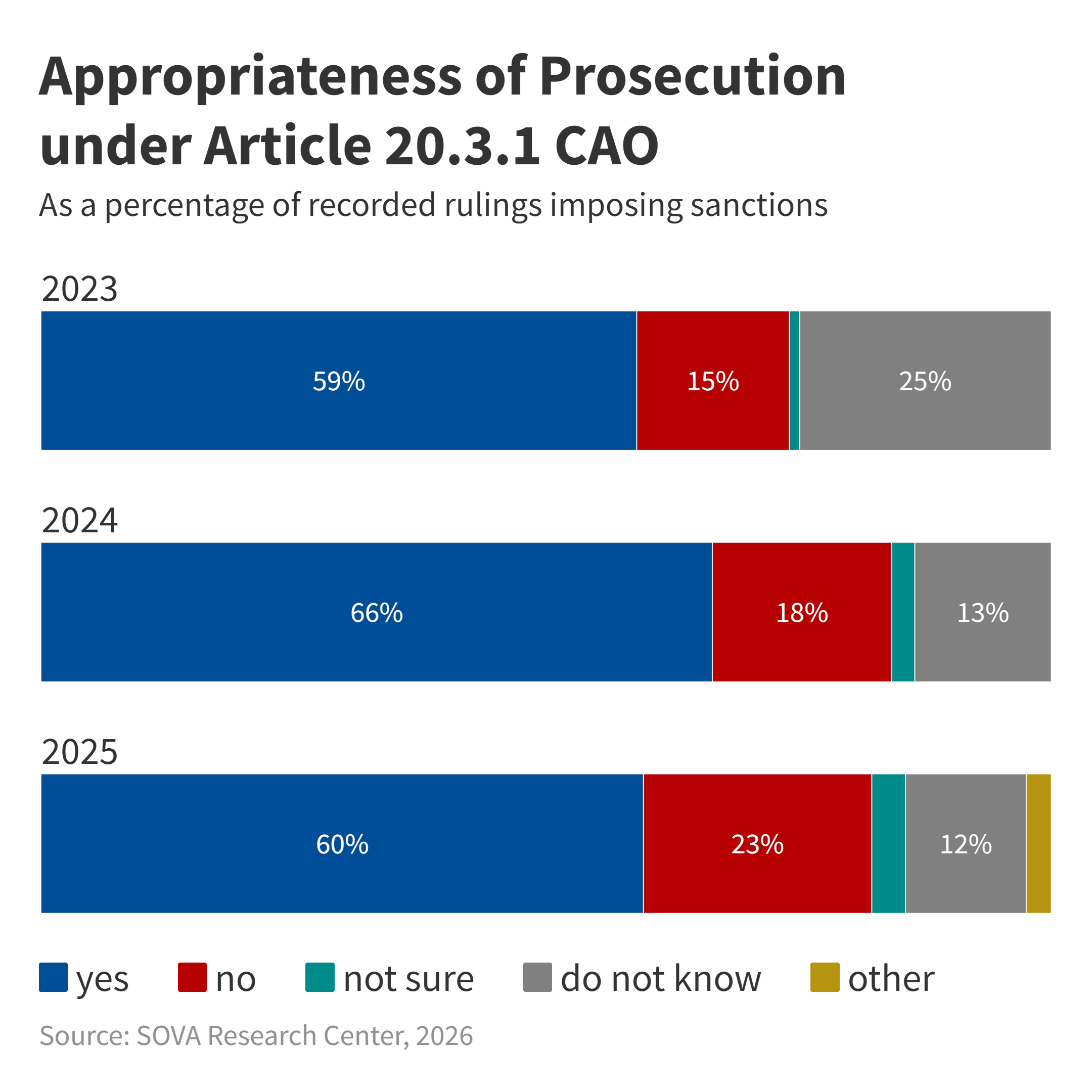
Partially due to this group of cases, the share of court decisions that we consider inappropriate has also changed. While such cases accounted for slightly more than 15% of the total in 2023,[35] and just under 18% in 2024, we classified nearly 23% of rulings imposing sanctions under Article 20.3.1 CAO as inappropriate in 2025 (that is, 176 rulings vs. 116 in 2024).
“Rehabilitation of Nazism”
Article 3541 CC covers a broad range of acts. We addressed the subset of these acts that can be characterized as attacks on material objects in another report; here, we only review speech. At the same time, the range of statements for which individuals are held liable under this article is also quite diverse. These include the glorification or denial of Nazi crimes; the dissemination (usually not accompanied by propaganda of violence) of “knowingly false” information about the activities of the USSR during the Second World War (Article 3541 Parts 1 and 2); disrespectful opinions about days of military glory, desecrating symbols of military glory, insulting the memory of defenders of the Fatherland, and humiliating the honor and dignity of veterans of the Great Patriotic War (Parts 3 and 4).
We have information on 68 court decisions applying this article in individual cases related to public statements. Fifty-nine individuals were convicted; in one case, proceedings were terminated due to the defendant’s death, and in another case, due to the expiration of the statute of limitations. As many as seven defendants were referred for compulsory treatment. In 2024, our database recorded 44 cases against 46 individuals, 43 of whom faced sanctions, one was acquitted, and two were referred for compulsory treatment.
Thus, the upward trend in the use of Article 3541 CC continued in 2025. The number of individuals sanctioned for their speech under this provision increased by approximately 50%. Considering the full scope of the article, including attacks on material objects, the growth is even more pronounced: we recorded 119 decisions in 2025 compared to 63 in 2024 – that is, nearly twice as many. This number significantly exceeds our conservative estimate of the number of convicted individuals (97) calculated on the basis of the Supreme Court data for previous years and the first half of 2025.
Both in 2024 and in 2025, almost half of the defendants under this article faced charges under Part 4 (insulting acts committed online or by a group of persons with respect to dates and symbols of military glory, or war veterans), while 26–28% were prosecuted under Part 3 (the same acts, but committed offline and individually) and under paragraph “c” of Part 2 (for the aforementioned statements about history committed online). If we focus only on speech, Part 2 paragraph “c” and Part 4 are equally prevalent (48% each), while a year earlier, Part 4 was more common.
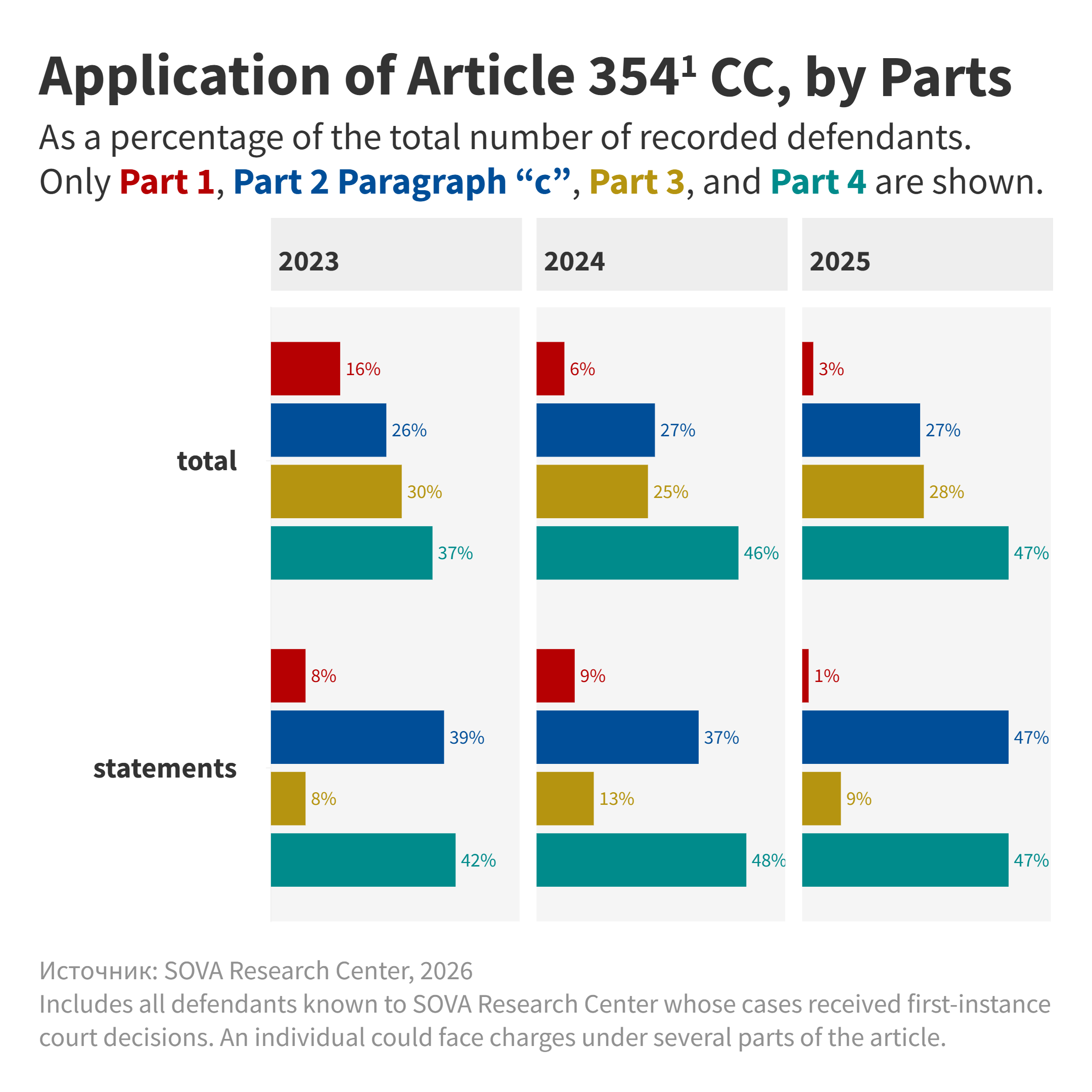
36% defendants convicted for statements under Article 3541 CC were sentenced to imprisonment (vs. 42% in 2024); 31% received suspended sentences (vs. 23% in 2024); 12% faced fines (vs. 16% in 2024), 8% were sentenced to compulsory labor (14% the previous year), and one individual was sentenced to community service.
In 15% of cases, the statements were made offline, in 84% – online, and in one case – both offline and online. A year earlier, offline statements accounted for about 28%, and statements made only online comprised 67%. Thus, law enforcement practice is increasingly shifting its focus to the Internet.
In 2025, half of the speech-related cases (against 34 defendants) were based on insults to values and symbols that the Russian authorities classify as traditional. In 2024, this category accounted for 46%.
A significant number of such convictions involved the publication of images featuring the St. George ribbon and comments critical of the Russian authorities, including in the context of the armed conflict with Ukraine. Notably, these posts were published by defendants holding a wide range of political views, from far-right figures such as Eleni Grigoriadi or Alexander Panasenko to the orthodox Stalinist Dmitry Denisov. At least four individuals were convicted for publishing images (particularly popular among “Citizens of the USSR”) claiming that Nazi collaborators used the St. George ribbon during the Great Patriotic War. Other objects, such as the monument “The Motherland Calls!” in the cases of trash streamer Golubka and St. Petersburg resident Yanina Lenskaya, could also be treated as symbols of military glory subject to desecration.
Another common law enforcement pattern is related to alleged disrespect toward days of military glory – most often, though not exclusively, criticism of the Victory Day celebrations.
In several cases, charges were based merely on deviations from state-promoted interpretations of events of the Second World War. Thus, Marina Zheleznyakova, the deputy head of the Primorye branch of Yabloko, was convicted for a post asserting that the “communist, totalitarian regime” bears part of the responsibility for the outbreak of the war and its numerous victims. In St. Petersburg, local historian Dmitry Vitushkin was convicted for a comment approving the actions of a Finnish sniper during the Winter War between the Soviet Union and Finland (1939−1940).
The case of St. Petersburg resident Andrei Tishchenko, who criticized referendums on the accession of new regions to Russia using a collage of historical photographs with his own caption, combines several of the above themes. In this case, the court interpreted a sarcastic caption – stating that Leningrad residents “with great enthusiasm and excitement” held a “referendum on joining Greater Germany” – as knowingly false information about the USSR during the World War II. The court also declared the Day of the Lifting of the Siege of Leningrad a desecrated day of military glory, and even recognized the Narva Triumphal Gate – erected in the second quarter of the nineteenth century and featured in one of the photographs – as a desecrated symbol of military glory.
34% of convictions (against 23 individuals) we classified as propaganda of ethnic xenophobia (43% in 2024). The overwhelming majority of such cases involved statements approving of or denying the Holocaust.
In at least six cases (9%), the statements were directly related to support for Ukraine; there were at least five such convictions (10%) in 2024.
We consider 43% of convictions for statements under Article 3541 CC inappropriate, and 38% as more or less appropriate. A year earlier, 48% were inappropriate, and 37% were appropriate.
We have information on 72 cases initiated under Article 3541 CC in 2025 against 76 individuals, specifically for their public statements. In total, we are aware of 110 new cases under this article against 135 individuals.
Article 13.48 CAO (publicly equating the goals, decisions, and actions of the USSR and Nazi Germany during the Second World War) continues to be used rarely. We are aware of only one instance of its application in 2025: Crimean Tatar activist Enver Seitmemetov was fined for asserting that, following the Second World War, tribunals should have been convened not only at Nuremberg but also to prosecute those responsible for the deportations of peoples in the USSR, including the Crimean Tatars.
Offending the Feelings of Believers and Desecration of Religious Paraphernalia
We are aware of 21 court decisions under Parts 1 and 2 of Article 148 CC (offending the feelings of believers) that were related to public speech. The total number of defendants in these cases was also 21 (although one of them was convicted twice in two different cases). A year earlier, we recorded more decisions – 33 verdicts against 36 individuals.
Data from the Judicial Department of the Supreme Court also indicate a slight decline in application of this norm: 18 individuals were convicted in the first half of 2025, and the year-end total is expected to exceed 30. In 2024, the Judicial Department recorded 43 convicted offenders.
The decisions known to us for 2025 found 18 individuals guilty and imposed punishment. In one case against a minor, the court terminated the proceedings and imposed compulsory disciplinary measures on the defendant. Two cases were terminated due to the expiration of the statute of limitations, and another due to reconciliation with the victim.[36]
Among those convicted, at least 10 (55%) were sentenced to community service, four (22%) to imprisonment, two (11%) received suspended prison sentences, and a fine was imposed in one case. In all cases where imprisonment was imposed, the charges also included other, more serious articles.
As in previous years, the majority of cases (involving at least 16 defendants) were related to statements made online.
Prosecutors brought cases under Article 148 CC in 2025 for a wide range of conduct. The incriminating acts included atheistic comments, statements against Islam, publications about Christianity by a “black magician”, advertisements for BDSM parties, a quarrel with a priest during an personal conflict, and recording a video with lowered trousers next to a church.
In most cases, we consider the convictions clearly inappropriate or doubt their appropriateness. Only the cases under Article 148 CC against blogger Areg Shchepikhin and radio prankster Valentin Bushuev can be viewed as appropriate, since their statements clearly incited hatred (both were also sentenced under Article 282 CC).
In 2025, we learned of 21 new cases under Article 148 Parts 1 and 2 CC against 27 individuals in connection with their statements. At least eight of these cases were adjudicated in the same year.
It appears that Article 5.26 Part 2 CAO (intentional public desecration of religious or liturgical literature, objects of religious veneration, signs or emblems of ideological symbolism and paraphernalia, or their damage or destruction) is being applied with increasing frequency.
We believe that this provision should primarily protect religious paraphernalia from physical damage. However, in practice, individuals are punished under it for the “desecration” of religious symbols that do not necessarily have a material form, and the concept of a “symbol” is interpreted quite arbitrarily. We consider such law enforcement practice to be entirely inappropriate.
Moreover, forensic experts often identify the elements of offending the feelings of believers and of desecrating symbols in the same statements. Thus, in practice, the elements of Article 5.26 Part 2 CAO and Article 148 Part 1 CC partially duplicate each other. Evidently, law enforcement agencies (primarily the Centers for Combating Extremism of the Ministry of Internal Affairs) often prefer filing an administrative report – or multiple reports – under Article 5.26 CAO to forwarding materials to the Investigative Committee for the initiation of a case under Article 148 CC. This is especially true in cases where claims are filed based on multiple publications by the same author simultaneously under several CAO articles – such as Article 20.3 CAO on the display of prohibited symbols and Article 6.21 CAO on the propaganda of “non-traditional sexual relations.”
Although we had no opportunity to systematically track the application of Article 5.26 Part 2 CAO across the entire country, we recorded 36 court rulings concerning 20 individuals; 34 of them were issued in Moscow.
Courts imposed sanctions in 34 cases: administrative fines in 19 of them, and community service in the remaining 15. One Moscow resident was released from liability on grounds of insignificance, and one case was terminated due to the expiration of the statute of limitations – the case of designer Artemy Lebedev, who faced charges for a photograph of a carpet depicting the Virgin Mary with a hand-rolled cigarette.
31 court rulings against 15 individuals related specifically to online publications. The overwhelming majority of these cases involved saved collages with Russian Orthodox icons on VKontakte or memes depicting Jesus, whose image experts and courts also treat as an object of veneration protected under Article 5.26 Part 2 CAO. In one case, the charges were based on an excerpt from the satirical cartoon Wonder Showzen; three claims were based on TikTok videos mentioning God and Jesus. Yet another case was based on an image depicting crescents instead of crosses on Saint Basil’s Cathedral in Moscow.
At least five cases concerned offline actions: a walk inside a monastery dressed as a woman and appearing in a bar dressed as a nun, the use of religious symbols in restaurant design and in khinkali ads, and selling paraphernalia in an esoteric goods store.
Recognizing Materials as Extremist and Sanctions for Their Dissemination
In recent years, we have noted that law enforcement agencies have been making increasingly less use of such an instrument as the banning of “extremist materials”[37] in court, followed by charges for their mass dissemination under Article 20.29 CAO. The growth of the Federal List of Extremist Materials (FLEM) has slowed annually, and prosecutions under Article 20.29 CAO have declined in frequency. In 2025, this trend stalled, with little change compared to the previous year in either respect.
At the same time, the FLEM has acquired a new function: since autumn last year, Article 13.53 has been added to the CAO, under which individuals may be punished not for disseminating, or even possessing, extremist materials, but merely for searching for them and becoming acquainted with their content. In our view, this provision is fundamentally unconstitutional: the right to seek information, as recognized by the International Covenant on Civil and Political Rights, is not subject to restriction under that Covenant or under the Constitution of the Russian Federation, and until now it had not been restricted in practice. Under Article 13.53 CAO, individuals can be held liable not only for searching materials included in the FLEM, but also for any materials whose content corresponds to the definition of “extremist materials” in the law. Given the breadth of this definition, the size of the FLEM, and the vagueness of many of its entries, one might theoretically expect a large number of cases under this new article; however, at the time of writing this report, we know of only three.
One of these cases reached the court in November 2025. A magistrate of Judicial District No. 2 of the Krasnogorsky judicial area of Kamensk-Uralsky in the Sverdlovsk Region initially required clarification of the police report, but once this was done, a local resident faced a fine of three thousand rubles. In late December, this decision was upheld on appeal. The substance of the charge was that student Sergei Glukhikh searched for information about the Azov regiment and the Russian Volunteer Corps, both recognized as terrorist organizations. However, information about terrorist organizations in itself does not constitute “extremist material,” and the revised version of the report stated that Glukhikh had searched for Azov symbols. This, in itself, would also be insufficient for prosecution: public display of symbols of terrorist organizations falls under Article 20.3 CAO, but this does not automatically make such symbols “extremist materials.” In this case, however, one of the symbols – the Azov chevron – does indeed appear in the FLEM under number 3269.
Regardless of the motives behind the student’s search for information, his prosecution should be considered inappropriate. This example clearly shows how easy it is to violate the new article of the Code of Administrative Offences inadvertently.
Additions to the Federal List of Extremist Materials
In 2025, the FLEM was expanded by 35 entries (vs. 38 in 2024). By the end of the year, the list contained 5,489 entries.
Among the 2025 additions, the most notable are materials originating from Ukraine that express anti-Russian sentiment, either in ethnic or national terms. (11 entries). The list also added six materials linked to the “Citizens of the USSR” movement, five associated with non-violent religious groups (primarily Falun Dafa and Jehovah’s Witnesses), and four entries consisting of AUE-style songs. Materials of other types appeared much less frequently. Only two materials by radical Russian nationalists were added – unchanged from the previous year, despite their earlier dominance among FLEM additions. There are also just two items from non-Russian nationalist groups, and only one Islamic entry, a book glorifying military jihad.
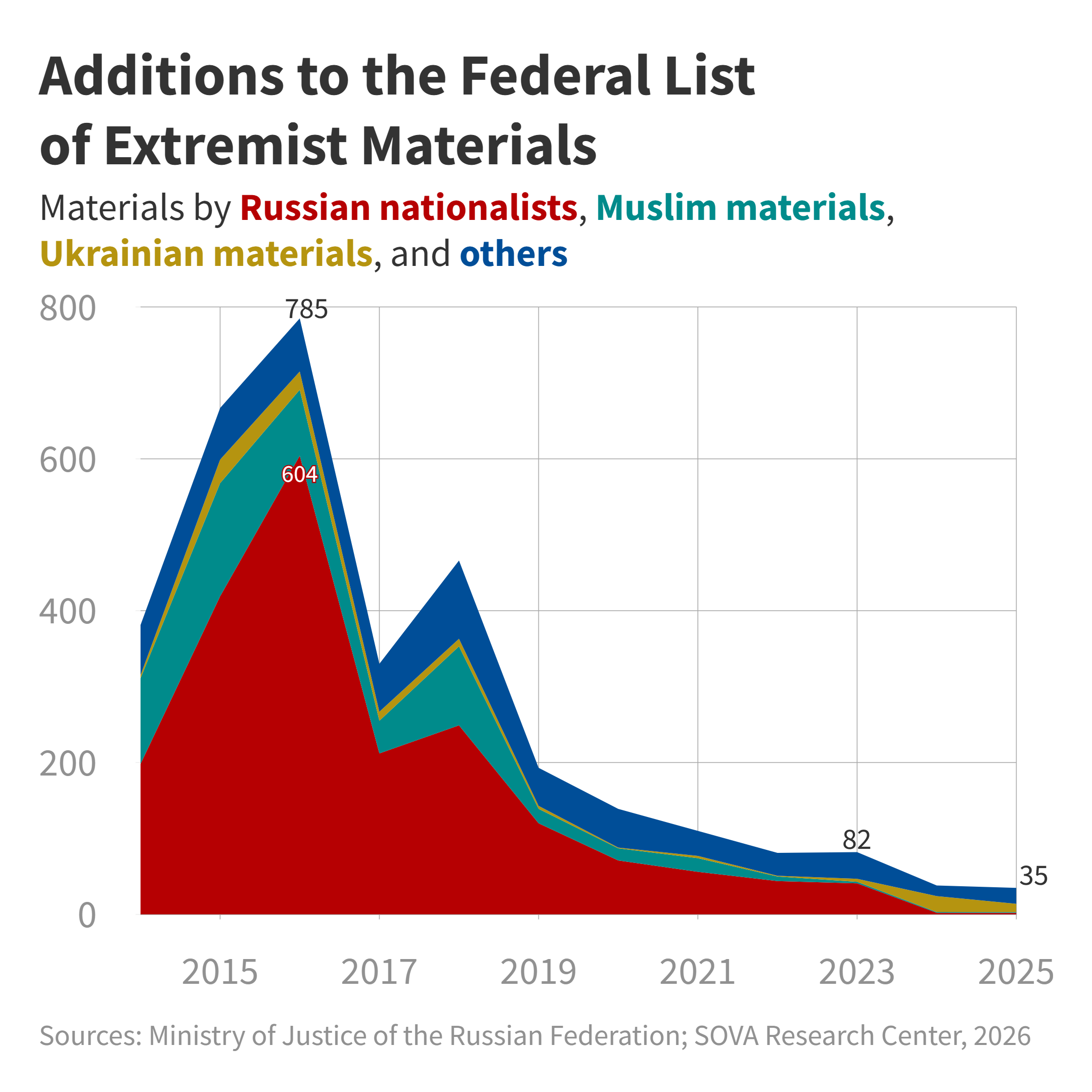
According to our estimates, nine out of the 35 materials were banned inappropriately in 2025 (vs. five out of 38 in 2024). Five of these were the religious texts mentioned above. We found no calls for violent actions in the Notes of a Bashkir Nationalist. Kuk Bure by Ruslan Gabbasov or Patriot by Alexei Navalny. The Ukrainian propaganda song “Listen, Mom, This Is Ukraine,” which is harshly critical of Russian soldiers, also contained no such calls. Finally, the little-known song “Pray” appears to have been misinterpreted by the court as a call to unlawful actions due to its refrain “Pray, steal, and kill,” reflecting a fairly common problem of interpreting polysemantic texts. Thus, materials were banned inappropriately in slightly over 25% of cases – a noticeably higher percentage than we observed earlier in this decade. Starting in 2020, this figure fluctuated between 10 and 18%.
Dissemination of Extremist Materials
The exact number of rulings imposing sanctions issued in 2025 under Article 20.29 CAO is not yet known. There were certainly at least 301 such decisions.[38] According to data from the Judicial Department of the Supreme Court, 178 rulings entered into force in the first half of the year. Taking into account the usual decline in the number of decisions in the second half of the year, this number suggests at least 320 decisions for the entire year. According to the official data, there were 314 such rulings in 2024.
Data for the first half of the year indicates that fines remained the primary penalty under Article 20.29: only two individuals (1% of cases) were subjected to administrative arrest, four times fewer than in the previous year.
We can analyze the content of court decisions using our database, which contains 187 rulings imposing sanctions in 2025, as well as one ruling terminating the proceedings due to the expiration of the statute of limitations (vs. 186 rulings imposing sanctions in 2024). This represents more than half of the total number of decisions made under this article, allowing us to draw certain conclusions about law enforcement practice as a whole.
Unexpectedly, the share of sanctions for offline dissemination rose from 6% in 2023 to 15% in 2024 and to 22% in 2025. This sharp increase in 2025 coincides with a 50% rise in clearly inappropriate charges under this article.
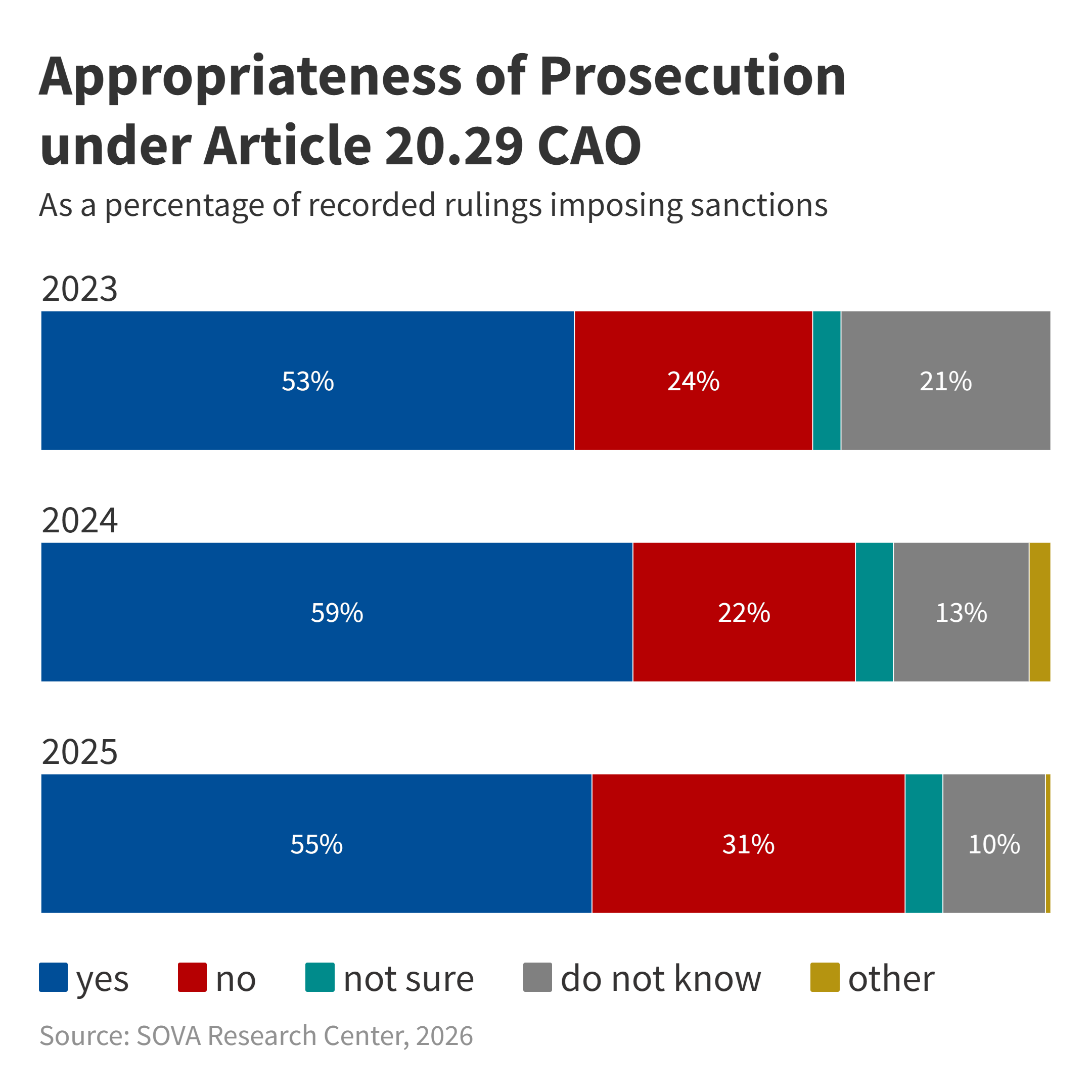
Traditionally, many inappropriate cases under Article 20.29 CAO are related to Islamic materials – 33 out of 64; 12 of them involve the popular book Fortress of the Muslim.
As before, the use of materials related to Nazism – not for Nazi propaganda, but for statements of a clearly different intent – may result in a fine under Article 20.29 CAO. For example, one Moscow resident accused supporters of Ukraine of brainwashing Russians. He used a portrait of the chief Nazi propagandist Joseph Goebbels seven times for this purpose and was punished seven times. This episode also illustrates that portraits of Nazi and fascist figures are treated as prohibited materials. We know of at least five cases in which individuals faced charges for certain pagan symbols that were interpreted as Nazi or neo-Nazi symbols, clearly with no regard to the context in which they were displayed (usually alongside other pagan symbols). Moreover, Article 20.29 CAO was applied rather than Article 20.3, even though these symbols are not included on the Federal List of Extremist Materials (FLEM).
Several cases involving charges under Article 20.29 CAO were somewhat unusual. Two individuals were fined for publishing the “Dulles Plan,” a well-known forgery popular among Russian nationalists, but banned inappropriately, since the text itself contains no unlawful incitement. Two scholars in Crimea were fined for a book that had not been banned, in which respondents, interviewed by sociologists, mentioned prohibited organizations. Here, Article 20.29 CAO was applied in a manner inconsistent with its scope.
It is somewhat more difficult to assess the focus of this law enforcement practice, since the content of some prohibited materials is unknown, and in other cases, law enforcement authorities interpret it differently from what might be expected.
Summarizing the available data, we can continue the comparison started in our 2024 report across different types of materials that triggered sanctions under Article 20.29 CAO.[39]
|
Types of materials |
Materials, percent |
||
|
2023 |
2024 |
2025 |
|
|
Expressing ethnic xenophobia[40] |
44 |
47 |
41 |
|
Religious[41] |
13 |
24 |
41 |
|
Related to Ukraine |
4 |
2 |
1 |
|
Other politically oppositional |
17 |
6 |
3 |
The trends are very clear. In the application of Article 20.29 CAO, the share of cases related to countering xenophobia remained more or less stable in 2023–2025; videos depicting scenes of violence, music videos, and audio recordings of far-right groups and similar materials continued to dominate with 52 court decisions last year. The share of law enforcement related to religion grew almost exponentially and, as noted, largely due to Islamic materials. Conversely, the percentage of charges for oppositional political statements, including the issue of the armed conflict with Ukraine, declined just as rapidly and has now become barely noticeable. Evidently, other legal provisions are used to punish such statements.
Aggregate Data on Sanctions under Criminal Code Articles for Speech
In 2025, we recorded a total of 699 court decisions against 731 individuals whose statements were classified under various criminal articles (703 faced court-imposed sanctions). In 2024, we only knew of 500 decisions against 531 defendants, and in 2023, of 388 decisions against 426 individuals. Please note that our calculations in this section exclude individuals sentenced under Article 2824 CC for demonstrating AUE symbols and under Article 2052 for “Columbine” propaganda.
In other words, in 2024, we recorded 25% more individuals facing trial for their statements than the year before, and in 2025, we observed a further 38% increase. According to official data, however (counting only the defendants sentenced under these articles as their primary charge), the increase was 44% in 2024 and, according to our conservative estimate, 26% in 2025. We conclude that our awareness of such cases increased in 2025.
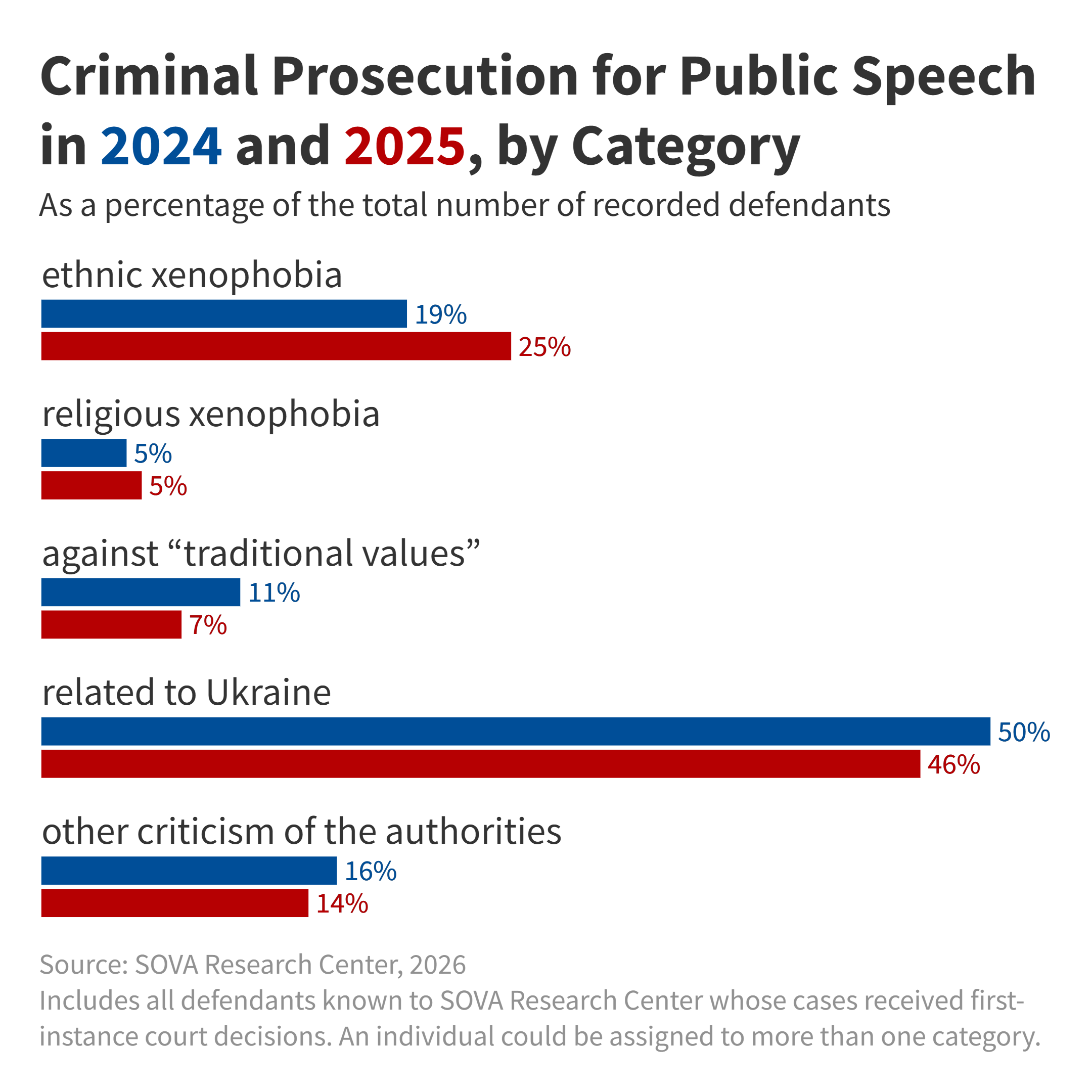
Let us consider the distribution of the court decisions known to us for 2024 and 2025 by category.[42] As in the previous year, Ukraine remained the most common theme of statements leading to criminal charges in 2025. However, according to our data, the share of defendants brought to trial for such statements declined slightly. At the same time, the proportion of convictions for propaganda of ethnic xenophobia increased noticeably.
The table below shows what types of sanctions were imposed in 2025 on those convicted, depending on the categories of their statements (it should be recalled that in some cases we assigned a single conviction to more than one category).
|
Statement categories |
Imprisonment |
Suspended sentences |
Compulsory labor |
Corrective labor |
Community service |
Fine |
|
Ethnic xenophobia |
74 |
53 |
18 |
9 |
9 |
9 |
|
Anti-government |
56 |
18 |
8 |
2 |
3 |
11 |
|
Pro-Ukrainian |
225 |
29 |
10 |
0 |
1 |
44 |
|
Against “traditional values” |
16 |
13 |
2 |
1 |
11 |
4 |
|
Religion |
28 |
4 |
0 |
0 |
1 |
5 |
This data indicates that approximately 41% of known defendants convicted for ethnic xenophobia were sentenced to imprisonment. Authors of pro-Ukrainian statements faced imprisonment in 69% of the verdicts. Imprisonment was imposed on 55% of defendants convicted for other statements directed against the authorities and 32% of defendants whose speech was deemed to attack “traditional values.” The highest percentage of prison sentences, nearly 74%, was observed among the relatively small number of defendants convicted for statements related to religion. This differs very slightly (only by 2–4%) from the pattern observed in 2024.
The 644 suspects in newly initiated cases concerning public statements are distributed across categories approximately as follows.
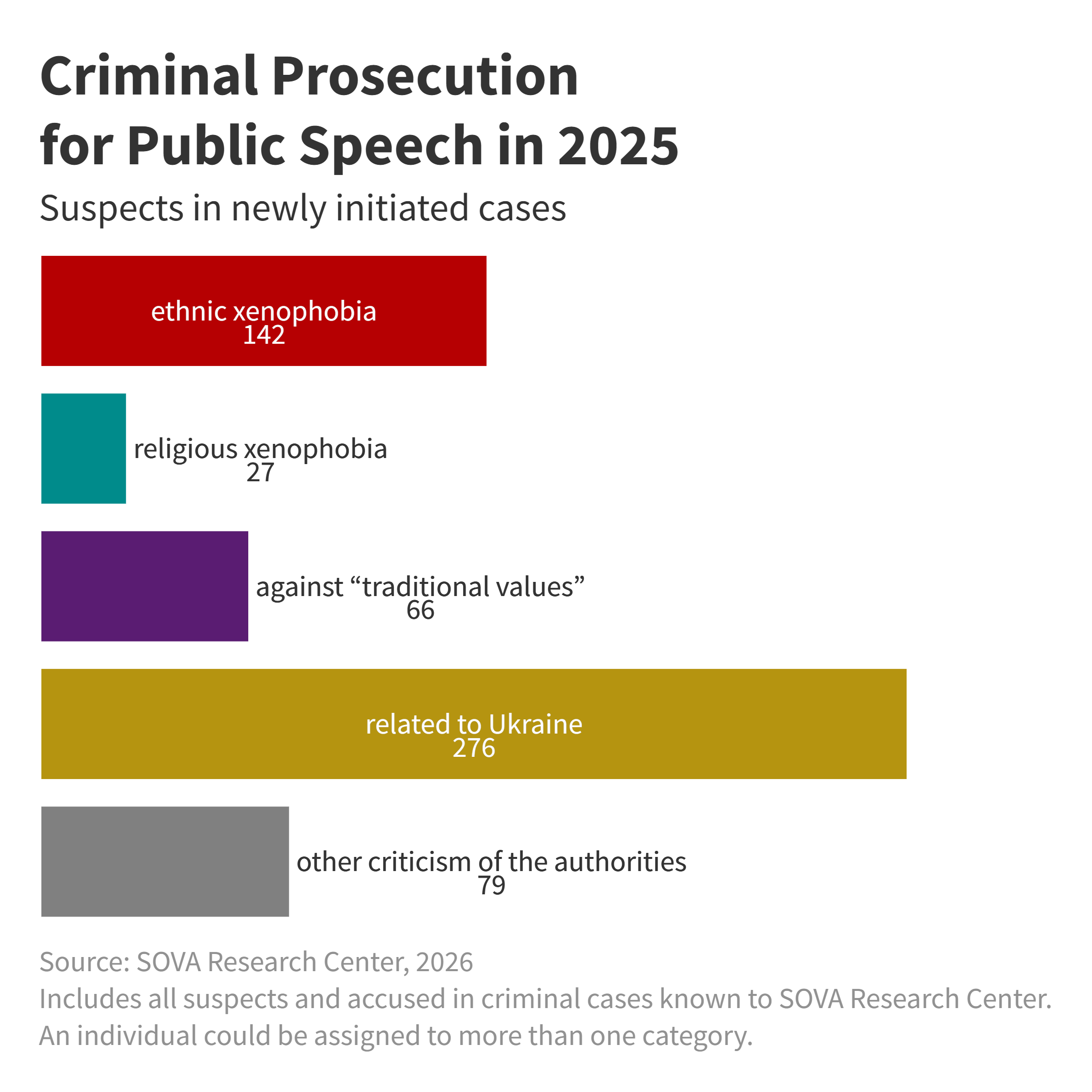
Comparing the relative percentages across the categories in newly initiated cases with those in already issued convictions, we see a gradual decline in cases involving speech related to Ukraine and critical of the authorities. Other categories do not exhibit a clear trend. It should be reiterated, however, that these calculations do not include cases involving the display of AUE symbols.
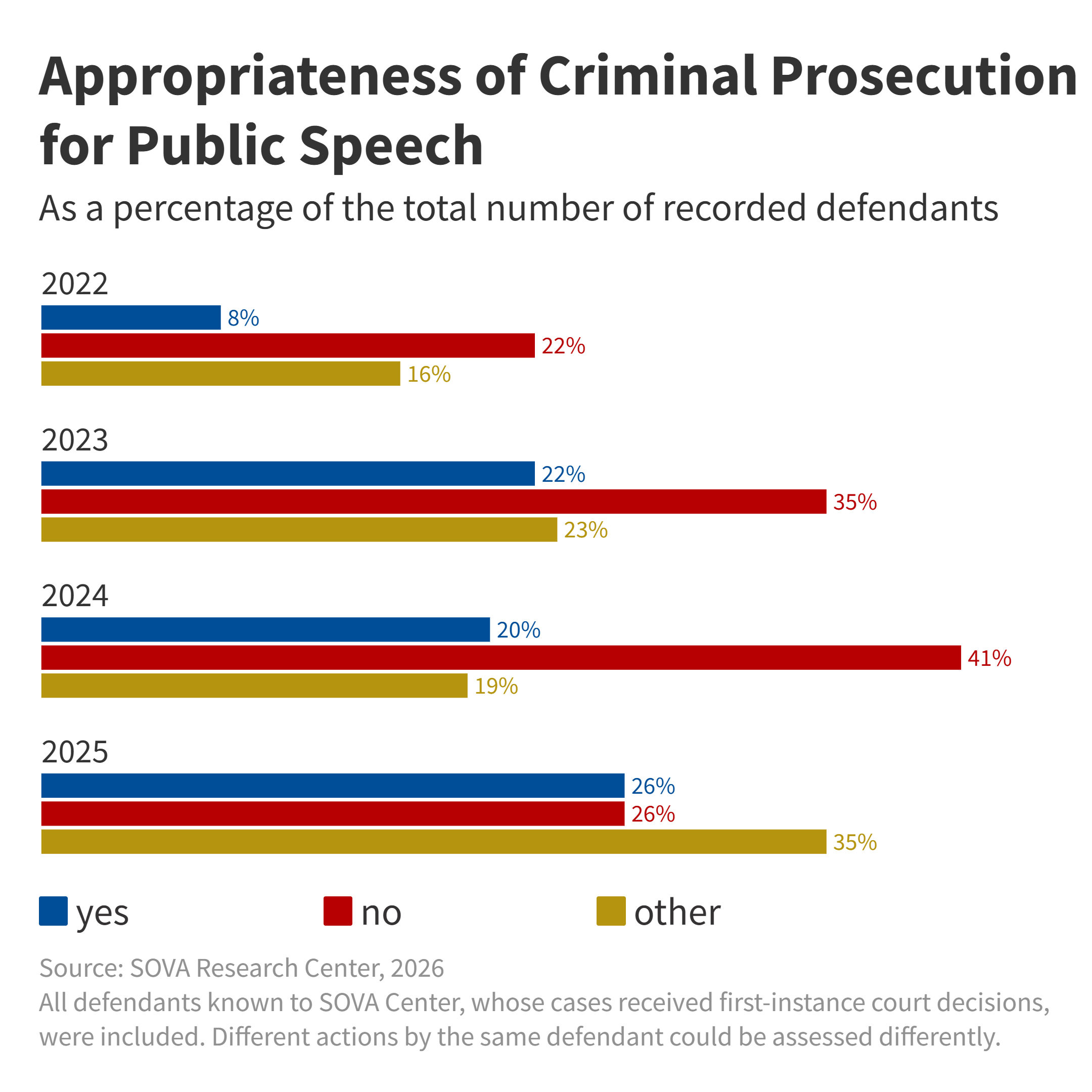
As reflected in the chart below, the appropriateness of the verdicts varies widely. It is worth noting that comparisons with 2022 data should be treated with caution. First, for several reasons, we classified appropriateness as “do not know” more frequently in 2022. Second, the “special military operation effect” had already influenced the initiation of new cases but had not yet significantly affected verdicts back then. However, we then observe that the share of clearly inappropriate decisions increased in 2024 at the expense of the “other” category, which includes convictions based on statements unrelated to xenophobia but for which state prosecution could be justified. In 2025, by contrast, the percentage of inappropriate convictions declined significantly because a greater percentage of cases were classified as “other” or as directly related to xenophobia. However, given the overall increase in the number of speech-related verdicts, the absolute number of inappropriate convictions known to us decreased only slightly, by 11%. Between 2024 and 2025, the number of cases in the ‘appropriate’ and ‘other’ categories increased by 154% and 83%, respectively.
Let us examine how the appropriateness of sanctions changed across statement categories.
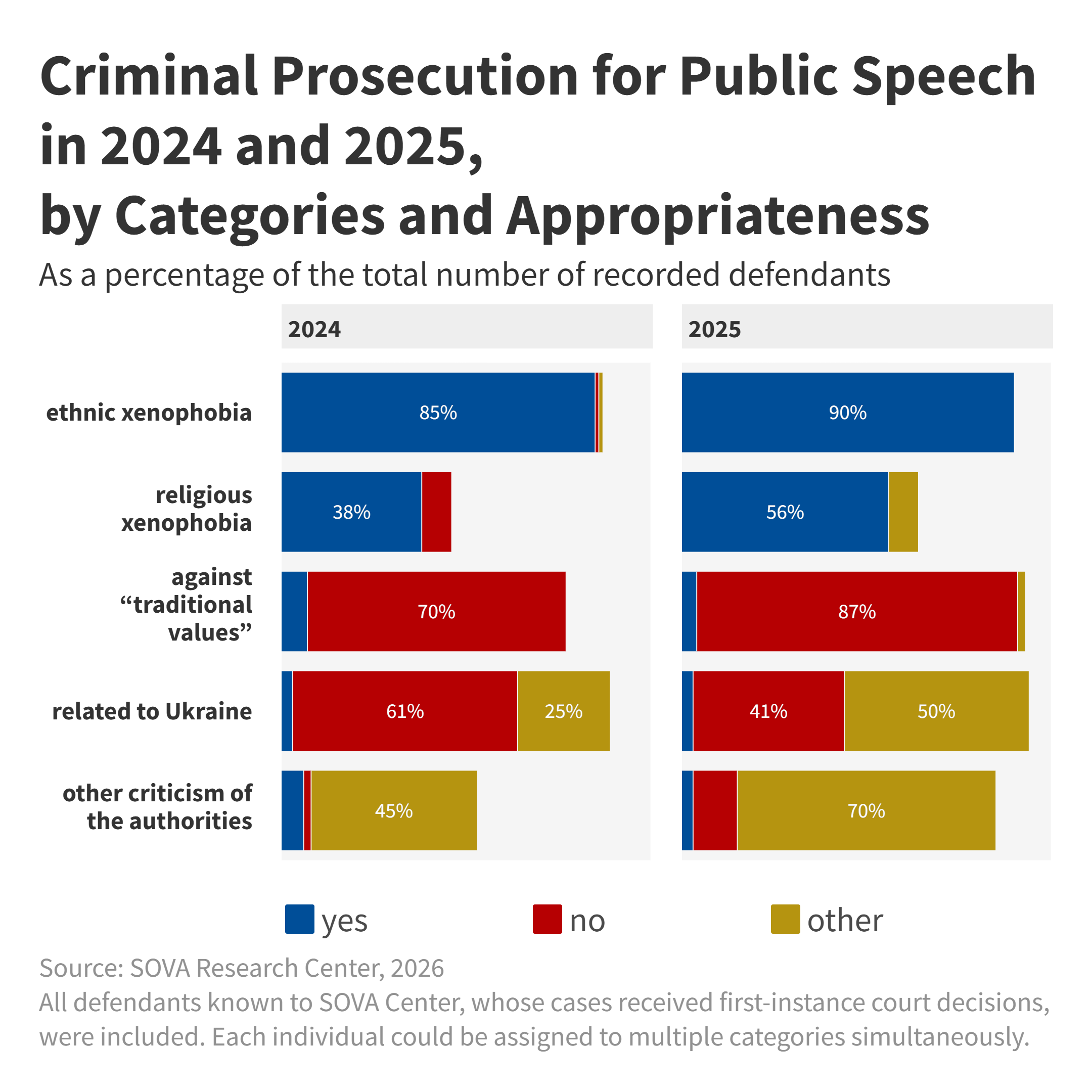
The most significant change is the doubling of the percentage of “other” convictions for statements related to Ukraine, driven by a decline in the percentage of inappropriate convictions. The share of “other” decisions issued for criticism of the authorities has also increased; however, in this case, inappropriate convictions rose dramatically as well.
Aggregate Data on Prosecution under CAO Articles Related to Public Speech
Although we did not monitor all politicized provisions of the CAO, we are able to present aggregate data on them. The chart below shows the number of decisions imposing administrative sanctions under the four most frequently applied provisions.[43]
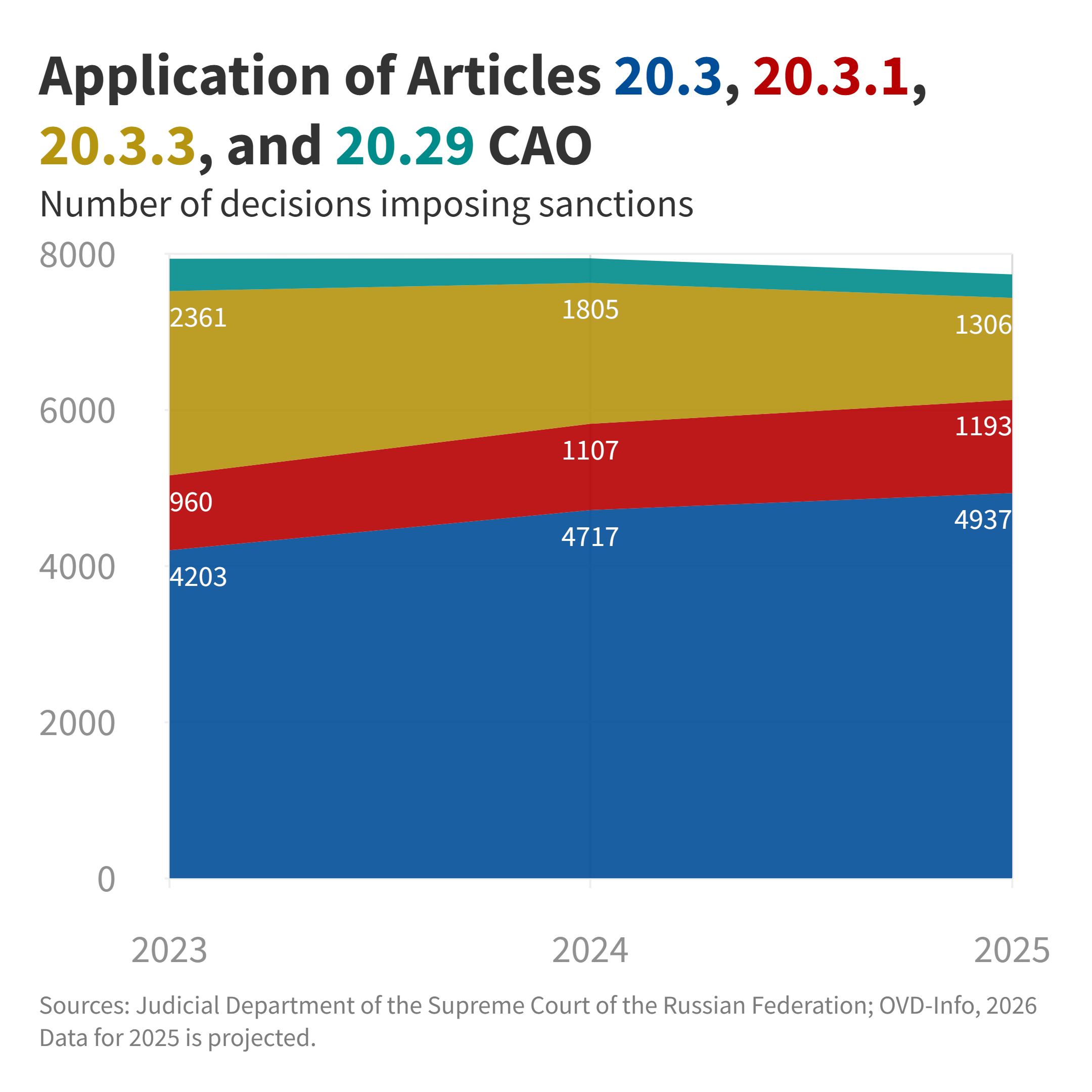
It appears that the long-term growth in the number of individuals punished under politicized articles of the CAO not only slowed in 2024 but declined somewhat in 2025. Amid a rapid increase in criminal prosecutions, the previously large gap between these two forms of law enforcement has narrowed slightly.
Restrictions on Organized Activity
From its emergence in 2002, anti-extremism legislation has been largely focused on prosecuting organized activity. Since then, the provisions regulating such prosecution have multiplied and become significantly more stringent. Three types of associations have emerged, participation in which is itself criminalized: terrorist, extremist, and undesirable organizations (listed in descending order of perceived threat).[44] Each designation is applied to associations for certain forms of activity deemed anti-constitutional and threatening to security.
In this section, we discuss criminal sanctions for participation in associations already designated as terrorist or extremist (we provide only general figures for “undesirable organizations”), and then the associations newly designated as terrorist or extremist.
We analyze the following Criminal Code articles:
- Article 2821 (involvement in the activities of an extremist community);
Article 2822 (involvement in the activities of an extremist organization);
Article 2823 (financing of extremist activities);[45]
Article 2054 (involvement in the activities of a terrorist community, only for far-right groups);
Article 2055 (involvement in the activities of a terrorist organization).[46]
It should also be noted that SOVA Center does not include in its monitoring the cases related to involvement in Islamist jihadist organizations,[47] as well as Muslim and other religious organizations and groups, if we do not have sufficient information about their activities.[48] As a result, we are unable to analyze many parameters of criminal sanctions for participation in associations based on our data, as we did for sanctions for public speech.
We do not aim to describe or even mention all cases. Instead, the analysis organizes the data by the categories outlined in the introduction and by the political types of organizations. However, for a number of defendants, even their alleged organizational affiliation is unknown.
Associations of Russian Nationalists and Neo-Nazis
In 2025, 42 individuals were convicted for participation in the activities of groups of Russian ethnic nationalists, some of which could be described as neo-Nazi. Additionaly, one female student was referred for compulsory psychiatric treatment. We consider all of these court decisions appropriate. Some of the groups were prosecuted as extremist, others as terrorist. Our database includes 25 such convicted individuals for 2024.
We know of two individuals sentenced to imprisonment under Article 2822 CC for participation in banned extremist organizations that can, to varying degrees, be considered nationalist (no such convictions were reported in 2024). These are two members of the All-People’s Union for the Revival of Russia (Obshchenarodny Soyuz Vozrozhdeniya Rossii, OSVR) led by Svetlana Peunova (Lada-Rus). They were convicted for continuing the activities of the banned Volya party, since the authorities reasonably view the OSVR as its continuation. The OSVR is also known for its anti-war stance.
In 2025, another 10 Russian nationalists became suspects under the same article, including four supporters of Lada-Rus and five members of T.O.Y.S., a Samara-based football ultras group, which was banned in 2017.
Nationalist groups face charges under Article 2821 CC much more frequently. In 2025, we recorded 23 convicted individuals (22 the previous year). These are usually members of small local groups, and sometimes, even the names of those groups remain unknown. An example of such a group is the Omsk Slavic Association, which was designated an extremist organization in May, while its members faced criminal charges. The degree of involvement in actual violence varied among the groups, but almost all of them were involved in violence to some extent. One group, for example, was preparing an explosion in the building of the Peoples' Friendship University of Russia (RUDN) in Moscow. The most notable case was likely the conviction of the administrators of the Telegram channel Natsdem, which in 2022–2024 combined anti-war and anti-migrant propaganda: the two principal administrators, known as Kesha and Pomorsky, received custodial sentences, while two others received suspended sentences. In total, at least 12 individuals were sentenced to incarceration under this article.
We know of two cases against eight individuals initiated in 2025, which are not at all similar: the Novosibirsk group has been charged with serious violent crimes, while the Volgograd group has been charged mainly with advocating such acts. There is also a case with an unknown number of suspects initiated in connection with the participation of the RDK column in an opposition rally in Berlin (the case involves Ilya Yashin and Vladimir Kara-Murza, among others).
We are aware of seven court decisions against 12 individuals under Article 2055 CC for participation in terrorist organizations (three individuals were sentenced under this article in 2024). These cases involve participants in the neo-Nazi networks NS/WP and Maniacs. Murder Cult (Manyaki. Kult Ubiystv, MKU). Both groups have faced sanctions for a long time, but their activity has not ceased. In all cases, the charges concerned public calls for violence or preparation for violent acts, and in some cases, also actual violent crimes. Article 2055 CC provides for a mandatory sentence of imprisonment with no alternative, but one female member of NS/WP was referred for compulsory treatment.
We also know of cases against another 11 individuals initiated in 2024; six of them face charges of participating in the same two networks. This Criminal Code article also appears in the case of the RDK at the Berlin rally, mentioned above.
In contrast to the previous year, we also know of two group convictions under Article 2054 CC. The first involved participants in the group that was preparing an explosion at RUDN. We do not know the details of the case or why four individuals were sentenced under Article 2054 and three also under Article 2821 CC. The second verdict concerns participants in Belaya Mast (White Color, or White Suit), a neo-Nazi group that supported imprisoned far-right offenders while glorifying their ‘feats’ and calling for further acts. Convicted individuals include Nikolai Korolev, serving a life sentence for organizing a bombing at the Cherkizovsky market in Moscow, and his wife. There had been a number of convictions in the Belaya Mast case already, and new cases continue to be investigated. To a large extent, this major court case is directed against neo-Nazis of the 2000s and 2010s who have continued their activities.[49]
We are aware of only one new case under Article 2054 CC, against two far-right individuals in Vladimir who were planning arson attacks on food establishments during periods when migrants are present in large numbers.
“Citizens of the USSR”
The activities of nine organizations of “citizens of the USSR”[50] have already been banned, and their participants have long been facing sanctions. “Citizens of the USSR” continue to disseminate various conspiracy theories, including xenophobic ones, and, most importantly, call on citizens, officials, and even law enforcement personnel not to obey the authorities of the Russian Federation, which they do not recognize as a state.
We know of nine verdicts against 12 activists issued under Article 2822 CC; one additional individual was referred for compulsory psychiatric treatment. This is significantly fewer than the previous year (36 convicted individuals), but similar to 2023 (13). Some of those convicted in 2025 were found by courts to be affiliated with the large community of “citizens of the USSR” led by Sergei Taraskin and banned back in 2019. Others were followers of an association banned in 2022 with its center in Novokuibyshevsk of the Samara Region. The sentence for one defendant also included Article 2823 CC for financing an extremist organization.
In Karachay-Cherkessia, a group of nine “citizens of the USSR” was convicted as an independent extremist community under Article 2821 CC.
Nine of those convicted were sentenced to actual imprisonment, 10 to suspended sentences, and two to other forms of punishment. One additional individual was referred for compulsory treatment.
It is worth noting that “citizens of the USSR” also faced charges under other articles, primarily those on public statements (Articles 280, 2803, 282, 2824, 3541 CC); in such cases, we can identify seven individuals who were inappropriately convicted. We identified no inappropriate convictions under Articles 2821, 2822, and 2823 CC.
We know of cases against 19 “citizens of the USSR” initiated in 2025 for participation in banned organizations.[51] So far, we have not been able to identify clearly inappropriate charges among them.
Banned Ukrainian Organizations
As in the previous year, we recorded many sentences and new cases for cooperation with organizations operating in Ukraine that are banned in Russia.[52] The charges were based on attempts to travel to Ukraine and join such organizations or to cooperate with them by carrying out acts of sabotage or propaganda activities on Russian territory. We do not consider such charges inappropriate, although in some cases, we may have doubts about their factual basis.
The overwhelming majority of convictions, as well as of new cases initiated last year, concern cooperation with the Russian Volunteer Corps (Russkiy dobrovolcheskiy korpus, RDK), recognized as a terrorist organization, or, somewhat more frequently, with the Freedom of Russia Legion (Legion “Svoboda Rossii,” LSR). We cannot determine with certainty to what extent these cases involved genuine interaction with a ‘handler’ from Ukraine and to what extent they were FSB operations aimed at identifying individuals willing to engage in such interaction. Nor can we say with certainty to what extent the defendants in known cases were motivated by ideological considerations, as opposed to financial or other motives. Most likely, as in the previous year, the latter significantly outnumbered the former. In some cases, however, it is known that defendants held far-right views, which may have contributed to their interaction with the RDK or with the also banned Azov or the Right Sector.
We are aware of 55 individuals convicted for their ties to these organizations (vs. 30 in 2024). They faced charges under Article 2055 Part 2 CC (and in two cases, for some reason, also under Article 2054; in one case, Article 208 on illegal armed formations was added, and, in another case, Article 2751 on confidential cooperation with a foreign organization). In 30 cases, the judgments also included Article 275 CC (high treason), as well as other articles, depending on the circumstances.
One individual was sentenced under Article 2822 CC for cooperation with the Right Sector back when it was still listed only as an extremist, not a terrorist, organization.
Two sentences were issued for actions in favor of Ukraine that were essentially similar to the above cases but unrelated to cooperation with Ukrainian organizations. These are the convictions against five members of a far-right group in the Moscow Region, sentenced under several articles, including Article 2054 CC, and against one member of the Artpodgotovka movement (see below), also sentenced under several articles, including Article 2055 Part 2 CC. All six discussed preparations for acts of sabotage. The terrorist group members from the Moscow Region had this conversation with an agent who had infiltrated the group, and one member even managed to carry out one such act.
Similar cases under Criminal Code articles on participation in organized activity in connection with Ukraine were initiated in 2025 against at least 39 individuals. Article 2055 appears in 36 of these cases, Article 2822 in four, Article 2051 in five, and Articles 2821 and 2823 each appear once.
Among those charged in 2025, the majority – at least 39 individuals – are allegedly connected with the RDK, LSR, or, in some cases, Azov.
Groups of activists speaking on behalf of various ethnic minorities and linked – or alleged by investigators to be linked – to the Free Nations of PostRussia Forum (recognized as a terrorist organization) form a separate category. This separatist Forum is indeed connected to Ukraine and includes combat units fighting on its side, so it can be described as a pro-Ukrainian organization. However, those prosecuted in connection with it are not necessarily genuinely affiliated with the Forum, since the officially published list of its “structural subdivisions” does not accurately reflect the coalition’s actual structure and composition.[53]
In April, two elderly activists of the Erzya national movement received suspended sentences under Article 2821 Part 2 CC in Mordovia. Although they were not charged under Article 2055, the case narrative was linked to other activists who were part of the Forum.
We know of five new individuals charged in 2025 under Article 2055 of the Criminal Code in connection with the Forum or organizations that are indeed part of it, though the actual number is likely higher. Among them are a young man who administered the Telegram channel Free Lapland, émigré activist Aigul Gimranova-Lyon of the Committee of the Bashkir National Movement Abroad, and Kalmyk wrestler and businessman Eduard Baltykov. The charges against activists from the Aborigen Forum – a long-standing coalition of ethnic minority activists that has not advocated separatism – are particularly concerning.
Banned Opposition Organizations
Sanctions against supporters of Alexei Navalny are increasingly taking the form of prosecution for financing his banned structures, primarily the Anti-Corruption Foundation (FBK).[54] Since we consider the designation of these organizations as extremist to be inappropriate, we also regard sanctions for participating in or financing them as unjustified.
Due to a partial leak of donor data, many individuals have become potential defendants, and the number of cases under Article 2823 of the Criminal Code for donations to the FBK has already surpassed all other cases against FBK activists. In 2025 alone, we have confirmed 86 convictions for donations to Navalny’s organizations, with a further eight almost certainly involving the same charges (compared with 20 in 2024 and four in 2023).
Of these 94 individuals, 12 were sentenced to imprisonment without additional charges in the judgment. Most of the others received substantial fines, while 14 were given suspended prison sentences.
In 2025, we are aware of 119 cases evidently initiated for financing the FBK (vs. 33 in 2024), although some of these have already resulted in convictions.
Meanwhile, prosecution of activists for actual participation in Navalny’s structures has also continued. In 2025, we knew of nine individuals sentenced under Article 2821 CC (five in 2024) for participation in an alleged extremist community, which, according to the law enforcement, Navalny created no later than 2014. This group includes three of Navalny’s lawyers and the current head of the FBK, Leonid Volkov.[55]
Four individuals were convicted for involvement in Navalny’s structures under Article 2822 CC.
We know of fewer such new cases in 2025: none under Article 2821 and, apparently, three under Article 2822.
Prosecution of Vyacheslav Maltsev’s Artpodgotovka movement[56] has continued. The movement itself was designated as extremist, but a small group of its participants, led by Maltsev in exile, was convicted as a terrorist community and thus added to the list of terrorist organizations. Therefore, Artpodgotovka participants and donors could, in principle, be prosecuted under both extremist (Articles 2822 and 2823, respectively) and terrorist (Articles 2055 and 2051) provisions of the CC; evidently, depending on whether the alleged actions took place before or after the group was designated as terrorist, so that some cases include charges of both types.
In 2025, eight individuals were convicted: five were charged under Article 2055, four under Article 205.1 Part 1.1, two under Article 2822, and one under Article 2823 CC. All eight were sentenced to imprisonment.
We know of 11 individuals who were newly charged in connection with Artpodgotovka movement; these cases were brought under various combinations of the same four articles of the CC.[57]
In October, a case was initiated against 23 members of the émigré Anti-War Committee of Russia (Antivoyenny Komitet Rossii, AKR), which includes many well-known public and political figures of the Russian diaspora, on charges of creating a terrorist community and attempting to overthrow the government. The details of the charges are not entirely clear, but it evidently includes support for Ukraine in the armed conflict. For almost all of the defendants, this is not their first case. For example, Garry Kasparov had previously been charged under Article 2054 CC as a leader of the Free Russia Forum, which was added to the list of terrorist organizations in March 2025. Within Russia, no individuals have yet been formally charged or named as suspects in the AKR case.
Other opposition organizations and groups encountered this type of anti-extremism enforcement less frequently in the past year. We are aware of one conviction almost certainly related to the inappropriately banned Vesna (Spring) movement, and one new case under Article 2822 against a coordinator of this movement, who had left the country. Another known case initiated in 2025 was opened against a coordinator of the Omsk Civic Association (OGO, also inappropriately banned), who had also left the country. In November, the former head of the Ministry of Internal Affairs of Ingushetia, a leader of the Ingush opposition (with seven other leaders already convicted in 2021), was sentenced to nine years of imprisonment.[58] In May, an anarcho-communist in Ufa was sentenced under Article 2821 CC and several other articles, including for arson attacks on administrative buildings committed in 2011.
In December, after a two-year trial, the court issued sentences to Marxist circle participants in Ufa. Unlike all the organizations mentioned above, this group was not critical of the armed conflict with Ukraine – on the contrary, it included veterans of the military campaign in Donbas. The investigation classified discussions of plans for a socialist revolution under Article 278 CC as preparation for the overthrow of the constitutional order. In addition, the participants were charged with involvement in a terrorist community, propaganda of terrorism, and offenses related to the illegal circulation of weapons. As a result, five members of the circle were sentenced to imprisonment for terms ranging from 16 to 22 years.
Banned Religious Organizations
Jehovah’s Witnesses
In 2025, we know of 66 convictions against 124 Jehovah’s Witnesses, prosecuted for continuing the activities of their organizations, which we consider inappropriately banned, and, in some cases, also for financing them. That is, the situation has remained virtually unchanged from the previous year, when 126 individuals were convicted, and one was acquitted. However, the charge of financing banned organizations appeared only in four cases this time (vs. 25 in 2024). One additional case was terminated due to the defendant’s death.
38 individuals received custodial sentences (29 of them with terms of five years or more), 49 received suspended sentences, and another 36 were fined.
We are aware of 70 individuals against whom cases were initiated in 2025 – more than in the previous year (49), but still significantly fewer than in 2023 (107).
Muslim Organizations That Face Inappropriate Sanctions
This section discusses three organizations: Nurcular (this designation is used to ban communities of followers of the Turkish theologian Said Nursi),[59] Tablighi Jamaat,[60] and the radical Islamic party Hizb ut-Tahrir al-Islami. The first two are banned as extremist organizations, and the last one as a terrorist organization.[61]
No one was convicted for participation in Nurcular in 2025 (two individuals were convicted in 2024), and we are not aware of any new cases.
As for Tablighi Jamaat, the sentence of Penza preacher Fawzi Bikmayev, originally convicted in 2021, was once again reviewed, with his suspended sentence replaced by a custodial one. The case against a five-person group, initiated in December 2024 in Rostov Region,[62] had not reached a verdict by the end of 2025.
On the other hand, 12 individuals were convicted for membership in Hizb ut-Tahrir (vs. seven in 2024). One was a Central Asian national already serving a sentence since 2014 on a similar charge and sentenced again, while in custody. The remaining individuals belonged to two interconnected Crimean Tatar groups from Dzhankoi. Members of both groups were also charged with preparing to overthrow the constitutional order. This charge is often brought in Hizb ut-Tahrir cases solely on the grounds that the party’s doctrine envisions, in the long term, replacing constitutional systems with Sharia rule. The Crimean defendants were sentenced to terms ranging from 13 to 17 years.
At least 11 individuals were arrested in 2025 in connection with newly opened cases. These include two groups in Crimea (five men and four women) and two foreign nationals in Moscow. In addition, a group of eight individuals was arrested in Bashkortostan; law enforcement authorities may also have considered them a cell of this party. The wife of one already convicted Hizb ut-Tahrir member in Kazan was also arrested on unreported grounds.
Other Religious Organizations
At least 11 adherents of the Allya-Ayat[63] were sentenced in 2025 (vs. none in 2024). Five women in the Novosibirsk and Kemerovo Regions received suspended sentences under Article 2822 CC. A group of four individuals was convicted in Rostov-on-Don: the group’s leader was sentenced under Article 2821 CC, and the participants under Article 2822; all of them received suspended sentences. One additional participant died in pre-trial detention during the investigation. The sixth participant in the same group had been convicted separately earlier and also received a suspended sentence.
Additionally, one Allya-Ayat follower was convicted not under an extremism-related article, but under Article 239 Part 1 CC (establishing a religious or public association whose activities involve violence against citizens or otherwise harm their health, as well as leadership of such an association). We are not aware of any newly initiated cases.
The leader and one participant of the Altai neo-pagan movement Ak Tyan[64] also faced sanctions in 2025. Both were sentenced under Articles 2822 and 2823 CC and received suspended sentences with bans on engaging in religious activities for several years.
Associations Encroaching on “Traditional Values”
In 2025, criminal sanctions continued for alleged participation in the non-existent but banned-as-extremist “international LGBT movement.” We are aware of six individuals sentenced under Article 2822 CC: a queer activist (convicted in absentia), one business owner whose activities were oriented toward gay clientele (who died under investigation), two individuals simultaneously charged with the dissemination of pornography and sexual coercion related to homosexuality, one individual convicted of sexual violence against a minor (for certain actions in a penal colony interpreted as creating a “cell” of the “LGBT movement”) and, finally, one individual who had simply publicly expressed his homosexual preferences.
We are aware of 19 individuals who faced new charges in 2025 under this article. The range of interpretations of participation in the “LGBT movement” is no less broad here. Among those charged are three employees of the Popcorn Books and Individuum publishing houses in the case that involved the confiscation of thousands of books; five employees of a massage parlor chain (this case, with 17 charged in total, also includes allegations of organizing prostitution); and three organizers of parties. At least three of those charged may be described specifically as LGBT activists. Cases initiated in 2024, primarily against owners and employees of gay clubs, are also continuing.
After the equally nonexistent “International Satanism movement” was added to the list of extremist organizations in September, we can expect similar criminal cases for participation in it. However, such cases had not yet appeared in 2025.
Other Banned Associations: AUE and Columbine
The state continues to actively use anti-extremism legislation against ordinary criminal activity, relying on the designation of the AUE phenomenon as an extremist organization.[65] In 2025, we learned of 78 individuals sentenced under Article 2822 CC and 18 under Article 2823 CC, for a total of 80 (100 the previous year). In only one case was the defendant sentenced to compulsory labor; in all other cases, courts imposed custodial sentences ranging from two and a half to 22 years. It is worth noting, however, that many of those convicted were already in a penal colony or pre-trial detention, and a significant number also faced other charges, such as occupying a leading position in the criminal hierarchy (Article 2101 CC), disrupting the operation of detention facilities (Article 321 CC), and so on.
Sanctions against another non-existent organization, banned as terrorist – the Columbine movement[66] – must also be noted. In fact, this designation refers to the school shooting subculture – adolescents (and, occasionally, somewhat older young people) associated with it romanticize and glorify school shooters. This subculture appears to overlap with broader misanthropic ideas that originated in neo-Nazi circles and are now most visibly represented in the MKU network (see above). The school-shooting fan community supports and, apparently, encourages the small number of individuals who actually intend to carry out armed attacks against schools, colleges, and similar institutions. Such incidents, unfortunately, occur with some regularity. As a result, this environment quite understandably attracts the attention of law enforcement.
The state prosecutes not only individuals who have actually carried out or planned such attacks, but also those who were merely active participants in the subculture. These adolescents exchange various materials, including genuinely dangerous ones – for example, instructions on making explosives. At the same time, however, they are prosecuted as participants in a terrorist organization, which carries extremely severe prison sentences.
In 2025, we know of three individuals sentenced under Article 2055 Part 2 CC, aged between 16 and 19. One young woman received a suspended sentence, while two young men received custodial sentences, although one of them was also charged with preparing a terrorist act. Another 16-year-old girl was referred for compulsory treatment.
Aggregate Data on Articles Concerning Involvement in Banned Associations
Using the conservative method, we have chosen for estimating the total number of individuals convicted in 2025, we see a very substantial increase in their number.[67]
We expect more than a twofold increase in sentences under Article 2054 CC, which we track only minimally and therefore cannot analyze in detail. Under Article 2822 CC, the number of convictions could rise by 50%; however, the data presented above across different areas of law enforcement offers no clear explanation for this significant growth.
Conversely, the twofold increase in sentences under Article 2823 CC continues the rapid growth that began a year earlier. Charges of financing extremist activity are being applied ever more broadly to a wide range of activities, primarily in connection with the FBK.
The number of verdicts under Article 2055 CC is increasing, but this development merely represents a return to 2023 levels. The growing number of sentences for cooperation with Ukrainian organizations is offset by a decline in sentences for participation in other organizations – presumably the radical Islamist groups not included in our monitoring.
It is not possible to determine the exact total number of individuals sentenced under the articles discussed in this section, since a single verdict may combine these charges or include other, more or less serious offenses. A very rough estimate of the trend can be obtained by summing the number of individuals sentenced under these articles as the primary charge and, separately, those sentenced under them as both primary and additional charges and then averaging these totals. Applying our conservative methodology to estimate the full year 2025 yields more than 850 convicted individuals. For comparison, the figures were approximately 550 in 2024 and 2023, and around 400 in 2022. We reiterate that this is a rough estimate; nevertheless, it clearly indicates that overall prosecution for participation in banned associations increased sharply in 2025.
Monitoring data of SOVA Center provides information on court decisions against 419 individuals, excluding those convicted for participation in AUE and Columbine.
Let us first present the data we have on the defendants sentenced under the increasingly widely applied Article 2823 CC on the financing of extremist activity.[68]
|
2022 |
2023 |
2024 |
2025 |
|
|
FBK |
1 |
4 |
14 |
94 |
|
Jehovah’s Witnesses |
19 |
21 |
25 |
4 |
|
AUE |
7 |
23 |
18 |
|
|
“Citizens of the USSR” |
1 |
4 |
0 |
1 |
|
Minor religious groups |
5 |
Let us examine how the distribution of individual sentences for participation in organized activity has changed across categories (the categories in sentences may overlap).
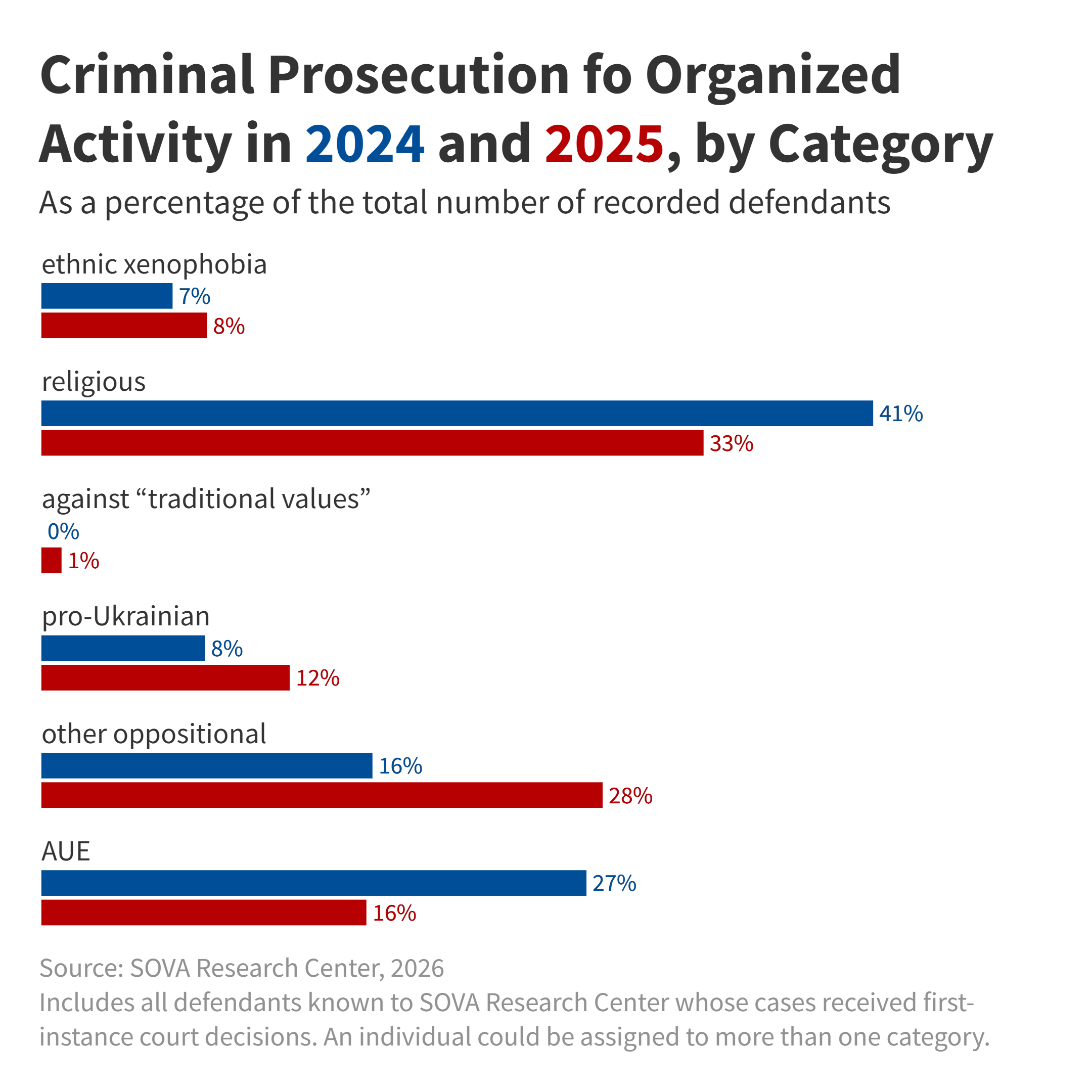
While the number of individuals convicted in connection with the religious associations we monitor has remained almost unchanged, their share has decreased noticeably. For AUE, both the number of known convicted individuals and their share have declined. However, we observe growth in other categories, and the number of cases within them has roughly doubled.
The increase is particularly pronounced in the “criticism of the authorities” category, driven by the large number of sentences for financing the FBK. The still relatively small number of sentences aimed at protecting “traditional values” consists of sanctions related to the “LGBT movement.”
We are now going to examine, by category, the 261 cases against 393 individuals that we currently know were initiated in 2025 for participation in organized activities. This does not include cases involving participation in AUE or Columbine.
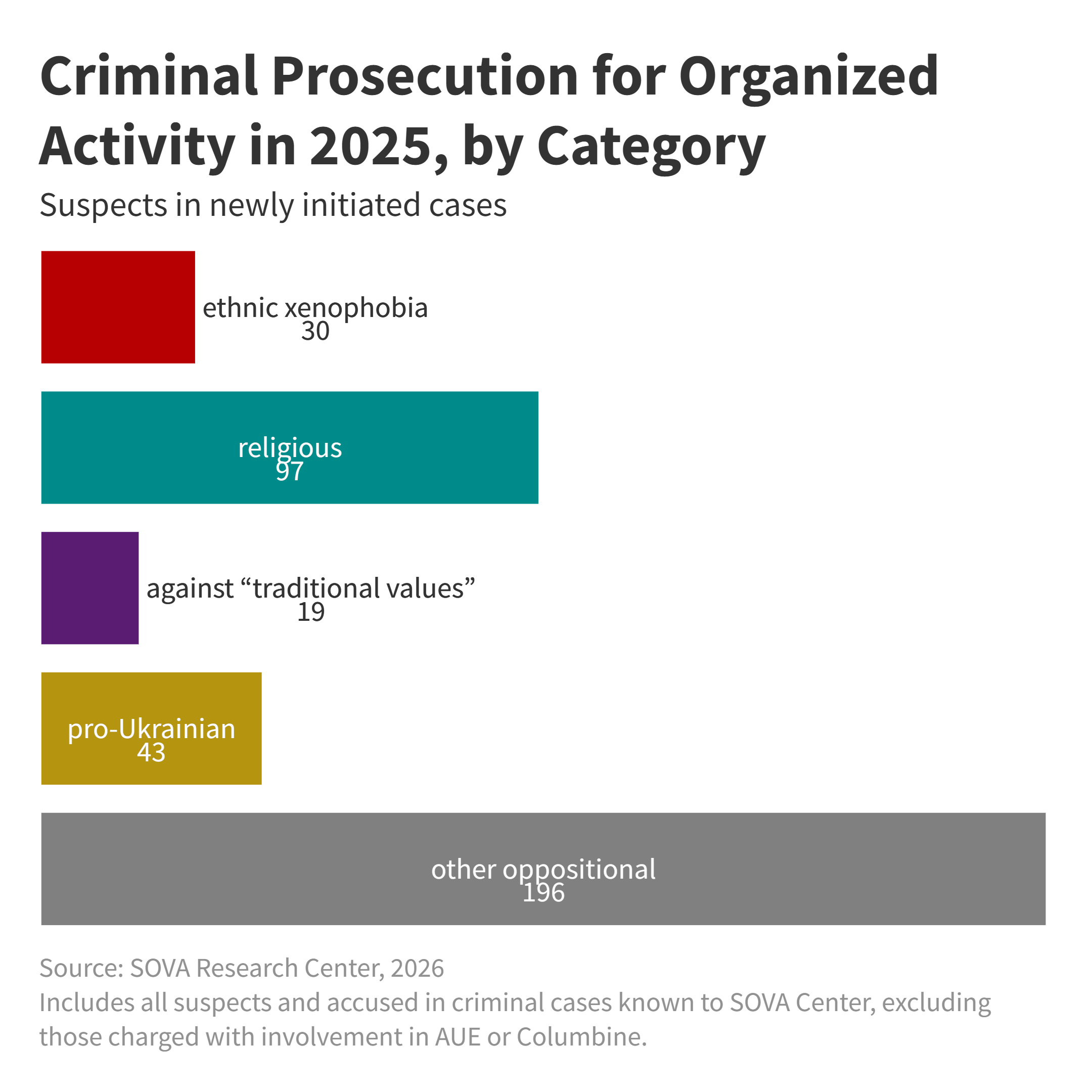
It is easy to see the continuation of the trends noted above.
Now, we shall review the distribution of the appropriateness of convictions by category. It is worth reminding that, with regard to religious organizations, we monitor almost exclusively inappropriate applications of the law; therefore, this category is omitted in the chart below. In addition, all sentences for organized activity in support of ethnic xenophobia were classified as “yes” (i.e., appropriate), and all convictions for involvement in AUE were classified as “other.” Accordingly, we examine the shift in the appropriateness of convictions in two categories: cases related to Ukraine and cases involving other oppositional activity.
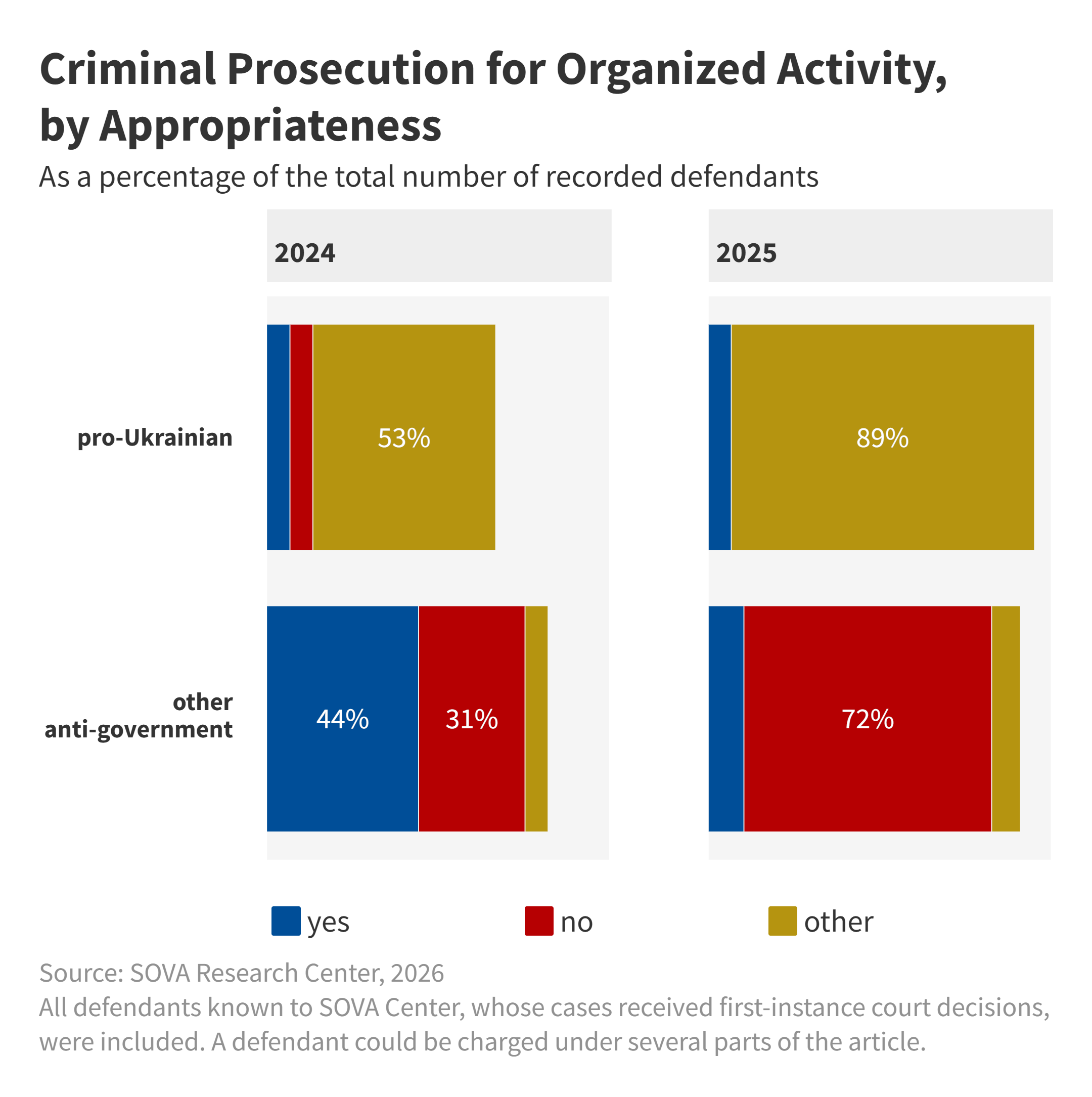
As we can see, in 2025, there were no verdicts for participation in pro-Ukrainian organizations that we consider entirely inappropriate. That said, there were only two such cases the year before, both involving clearly incorrect legal qualification of the defendants’ actions. The number of cases we consider questionable has also decreased significantly. As a result, nearly 90% of convictions in this category are classified as “other,” meaning that in these instances the state apparently had grounds for criminal prosecution. Here we observe the same trend as in the area of public speech related to the armed conflict – there has been a drastic increase not merely in anti-war expression, but in direct support for the opposing side in the conflict, often in the form of sabotage and similar actions. The state is predictably prosecuting such activity.
The distribution of appropriateness in cases involving participation in other opposition-related associations has been markedly affected by the wave of cases concerning the financing of the FBK, which we consider inappropriate. As a result, the share of cases related to countering xenophobia has declined sharply, although the absolute number of such convictions has increased. Meanwhile, the share of cases we classify as “other” has also grown, with their number tripling (12 compared to 4), largely due to defendants associated with Artpodgotovka.
SOVA Center does not monitor prosecutions for cooperation with “undesirable organizations,” but such prosecutions also continued. Initial instances of such cooperation are punishable under Article 20.33 CAO, while repeated cooperation (within one year), leadership roles, or financing are prosecuted under Article 2841 CC.
The Judicial Department does not publish statistics under Article 20.33, so we can rely only on data from the OVD-Info human rights media project, which tends to be nearly complete: first-instance courts imposed sanctions on 158 individuals in 2025 (vs. 201 the previous year). According to Supreme Court data, sentences against 14 individuals entered into force in the first half of the year under Article 2841 CC (vs. six for the entire 2024); however, according to OVD-Info, courts of first instance issued sentences to a total of 41 individuals in 2025. Thus, this area of criminal law enforcement, unlike administrative enforcement, is accelerating sharply.
Recognizing Organizations as Extremist and Terrorist
It should be recalled that Russian legislation provides for two statuses for associations designated as terrorist or extremist. The first – “community” – refers to those whose participation has been recognized by criminal process as a crime under Articles 2054 or 2821 CC. The second – “organization” – refers to associations banned by a separate court decision for activities deemed terrorist or extremist. Participation in such organizations, after their inclusion in the relevant lists, is punishable under Articles 2055 or 2822 CC, respectively. However, for some time now, recognizing an association as a terrorist community has entailed its inclusion on the list of terrorist organizations without additional judicial review. Since 2025, the same mechanism has been introduced for extremist communities.
Moreover, organizations already present on one list may sometimes be deemed more dangerous than previously thought and added to another list. They are not removed from the original list, but in practice, liability for participation in their activities is thereafter assessed under the more severe designation. For example, in 2025, the Ukrainian Right Sector was designated not only as extremist but also as terrorist, but there are currently few cases involving participation in the Right Sector. The new religious movement AllatRa (also of Ukrainian origin) was designated not only as undesirable but also as extremist. A number of criminal cases were opened against its participants, although for now, they are being prosecuted for participation in an undesirable organization and its financing. The émigré Free Russia Forum was “reclassified” from undesirable directly to terrorist; criminal prosecution against some of its participants is already underway. A similar transition was expected over time for the Anti-War Committee of Russia, as a result of a group criminal case against it as a terrorist community. However, the Prosecutor General’s Office did not wait for a verdict and, on February 13, 2026, applied to the Supreme Court to designate it a terrorist organization; the court granted this request on March 2.
On the other hand, in April, the status of a terrorist organization was suspended for the first time – for the Taliban, whose government in Afghanistan has been de facto recognized by Russia. At the same time, there is still no mechanism for complete removal from the lists of extremist and terrorist organizations.
We already wrote in last year’s report about the largest addition to the list of terrorist organizations: the émigré of Free Nations of PostRussia Forum was recognized as a terrorist organization in 2024, but added to the list only in 2025. In our opinion, this decision may become the source of many controversial criminal cases, since the published list of 172 “structural subdivisions” of the Forum includes both real combat units fighting on the side of Ukraine, separatist groups not engaged in violent activity, organizations of ethnic minorities that are not separatist, and various associations that either never belonged to the Forum (and immediately distanced themselves from it) or do not exist at all.[69] To date, there are few criminal cases related to the Forum, but more can be expected.
Direct support for Ukraine in the armed conflict became the basis for adding to the list the above-mentioned Free Russia Forum and, certainly, the Belarusian Kastuś Kalinoŭski Regiment, which is fighting on Ukraine’s side, as well as the Right Sector. A certain sabotage group from Perm, recognized as a terrorist organization in 2023, was also added to the list.
Islamist terrorism is represented in the 2025 additions to the list only by a group referred to as the Megion Jamaat, also recognized as terrorist in 2023.
Apparently, the radical left is viewed as a greater threat. The list was expanded to include the VKP(b) or “Join VKP(b)” (the name of its VKontakte group) from Omsk, designated as a terrorist community in 2024. In January 2025, the Kaluga anarchist rock band Antisocial Distancing and an “association” of the same name were recognized as terrorists; the People’s Communist Movement (Narodnoe kommunisticheskoe dvizhenie, NKD) received the same designation in April. In all cases, the charges involved preparing terrorist acts. However, this activity was not necessarily related to support for Ukraine – a connection to Ukraine apparently existed for the NKD,[70] but apparently not for “Join VKP(b).”[71] Antisocial Distancing expressed anti-war sentiment, but the court decision appears to be based instead on the justification of violence against far-right actors and anti-regime violence, including the well-known attack by Mikhail Zhlobitsky[72], who blew himself up in an FSB building in Arkhangelsk back in 2018. A group of radical communists in Ufa, convicted on December 16, including on charges of creating a terrorist community, was also not pro-Ukrainian but will be added to the list of terrorist organizations once the verdict enters into force.
There were also other convictions issued under Article 2054 CC in 2025, so the list may yet be expanded to include additional groups, including far-right ones.
In total, the list grew by 11 entries over the year (counting the Free Nations of PostRussia Forum, together with all its structural subdivisions as a single entry) and reached 70 entries.
In November 2025, the Supreme Court recognized Anti-Corruption Foundation, Inc. (ACF) – the U.S.-registered legal entity of the FBK – as a terrorist organization. Although Navalny’s organizations, previously designated as extremist, did not automatically acquire terrorist status, we can assume that cooperation with them after the entry of the ACF decision[73] into force will be classified under terrorist articles.
In December, the Congress of People’s Deputies, created in exile by Ilya Ponomarev, was deemed a terrorist organization. The Supreme Court’s press release noted that the organization was led by Ponomarev and Andrei Sidelnikov, both of whom had previously been sentenced under Article 2052 CC. However, the Congress had already split in 2024, with the two politicians ending up on opposing sides, and a new organization was subsequently formed on the basis of the faction that included Sidelnikov. It remains unclear to whom, and in what manner, the ban (which entered into force in January 2026) will be applied.
Far-right groups have traditionally been among those added to the list of extremist organizations. In 2025, these included the Tula-based soccer fan group Cyborgs and the Omsk Slavic Association.
AllatRa, the new religious movement mentioned above, in addition to its anti-war stance, attracted the attention of law enforcement with its conspiracy theories and criticism of the authorities.
In September, the list grew further to include the “International Satanist movement” banned in July by the Supreme Court of the Russian Federation. This is yet another ban of a non-existent organization to create a broad framework for restrictions and sanctions targeting a wide range of individuals and groups. The court decision has still not been published. Only a press release from the Prosecutor General’s Office and an interview with Roman Silantyev (a proponent of “destructology” whose expert analysis was used by the court) are available. These materials present Satanism as linked to neo-Nazism, anti-Orthodox vandalism, occult rituals, and ordinary criminal activity. However, why the authorities have chosen to address these diverse issues in this particular way can only be a matter of conjecture; it appears consistent with the broader trend of promoting “traditional values.”
The inclusion on the list of an “association” consisting of publicist Alexander Nevzorov and his wife reflects a court decision issued in 2024, undoubtedly related to Nevzorov’s criminal case for statements in support of Ukraine.
Finally, in 2025, the practice of designating groups of Ukrainian businessmen as extremist associations expanded, with their property in Russia subsequently confiscated.[74] Seven such groups were added to the list on the Ministry of Justice website (vs. three in 2024), and the process of banning such groups is ongoing.[75] In total, the list grew by 12 entries over the year and reached 129 entries.
The list will continue to expand. In October, the Niyso Popular Movement, which describes itself as a “de-occupation movement,” was banned in Chechnya.[76]
In 2025, 101 foreign or international organizations were added to the list of “undesirable organizations” on the Ministry of Justice website; by the end of the year, it contained 296 organizations. The entities added last year include numerous journalistic and human rights organizations, as well as structures created by Russian political émigrés. Particularly notable are organizations apparently associated with LGBT-related issues. Thus, the list came to include a number of organizations that the authorities could, in one way or another, associate with associations, real or imagined, that have already been banned in Russia.
In Place of a Conclusion
In 2025, we recorded 699 total court decisions against 731 individuals issued under Criminal Code articles for criminalized speech, and 289 decisions against 419 individuals related to participation in organizations and their support. The figures do not include sanctions for involvement in AUE and Columbine, or for displaying their symbols (this area of law enforcement cannot be classified as politicized).
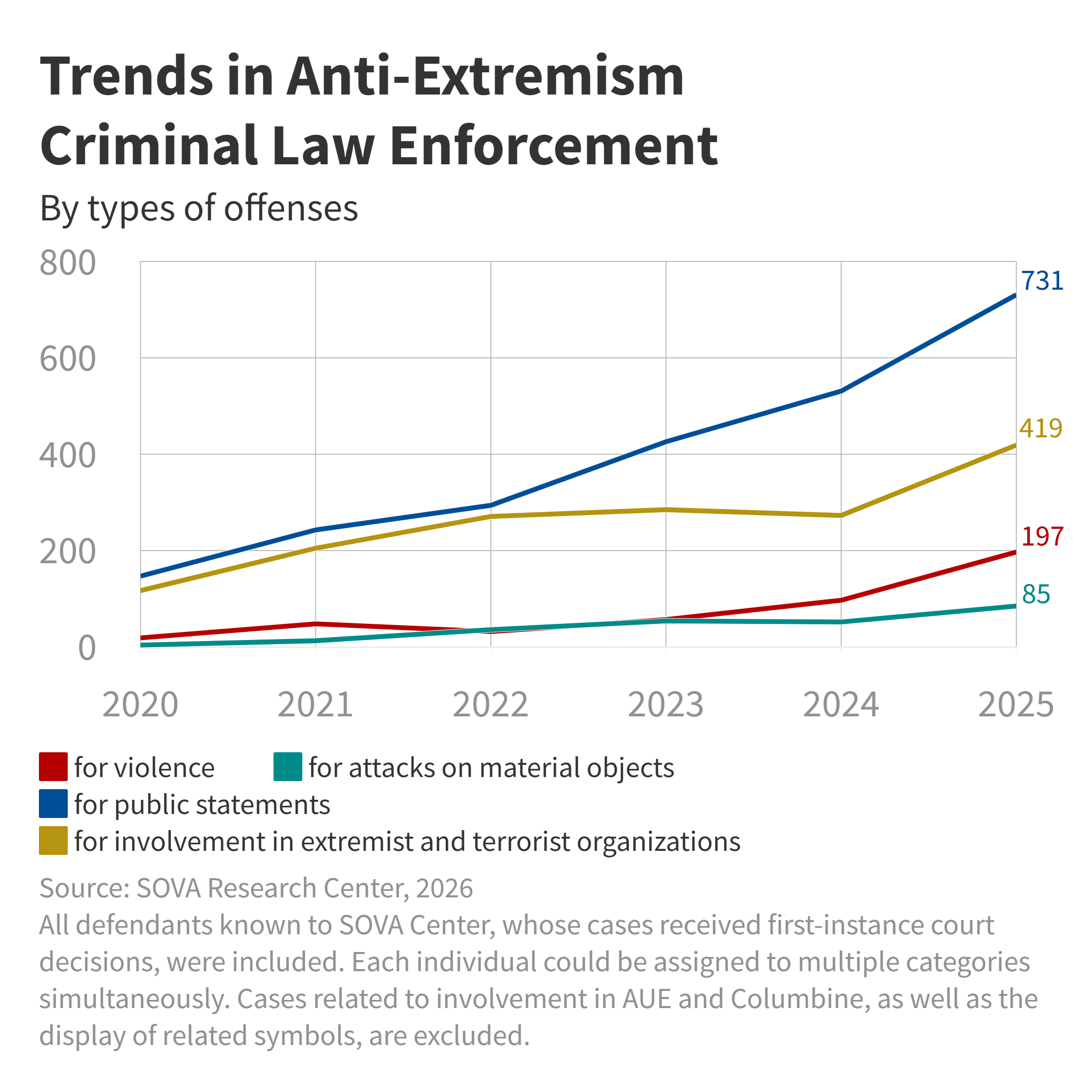
[1] Of course, provisions concerning ordinary crimes or offenses may at times be applied for political purposes. Moreover, the acts themselves may be motivated by political and ideological considerations not of those who carry them out, but of those who, in one way or another, have incited them.
[2] Radicalization of Far-Right Violence: Ideologically Motivated Crimes against Persons and Property and State Responses in Russia in 2025, SOVA Center. January 21, 2026. (https://www.sova-center.ru/en/xenophobia/reports-analyses/2026/02/d47128/). Until 2025, we published a similar report, a report on the misuse of anti-extremism legislation, as well as a report on such enforcement overall. Last year, we discontinued the separate report on misuse of anti-extremism legislation, but instead issued two reports – on the application of the Criminal Code (CC) and the Code of Administrative Offenses (CAO). Now, we have further simplified the structure of our reports.
[3] Maria Kravchenko and Natalia Yudina. Sanctions for Administrative Offenses Related to Extremism in 2023–2024, SOVA Center. July 25, 2025 (https://www.sova-center.ru/en/misuse/reports-analyses/2025/07/d47113/);
M. Kravchenko and N. Yudina. Counter-Extremism in 2024: Regulation of Public Speech and Organized Activity, SOVA Center. August 28, 2025 (https://www.sova-center.ru/en/misuse/reports-analyses/2025/08/d47115/).
[4] Database: Sentences, SOVA Center (https://www.sova-center.ru/en/database/sentences/).
[5] Judicial Statistics for Cases Considered by Federal Arbitration Courts, Federal Courts of General Jurisdiction, and Justices of the Peace, Judicial Department of the Supreme Court of the Russian Federation (https://cdep.ru/?id=5, in Russian)
[6] When the Supreme Court publishes the full data for 2025, SOVA Center will release updated charts based on it.
[7] SOVA Center does not include prosecutions for defamation and the dissemination of false information in its monitoring, as these actions do not directly fall within the scope of anti-extremism regulation. However, if such charges are brought with an aggravating circumstance such as a motive of hatred, they are included.
[8] In 2025, we discontinued monitoring and detailed analysis of the application of this legal norm and provide only general assessments.
[9] This includes, in particular, cases under Parts 3 to 5 of Article 20.1 CAO (“disrespect for authorities”), which were previously included in our monitoring. On the application of this provision in 2025, see: Insulting Public Morality of the President: How Russians Are Punished for ‘Disrespect’ Toward Putin, Verstka. August 19, 2025 (https://verstka.media/kak-rossiyan-nakazyvayut-za-neuvazhenie-k-putinu, in Russian). In addition, only one person was punished under Article 20.3.4 CAO (calls to impose sanctions against Russia) in 2025.
[10] Ministry of Internal Affairs Data on Countering Extremism and Terrorism in 2025, SOVA Center. February 13, 2026 (https://www.sova-center.ru/racism-xenophobia/news/counteraction/2026/02/d53122/; in Russian).
[11] Statistics of the Judicial Department of the Supreme Court in the Sphere of Combating Extremism for the First Half of 2025, SOVA Center. October 22, 2025 (https://www.sova-center.ru/racism-xenophobia/news/counteraction/2025/10/d52454/, in Russian).
[12] A number of these defendants were also charged under other articles related to speech, in particular: 29 individuals with incitement to extremism (Article 280 CC), 13 with other calls to actions against state security (Article 2804 CC), and six with “fakes about military” motivated by hatred (paragraph “e” of Article 2073 Part 2 CC). Sixteen defendants in cases under Article 2052 CC were also convicted of treason (Article 275 CC), three for confidential cooperation with a foreign state (Article 2751 CC), and 13 individuals for participation in a terrorist organization, namely the LSR or RDK (Article 2055 Part 2 CC).
[13] Ministry of Internal Affairs Data on Countering Extremism and Terrorism in 2025.
[14] M. Kravchenko and N. Yudina. Sanctions for Administrative Offenses Related to Extremism in 2023–2024.
[15] According to data obtained through the OVD-Info human rights media project.
[16] We decided not to include such verdicts in our database and not to conduct a detailed analysis of them.
[17] There were no sanctions for using the USSR state emblem, although, in previous years, we have noted several administrative cases under Article 20.3 CAO for its use.
[18] Black-and-white images, and in particular car stickers featuring a pit bull, became popular after the release of racing video games created by the British company Pitbull Syndicate Ltd. However, since 2023, Russian courts – primarily in Dagestan – have begun to classify such images as symbols of the neo-Nazi group Pit Bull, which operated in Krasnodar and was designated an extremist organization in 2010. Most people who use and distribute these images are clearly unaware of the Krasnodar group and, accordingly, do not promote its activities. Moreover, the court decision banning the Pit Bull group made no mention of its symbols.
[19] We refer to the imposition of imprisonment for speech-related offenses in combination with other articles CC, as well as to those who were already in custody, on probation, or released on parole.
[20] Including all cases known to us involving AUE symbols.
[21] However, this comparison is only preliminary in nature, since the collection of data on 2025 verdicts was conducted more thoroughly.
[22] We discontinued monitoring such cases as of April 2025.
[23] Ivan Smurov and Iva Tsoi. Pentagram, Tarot, and a Cow Skull: How the State, Under the Guise of Fighting Satanists, Persecutes Cosplayers and Musicians, Verstka. December 4, 2025 (https://verstka.media/kak-gosudarstvo-pod-vidom-borby-s-satanistami-presleduet-kospleerov-i-muzykantov, in Russian).
[24] We believe that in the application of Article 2073 CC, the motive of ideological and political hatred is clearly used without sufficient justification: people who publish information about the military actions in Ukraine that differs from the official version are, in most cases, ideologically and politically opposed to the authorities’ course, so such publications usually constitute a form of political criticism. Therefore, we consider cases under paragraph “e” of Article 2073 Part 2 CC inappropriate in all cases where the charge is unrelated to violence or direct calls for it.
[25] Most frequently, these were charges under Article 2052 CC (public justification of terrorism) in nine cases; Article 3301 CC (violation of the obligations of a “foreign agent”) in five cases; and Article 3541 CC (“rehabilitation of Nazism”) in five cases.
[26] We consider punishment for discrediting the actions of the Russian army and state bodies abroad to be an unjustified restriction of freedom of speech, aimed at suppressing criticism of the actions of the government and the armed forces of Russia. Therefore, we regard prosecution under Article 2803 CC as inappropriate in all cases where the charge is unrelated to violence or direct calls for it, that is, in the overwhelming majority of cases.
[27] According to the data obtained through OVD-Info as well as the adjusted forecast based on data from the Judicial Department of the Supreme Court for the first half of 2025.
[28] For more on this change, see: Anti-Extremism Lawmaking in 2025, SOVA Center. January 28, 2026 (https://www.sova-center.ru/en/misuse/reports-analyses/2026/01/d47127/#c1).
[29] For more on these changes, see: Anti-Extremism Lawmaking in 2025, SOVA Center. January 28, 2026. (https://www.sova-center.ru/en/misuse/reports-analyses/2026/01/d47127/#b1).
[30] That is, this figure does not include verdicts in which charges under Article 282 CC were connected to attacks motivated by hatred.
[31] M. Kravchenko and N. Yudina. Sanctions for Administrative Offenses Related to Extremism in 2023–2024.
[32] According to data obtained through the OVD-Info human rights media project.
[33] See: M. Kravchenko and N. Yudina. Sanctions for Administrative Offenses Related to Extremism in 2023–2024.
In our 2023-2024 report, we adjusted the data we collected on sanctions imposed under Article 20.3.1 CAO based on the aggregate annual data for Articles 20.3 and 20.3.1 provided by the Judicial Department of the Supreme Court of the Russian Federation. The correction turned out to be very minor; we noted only that community service was imposed slightly more often than SOVA’s data indicated. Overall, this experience has demonstrated that the data we collect on types of punishment is sufficiently accurate.
[34] For cases, in which the target of hostility is known from the court ruling or could be determined from other sources.
[35] Taking into account the smaller share of rulings processed by us.
[36] Cases under Article 148 CC fall under public prosecution and, according to the Criminal Procedure Code, cannot be terminated on the grounds of reconciliation between the parties. Nevertheless, since 2021, at least four cases have been terminated on this basis.
[37] Quotation marks here indicate a reference to the definition in Article 1 of the law “On Countering Extremist Activity.”
[38] According to data obtained through the OVD-Info human rights media project.
[39] M. Kravchenko and N. Yudina. Sanctions for Administrative Offenses Related to Extremism in 2023–2024.
[40] This category includes any works by authors of a nationalist or (neo-)Nazi orientation, except for Ukrainian ones, which are placed in a separate category.
[41] This category also formally includes materials whose creators or distributors may not have regarded them as religious: songs by the 1990s Chechen singer-songwriter Timur Mutsuraev, the slogan “Orthodoxy or Death,” neo-pagan symbols, and so on.
[42] Again, we excluded the cases involving the display of AUE symbols.
[43] That is, it does not include rulings under Article 5.26 Part 2, Articles 13.48, 20.3.2, 20.3.4, as well as Parts 3 to 5 of Article 20.1 CAO. The number of rulings for 2025 is approximate – based on data obtained through the OVD-Info human rights media project.
[44] By definition, “undesirable organizations” exist outside Russia. They receive this designation without a judicial procedure, unlike the two other categories. However, cooperation with these organizations within Russia is punishable as well.
Organizations can also be designated as “foreign agents,” but then participation is not punishable in and of itself, although it entails a number of restrictions and obligations, as well as sanctions for non-compliance.
[45] We do not systematically track facilitating terrorist activity, including its financing. Still, such charges (usually under Article 2051 Part 1.1 CC) may appear in cases that were included in our monitoring for other reasons.
[46] For Articles 2054 and 2055 CC, imprisonment is the only sanction provided, so they will not be specified further.
[47] This limitation in the scope of monitoring is attributable primarily to insufficient information on both the cases and the activities of these groups.
[48] This includes, among others, scattered groups of adherents of ‘pure Islam,’ whom the authorities prosecute as members of the extremist organization At-Takfir wal-Hijra, although, to our knowledge, no such organization currently exists in Russia (and its past existence is debatable). In 2025, we recorded 17 individuals convicted of participation in it; at least four others were arrested on the same charges and remain under investigation.
[49] The alleged founder of Belaya Mast, Artyom Tsepp, was first sentenced in 2014. The alleged administrator of the group’s Telegram channel, Mark Filippov, is ‘famous’ after the incident, when, during a 2010 search, the head and hands of an associate he had killed were found in his refrigerator. Another figure associated with this group, David Bashelutskov, who was convicted in 2010 for a series of murders and bombings and released after serving his sentence, drowned in a pond shortly before arrests in this case began.
[50] For more on “citizens of the USSR,” see: Mikhail Akhmetiev. Grazhdane bez SSSR. Soobshchestva «sovetskikh grazhdan» v sovremennoy Rossii [Citizens without the USSR. Communities of “Soviet citizens” in modern Russia], Moscow: SOVA Center, 2022 (in Russian).
[51] The cases initiated last year, mentioned here and below, include several for which the verdicts were also issued in 2025; however, they are not included in our calculations.
[52] Many known cases involved charges of treason and confidential cooperation with Ukrainian state bodies, but we do not monitor such cases.
[53] Free Nations of PostRussia Forum and Its Subdivisions Added to the List of Terrorist Organizations, SOVA Center. January 13, 2025 (https://www.sova-center.ru/racism-xenophobia/news/counteraction/2025/01/d50882/, in Russian).
[54] The American legal entity of the FBK was designated as a terrorist organization in late 2025 (see below), but this change has not yet been reflected in law enforcement practice.
[55] He was sentenced under multiple articles CC at once.
[56] We do not currently consider Artpodgotovka a nationalist organization, although initially the movement could have been classified as such.
[57] Another activist was instead charged with propaganda of violence under Article 280 CC.
[58] Former Head of the Ministry of Internal Affairs of Ingushetia Pogorov Sentenced to Nine Years of Imprisonment, SOVA Center. November 20, 2025 (https://www.sova-center.ru/misuse/news/persecution/2025/11/d52632/, in Russian)
[59] In 2008, the Supreme Court recognized the followers of the moderate Turkish theologian Said Nursi, collectively referred to as Nurcular, as an extremist organization. We view the ban on Nursi’s books and on the association of his followers as inappropriate, and the European Court of Human Rights agreed with this position in 2018.
[60] The pietist Muslim movement Tablighi Jamaat was banned in 2009, and we consider this ban inappropriate as well. For more on the persecution of Tablighi Jamaat followers, see: Ilyas Kurmanbek. Criminal Trials Concerning Tablighi Jamaat in Russia (2010-2025), Memorial, Support for Political Prisoners. February 6, 2026 (in Russian).
[61] The European Court of Human Rights has repeatedly ruled that neither the doctrine nor the practice of Hizb ut-Tahrir indicate that the party is terrorist in the strict sense of the term. However, the ban against it could be justified, since it advocates the overthrow of a number of existing political systems in order to establish a dictatorship based on Sharia. Furthermore, Hizb ut-Tahrir ideology includes antisemitism and the demand for the elimination of the State of Israel, as well as a categorical rejection of democracy and human rights. The use of violence against countries that the party considers aggressors against the “lands of Islam” is viewed as legitimate.
Under Russian legislation (among others), calls for the violent overthrow of a government (not necessarily Russian) can be classified as terrorist, providing formal grounds to designate Hizb ut-Tahrir as terrorist. However, it is important to note that Hizb ut-Tahrir does not call for the overthrow of governments outside of the “lands of Islam,” including in Russia. On this basis, and taking into account the severity of sanctions under Article 2055 CC, we consider the prosecution of organization’s followers under this article solely for the fact of their membership clearly excessive. However, this does not apply to prosecution for other unlawful acts.
[62] Our previous report mistakenly stated that there were four defendants.
[63] This para-religious teaching is focused on highly unconventional methods of healing, but it does not incite hatred and does not practice violence. Therefore, we consider the designation of its followers as extremist inappropriate.
[64] The ban against Ak Tyan (also known as the Karokol Initiative Group) was justified on the grounds that the movement’s participants not only advocated for the restoration of Altai paganism, but also conducted aggressive propaganda against representatives of other religions, such as Buddhists, and asserted the ethnic superiority of Altaians over other peoples.
[65] The romanticization of the criminal underworld and its exploitation, including for commercial purposes – associated with the notion of a so-called AUE movement (Arestantskoe Ugolovnoe Yedinstvo or Prisoners Criminal Unity) may and should be counteracted by law enforcement. However, it clearly does not exist as an organization. The specific “laws” of the criminal underworld, along with associated symbols and attributes, promotion of criminal activity and normalization of these “laws,” pose a social danger. Yet this set of ideas is not political in nature and does not, in and of itself, threaten the constitutional order. Therefore, in our view, anti-extremism legislation is not an appropriate instrument for countering AUE.
[66] Despite the obvious public danger of school shootings, recognizing the entirety of their supporters as a terrorist organization is hard to justify. According to the definition provided by the law “On Countering Terrorism,” terrorism must be aimed at influencing the actions of authorities and intimidating society, whereas school shooters pursue entirely different goals.
[67] This will become clearer after the publication of the official data for 2025.
[68] Isolated verdicts for donations to certain organizations are not included in the table.
[69] Free Nations of PostRussia Forum and Its Subdivisions Added to the List of Terrorist Organizations, SOVA Center. January 13, 2025 (https://www.sova-center.ru/racism-xenophobia/news/counteraction/2025/01/d50882/, in Russian).
[70] “People’s Communist Movement” Organized Terrorist Attacks on Instructions from Ukraine, Izvestia. June 6, 2025 (https://iz.ru/1899768/2025-06-06/narodnoe-kommunisticheskoe-dvizhenie-organizovyvalo-terakty-po-zadaniiu-ukrainy, in Russian).
[71] This refers to the case of Maksim Prikhodko. See: Konstantin Voronov. The Court Assessed the Organizational Abilities of a Security Guard, Kommersant. August 8, 2024 (https://www.kommersant.ru/doc/6879677, in Russian).
[72] The Kaluga Prosecutor’s Office Demanded That a Disbanded Anarchist Rock Group Be Recognized as “Terrorist,” OVD-Info. November 17, 2024.
[73] The decision entered into force in February 2026, and ACF was added to the list on March 3, 2026.
[74] We wrote about this in: Family Values. The Anniversary of an Innovation in Russian Anti-Extremist Policy, SOVA Center. January 10, 2025 (https://www.sova-center.ru/en/misuse/reports-analyses/2025/01/d47100/).
[75] In addition, in late 2025, a decision was made to recognize an organized criminal group in Chelyabinsk as an extremist association on the grounds of its alleged connection to the banned AUE movement among other charges. See: Chelyabinsk “Makhoninskie” Group Recognized as Extremist, SOVA Center. November 17, 2025 (https://www.sova-center.ru/misuse/news/persecution/2025/10/d52492/, in Russian).
[76] It was added to the list in January 2026.